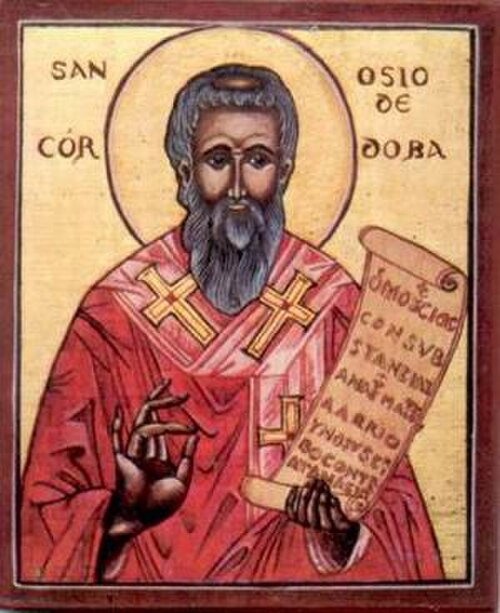
Saint
Hosius of Corduba
Bishop of Corduba
Bishop of Cordoba in Spain, adviser of Constantine the Great and defender of the faith at Nicaea.
Life
Saint Hosius of Corduba, also called Hosius the Confessor, was bishop of Corduba in Spain, adviser of Saint Constantine the Great and defender of the true faith in the time of the Arian disputes. He was one of the most important bishops of the fourth century and, by all signs, presided at the First Ecumenical Council at Nicaea. He is commemorated on 27 August.
Beginnings
He was born around 256 at Corduba, in the Roman province of Hispania. He was elected bishop of Corduba around 295 and narrowly escaped martyrdom in the persecution of Maximian; according to some sources he was persecuted in 303-305. In 300 or 301 he took part in the local synod of Elvira, where his name appears second in the list; the synod set severe canons on clerical discipline and on those who had denied the faith in persecution. After 313 he came to the court of Constantine, who mentions him by name in a decree to Caecilianus of Carthage.
Adviser of the emperor and Nicaea
After Lactantius, Hosius was Constantine’s closest Christian adviser and guided the content of the words the emperor spoke to the bishops. In 320 or 321 Alexander, bishop of Alexandria, gathered a synod at Alexandria, which anathematized Arius. In autumn 324 Hosius carried to Alexander and Arius the emperor’s letter urging them to reconcile. After that he presided at a synod at Antioch, on the occasion of the election of Eustathius after the death of Philogonius, where the bishops supporting Arius were suspended and a larger synod was announced, moved then by the emperor to Nicaea. There the First Ecumenical Council opened on 20 May 325, and Hosius, whose name is first in the list of participants, probably presided, supporting Alexander against Arius. After the council he returned to Spain. For nearly fifty years he was one of the foremost bishops of his time, held in universal esteem.
Persecution and last years
After Constantine’s death, in 337, Eusebius of Nicomedia, an Arian, came to Constantinople and pressed Constantius II to drive out Athanasius of Alexandria a second time. Hosius, a supporter of Athanasius, was summoned to Milan, but would not condemn him and impressed the emperor, who let him go home. At the Council of Serdica, in 343, he had a leading place, being the first to sign the acts. When the emperor pressed him to yield, Hosius wrote him, in 353 or 356, a courageous letter against the emperor’s interference in the Church’s affairs: “God has given you the empire; to us He has entrusted the Church.” The letter survives through Athanasius. In 355 he was exiled to Sirmium. Under pressure from the Eusebians, in 357 he signed the formula adopted by the third council of Sirmium, which meant communion with the homoeans without condemning Athanasius. He was allowed to return to Spain and died between 357 and 359. Later stories that he anathematized the Arians on his deathbed are uncertain. He wrote letters and took part in drawing up the canons of the synod of Serdica; Isidore of Seville attributes to him two lost works, on the praise of virginity and on priestly vestments.
Commemorated the same day August 27
 Liberius of RomeSaint · Bishop of RomeAug 27
 Caesarius of ArlesSaint · Archbishop of ArlesAug 27
 Poemen the GreatVenerable · Desert FatherAug 27
 Chrysostomos of SmyrnaHieromartyr · Metropolitan of SmyrnaAug 27
 PhanouriosMartyr · the Newly RevealedAug 27
 Lycerius of CouseransSaint · Bishop of CouseransAug 27
 Gebhard of ConstanceSaint · Bishop of ConstanceAug 27
 NarnusSaint · First bishop of BergamoAug 27
 Kuksha of the Kiev CavesHieromartyr · Monk of the Kiev Caves LavraAug 27
 Rufus of CapuaMartyrAug 27
 John SmirnovHieromartyr · Archpriest at ZarayskAug 27
- Alexander TsitserovHieromartyr · PriestAug 27