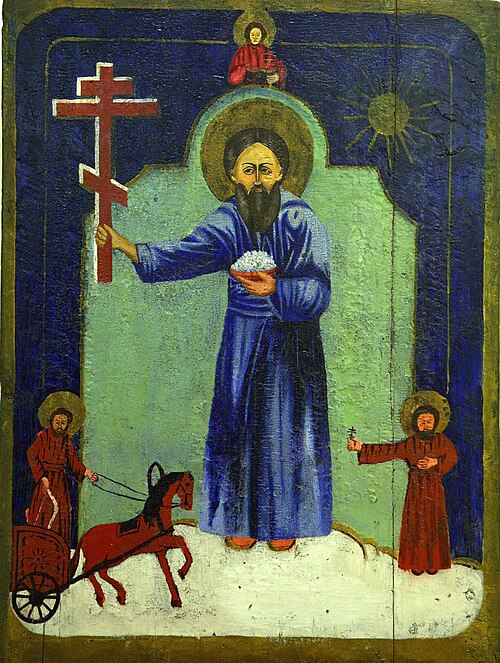
Martyr
Conon the Gardener
Martyr of Pamphylia
Gardener born at Nazareth, who died a martyr around 250 at Magydos in Pamphylia.
Life
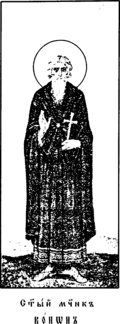
Saint Conon the Gardener, called also Conon of Perga, was a martyr of the Roman Empire, born in the third century at Nazareth, who died around 250 (according to the Serbian source in 251) at Magydos in Pamphylia. The Orthodox Church commemorates him on 5 March (18 March by the new calendar), the Catholic Church on 4 February; it is possible that these are actually two different persons.
Conon came from a Greek Christian family at Nazareth and was gentle and without guile. In the time of Decius he was tortured for Christ because he refused to sacrifice to the pagan gods. He remained firm in the Christian faith and sharply rebuked the pagan judges for their folly. He was put to death at Perga (in Pamphylia in Asia Minor, according to another source in Phrygia or Pisidia): spikes were driven through his feet and he was made to run before his own chariot, tied to the prince's chariot, dragged until he fell exhausted. Then he prayed to God a last time and gave up his spirit. Richard Bauckham has suggested that Conon may be the last known relative (desposyni) of Jesus Christ, on the basis of this passage from the Martyrdom of Conon: "I am of the city of Nazareth in Galilee, I am of the family of Christ, whose worship I have inherited from my ancestors, and whom I recognize as God over all things." When the Byzantine Emperor Constans II entered the city of Rome through the Porta Appia during his Italian campaign against the Lombards, a stone with an incised cross stood over the gate that had, at the bottom, the names of Saint George and Saint Conon written in Greek, with the phrase "thanks be to God" at the top.
Commemorated the same day March 5
 Nikolaj VelimirovićSaint · Bishop of Ohrid and ŽičaMar 5
 Ivan ShishmanRight-Believing · Tsar of BulgariaMar 5
 Piran of CornwallVenerable · Abbot in CornwallMar 5
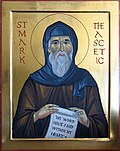 Mark the AsceticVenerable · Ascetic writerMar 5
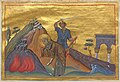 Phocas the GardenerMartyr · Martyr of SinopeMar 5
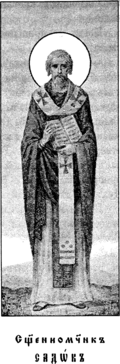 Sadoth of PersiaHieromartyr · Bishop of Seleucia-CtesiphonMar 5
- Theophilus of CaesareaSaint · Bishop of Caesarea in PalestineMar 5
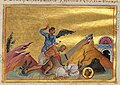 Adrian of CaesareaMartyr · Martyr of Caesarea in PalestineMar 5
 Conon of IsauriaHieromartyr · Martyr of IsauriaMar 5
- Nicholas PokrovskyHieromartyr · PriestMar 5
- John the BulgarianNew Martyr · New Martyr of ConstantinopleMar 5
- Archelaus of AntinoeMartyrMar 5