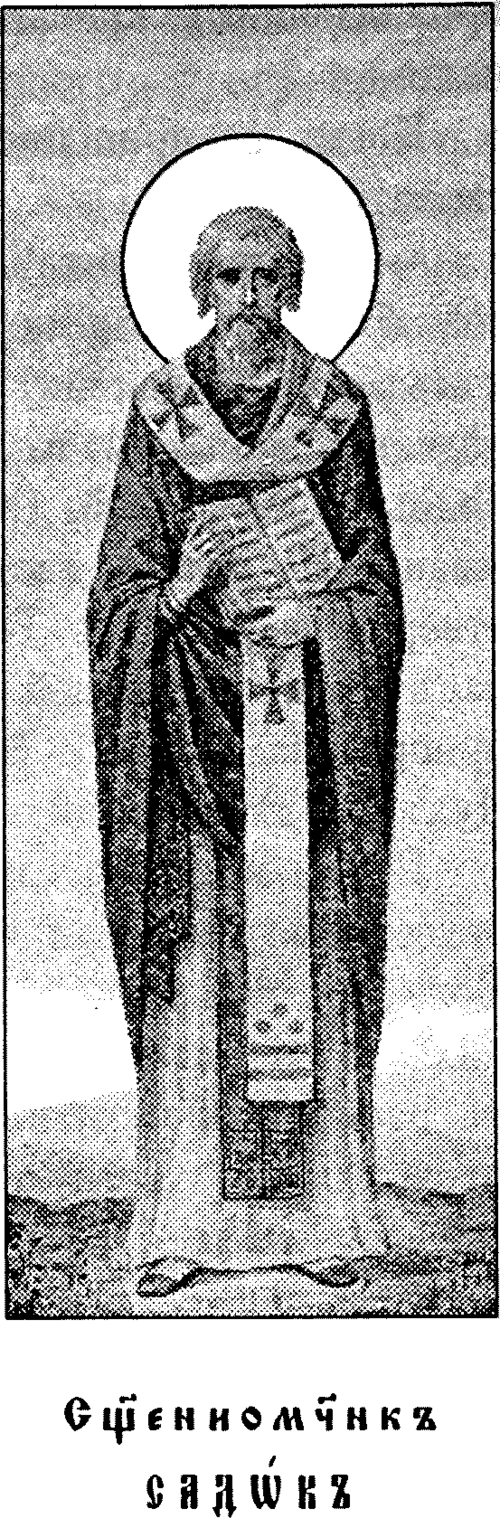
Hieromartyr
Sadoth of Persia
Bishop of Seleucia-Ctesiphon
Bishop of Seleucia-Ctesiphon from 341 to 343, martyred in the great Persian persecution under Shapur.
Life
Saint Sadok (Shahdost), hieromartyr, was Bishop of Seleucia-Ctesiphon and head of the Church in Persia in the time of the great persecution of Shah Shapur II. He was killed, with 128 priests, deacons, monks and nuns, around the year 342. He is venerated in the Orthodox and Catholic Churches and in the ancient Eastern Churches. His commemoration in our sources is on 5 March and 19 October.
The Church in Persia
The condition of Christians in the Sasanian Empire worsened after the emperor Constantine the Great turned to Christianity. Shapur II (309-379) suspected that his Christian subjects sympathized with their co-religionists in the West, and the Church was persecuted. In 339 the shah laid an extra tax on Christians, as ransom from military service. Bishop Shimun bar Sabbaʿe of Seleucia refused to collect it and was arrested and killed, with five bishops, a hundred priests and his sister Tarbo.
Bishop Sadok
The name Shahdost means friend of the king, and the Greeks rendered it as Sadok. According to the Chronicle of Seert, from the ninth century, the oldest and fullest account, and the later historians Mari and Bar Hebraeus, he was from Beth Garmai (some say Susa), an archdeacon and, according to Bar Hebraeus, his predecessor's nephew by his sister. He was chosen bishop by lot and consecrated in secret, in the house of a believer, some months after Shimun's death. He appointed many metropolitans and bishops, who strengthened the faithful to stand firm against the shah. The life by Demetrius of Rostov describes him as a man of great abstinence, full of righteousness and faith, who imitated Saint Simeon.
He led the Church for two years and five months (341-343). According to Jérôme Labourt, he was arrested in the autumn of 341 at Seleucia, where the shah was, with 128 priests, deacons, monks and nuns of the city and its surroundings. They spent five months in prison, in chains, in a dark place, under torments. The executioners told them to worship the sun and fire in order to live, but Sadok answered on behalf of all that they were Christians, worshipped one God, Creator of heaven and earth, and did not worship the sun and fire, which were made for the service of men. They would not obey the king's command and would not fear death, which leads them into the eternal kingdom.
Martyrdom
The sources differ in detail. According to Mari, one hundred twenty of them were killed by the marzban, while Sadok and the nuns were sent to Shapur, who asked him to become a magus and said he would not let the Christians live unless he yielded. Sadok answered that as long as there is water in the sea there will be Christians. The king grew angry and killed him with his companions in the month of April. Bar Hebraeus says that 118 priests, believers and monks and two brothers of Sadok were killed. According to Labourt, the companions were tortured on 20 February, while Sadok was taken to Beth Lapat, where his head was cut off, probably in the summer of 342. It is said that, in a vision before his arrest, he saw Christ at the top of a ladder, calling him to come up.
Commemorated the same day March 5
 Nikolaj VelimirovićSaint · Bishop of Ohrid and ŽičaMar 5
 Ivan ShishmanRight-Believing · Tsar of BulgariaMar 5
 Piran of CornwallVenerable · Abbot in CornwallMar 5
 Mark the AsceticVenerable · Ascetic writerMar 5
 Phocas the GardenerMartyr · Martyr of SinopeMar 5
 Conon the GardenerMartyr · Martyr of PamphyliaMar 5
- Theophilus of CaesareaSaint · Bishop of Caesarea in PalestineMar 5
 Adrian of CaesareaMartyr · Martyr of Caesarea in PalestineMar 5
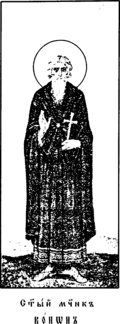 Conon of IsauriaHieromartyr · Martyr of IsauriaMar 5
- Nicholas PokrovskyHieromartyr · PriestMar 5
- John the BulgarianNew Martyr · New Martyr of ConstantinopleMar 5
- Archelaus of AntinoeMartyrMar 5