Venerable
Constantine Alamansky
Wonderworker
A venerable father honored as a wonderworker in the Russian Church.
- Feast
- July 1old style July 14
- Era
- 14th century
- Order
- Venerables
Life
Holy Venerable Constantine Alamansky, the wonderworker, is not known to the ancient compilers of the lives of the saints. But he is attested by the Cypriot chronicler of the fourteenth century Leontios Machairas and by the nineteenth-century Greek humanist historian Constantine Sathas.
Saint Constantine belongs to the three hundred holy Alamanian monks who crossed from the Holy Land to Cyprus, fleeing the persecution of the Avars in Palestine. Another view, first reflected in the chronicle of Machairas, says that the Alamans were Germans from the crusades who went on pilgrimage to Jerusalem and then moved to Cyprus, where they lived in prayer and fasting; this view, however, finds no support in historical data, especially as Neophytos the Recluse, who himself lived in the monasteries of Palestine, says nothing of the Alamans. Researchers today think that the wave of monks leaving Palestine came rather in the sixth and seventh centuries, when the Arab raids began.
Sathas writes that the saint died a martyr's death by order of the governor of the island, Savinus, who ruled at the end of the third and beginning of the fourth century, when the island was not yet fully enlightened. Most likely, because of the scarcity of evidence for the history and hagiography of Cyprus, the researcher confused the venerable one with a martyr of the same name. Machairas mentions a magnificent church in the saint's honour, in which his tomb stood. The church of the chronicle has not survived; on its site in the eighteenth century a church of the holy unmercenaries Cosmas and Damian was built. In 1901 the villagers of Ormideia decided to pull down the old church and build a larger one in honour of Saint Constantine. Today the saint's tomb lies in the altar of the church, and his relics are brought out of the altar for veneration on the day of his commemoration, named in the page as 1 July.
The page gives the day of Saint Constantine's commemoration as 14 July, according to the Greek calendar. His name is not in the present calendar of the Russian Orthodox Church.
Commemorated the same day July 1
 EstherSaint · Queen of PersiaJul 1
 Cosmas and DamianHoly Unmercenary Healers · Unmercenary physiciansJul 1
 Angelina of SerbiaVenerable · Despotess of SerbiaJul 1
 Cybard of AngoulêmeVenerable · Hermit of AngoulêmeJul 1
 Serf of CulrossSaintJul 1
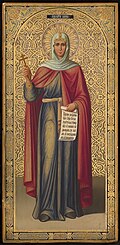 Galina of CorinthMartyrJul 1
- Julius and AaronHoly MartyrsJul 1
 Castus and SecundinusMartyr · Martyrs of SinuessaJul 1
- Arcadius GaryaevHieromartyr · PriestJul 1
- Peter the PatricianVenerable · Byzantine commander turned monkJul 1
- 25 Martyrs of NicomediaHoly MartyrsJul 1
- Ailill IISaint · Bishop of ArmaghJul 1