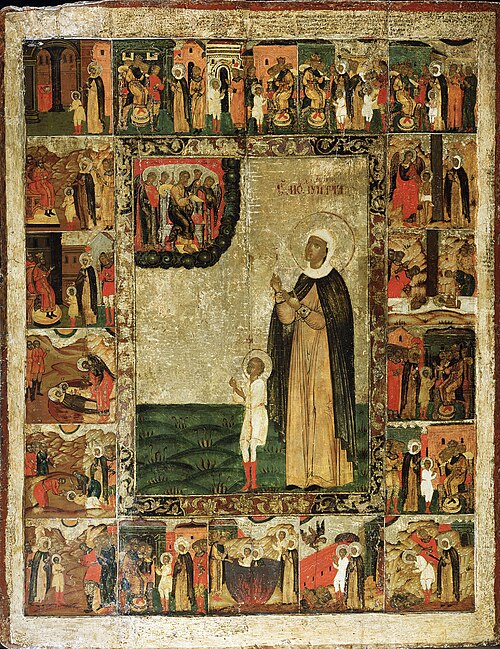
Holy Martyrs
Cyricus and Julitta
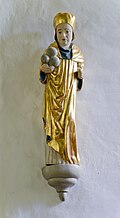
The mother Julitta and her son Cyricus, martyrs put to death at Tarsus, according to tradition, in 304.
Life
The Holy Martyrs Cyricus and Julitta, mother and son, are among the best loved martyrs of the early Church. According to tradition they suffered at Tarsus in Cilicia during the great persecution of Diocletian, around the year 304. The Church commemorates them in July, and their veneration spread from Asia Minor across the East and the West.
Life and martyrdom
According to their life, Julitta was a young widow of noble family from Iconium, and she had raised her son Cyricus, only three years old, in the Christian faith. When the persecution broke out she left her property and, with two maidservants, fled with the child, living as a poor stranger, first in Seleucia and then in Tarsus. The Serbian tradition adds that she had baptized him at birth and taught him faith and prayer.
At Tarsus Julitta was recognized as a Christian and brought before the governor of the city, named Alexander in some sources. She confessed her faith firmly. The child, held by the governor, cried out that he was a Christian and asked to be let go to his mother, scratching the judge's face. In anger the governor threw him down the stone steps, and Cyricus died. Julitta, seeing this, did not weep but thanked God that her son had received the crown of martyrdom.
The mother was subjected to harsh torments, her body torn with iron hooks, and in the end she was beheaded. The bodies of mother and child were thrown outside the city among those of condemned criminals, but Julitta's maidservants took them and buried them in a nearby field.
There is also a second version, kept in Latin, Syriac and Arabic sources. In it Julitta is arrested without her son and refuses to sacrifice to the idols; she asks that a child be brought, so that he may be asked whether it is right to worship one God or many. Cyricus is found and declares himself a Christian. Both endure many tortures and miraculously survive them, and in the end both are beheaded. These stories, in their developed form, were judged apocryphal, and in the sixth century such a text was placed in the list of rejected writings known as the Decretum Gelasianum. It is believed, however, that behind them lies the memory of a child martyr at Antioch.
Relics and veneration
It is said that their relics were found in the time of Emperor Constantine the Great, after one of the maidservants pointed out the place, and were taken to Constantinople, where a monastery was built in their honor; pilgrims from the twelfth to the fifteenth century mention them in Hagia Sophia. According to another tradition, Bishop Amator of Auxerre brought them from Antioch to Gaul in the fourth century. Portions of the relics are kept at Nevers and Tournai, and part of them lies in the church of the Mother of God Bolnička at Ohrid.
Their cult was strong in France, where the name Cyricus survives as Saint-Cyr in many place names, and in Italy (San Quirico), England, Wales and Cornwall, Croatia, Georgia, Ethiopia and Eritrea (Qirqos), and on the Aegean islands, Crete and Cyprus. They are patrons of many Italian towns, and in Cappadocia they are regarded as protectors and intercessors; in Byzantine art they are often painted near the sanctuary. A story from Nevers says that Charlemagne dreamed of a naked child who saved him during a boar hunt in return for clothing, and the bishop understood the dream as a request to repair the roof of the cathedral of Saint-Cyr-et-Sainte-Julitte at Nevers. In Russian folk tradition their day was held to be the middle of summer.
Commemorated the same day July 15
 Vladimir of KievEqual-to-the-Apostles · Grand Prince of KievJul 15
 Swithun of WinchesterSaint · Bishop of WinchesterJul 15
 Donald of OgilvySaintJul 15
- Abudimus of TenedosMartyr · Martyr of TenedosJul 15
 Job KundriaVenerable · Archimandrite in TranscarpathiaJul 15
 Matrona of ChiosVenerableJul 15
- Edith of PolesworthVenerable · Abbess of PolesworthJul 15
 Jaglika AdžićMartyrJul 15
 Terentius of LuniSaint · Bishop of LuniJul 15
- 28 Child Martyrs of PlavHoly New MartyrsJul 15
- Aeternus of ÉvreuxSaint · Bishop of ÉvreuxJul 15
 AnsverusVenerable Martyr · Abbot of RatzeburgJul 15