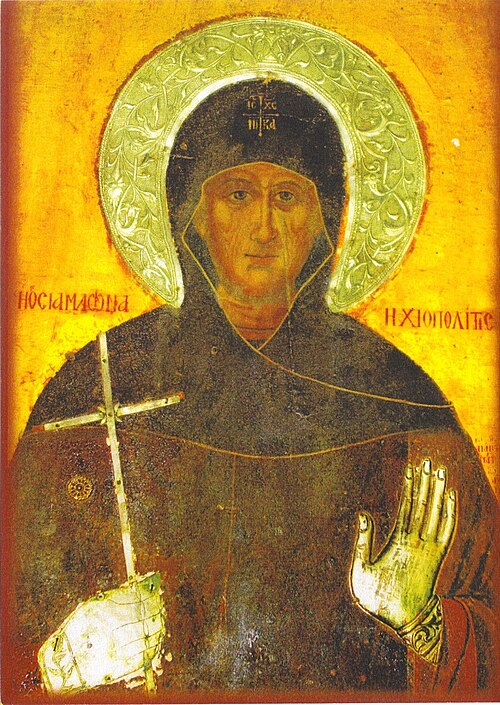
Venerable
Matrona of Chios
Venerable woman of the island of Chios, born in the village of Volissos; commemorated on 20 October.
- Feast
- July 15old style July 28
- Reposed
- 150015th century
- Place
- Chios
- Order
- Venerables
Life
Venerable Matrona of Chios (in Greek Matrona Chiopolitis), born Maria, was a nun of the island of Chios in Greece, born in the village of Volissos, the same village in which Saint Markella suffered martyrdom in 1462. She founded and led a convent, was loved for her almsgiving and gift of healing, and fell asleep before the year 1455. The Church commemorates her on 20 October, and the finding of her head on 15 July. The sources do not agree on the century of her birth: some say the fourteenth, others the fifteenth.
Childhood and calling
Maria was born in the village of Volissos on Chios, to a respected and well-to-do family, of Leon and Anna. She was the youngest of seven children. From youth she showed an attraction to monasticism. When her parents wanted to arrange a marriage for her, she refused, wishing to remain a virgin. To escape this marriage she left Volissos for a place above the village called Katavasis, where there was a convent. Her parents searched everywhere for her and, finding her, persuaded her to return home. Maria complied with all her parents' wishes except one, marriage. Her parents, seeing she still desired monastic life, gave her leave to follow her chosen path.
The convent and abbacy
After her parents' death Maria gave a large part of her inheritance to the poor and spent the rest building a convent in the Palaiokastro quarter of the town of Chios. Then her name was changed to Matrona. Matrona surpassed the other nuns in zeal, spirituality and understanding. Her sincerity persuaded other girls to come to this convent and lead the same life. The church being small, the abbess accepted Matrona's plan to enlarge it and build cells for the nuns. She sold what land and belongings she had left, and with the money the convent built a public bath where the poor and travellers could bathe. Baths of this kind were very common then. Then the renewal of the church began. When the church was finished (with the help of Saint Artemius, to whom it was dedicated), the abbess of the convent died. The nuns then chose Matrona as the new abbess. She was honoured throughout Chios for her virtuous life and holiness. She showed charity to the poor and was able to heal the sick.
Repose and veneration
After this Saint Matrona saw her own death in a dream. She suffered illness for seven days and in those seven days advised the other nuns as a mother would advise her children. She fell asleep some time before 1455 and was buried in the convent church, in which she had spent most of her life. Miracles are said to have occurred after her death. Many people with various afflictions came to the church and were healed. In the village of Katavasis a church was built to honour the place where Saint Matrona had begun her spiritual struggles. Later a larger church was built, and the smaller one was used as a cemetery chapel.
The Holy Monastery of Saint Matrona was built by the nobleman Roidis, in 1470, near the village of Mesa Didyma. He had intended to build a summer villa, but Saint Matrona appeared to him in a dream and urged him to build a monastery instead. His sisters were the first two nuns to enter. The abbot of the monastery in the time of Turkish rule was Venerable Nikephoros of Chios, who wrote the 24 hymns of Saint Matrona. Today four nuns live in the monastery. The monastery keeps its feast each year on 20 October.
Commemorated the same day July 15
 Vladimir of KievEqual-to-the-Apostles · Grand Prince of KievJul 15
 Swithun of WinchesterSaint · Bishop of WinchesterJul 15
 Cyricus and JulittaHoly MartyrsJul 15
 Donald of OgilvySaintJul 15
- Abudimus of TenedosMartyr · Martyr of TenedosJul 15
 Job KundriaVenerable · Archimandrite in TranscarpathiaJul 15
- Edith of PolesworthVenerable · Abbess of PolesworthJul 15
 Jaglika AdžićMartyrJul 15
 Terentius of LuniSaint · Bishop of LuniJul 15
- 28 Child Martyrs of PlavHoly New MartyrsJul 15
- Aeternus of ÉvreuxSaint · Bishop of ÉvreuxJul 15
 AnsverusVenerable Martyr · Abbot of RatzeburgJul 15