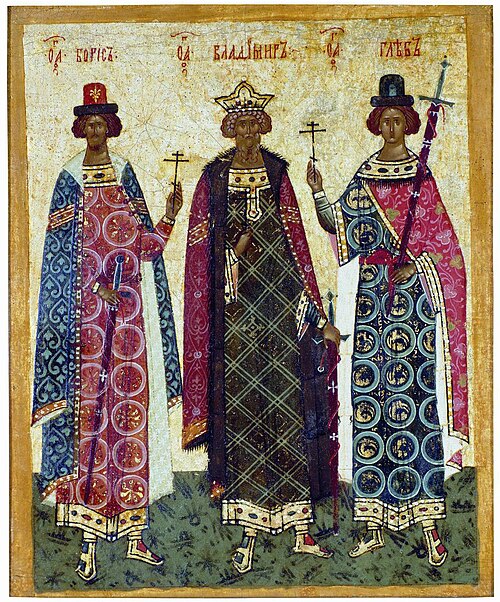
Equal-to-the-Apostles
Vladimir of Kiev
Grand Prince of Kiev
Prince who accepted Baptism in 988 and Christianized Kievan Rus.
- Feast
- July 15old style July 28
- Reposed
- 101511th century
- Place
- Berestove
Life
Saint Vladimir of Kiev, called Basil in Baptism, was grand prince of Kyiv from 978 until 1015. Through the Baptism he received in 988 and the conversion of his people, Kyivan Rus' entered the Church of Christ. The Church honours him as Equal of the Apostles and as the enlightener of the Russian, Ukrainian and Belarusian peoples.
Youth
He was born around 958 (the Greek Synaxarion) or 963 (OCA), the youngest son of Prince Sviatoslav. His mother, Malusha, had been a servant of Saint Olga, the first Christian of the ruling house of Kyiv, who raised the boy until her repose. His father sent him to rule in Novgorod, under the care of his uncle Dobrynya.
After Sviatoslav was killed by the Pechenegs in 972, his sons fell into war. Yaropolk had their brother Oleg killed, and Vladimir fled overseas to Scandinavia. He returned with a Varangian army and took Kyiv in 978. By 980 he had united his lands from the Baltic Sea to the southern frontiers, and had strengthened the borders against the Volga Bulgars, the Baltic tribes and the eastern nomads.
The pagan prince
At first Vladimir was a pagan ruler. He set up idols on a hill in Kyiv, among them Perun, had several wives and many concubines, and offered sacrifices to the gods. In 983 a mob killed the Christians Theodore and his son John, later counted the first martyrs of Rus', and their death remained with him.
Baptism
The chronicle called the Tale of Bygone Years says that Vladimir sent envoys to examine the faiths of his neighbours. Those who went to Constantinople reported that during the service in Hagia Sophia they did not know whether they stood in heaven or on earth. The Byzantine emperors had asked his help against the rebel Bardas Phokas and sent clergy and what was needed for Baptism. In return Vladimir asked for the hand of Princess Anna, sister of Emperor Basil II. When the emperors delayed, he took the city of Korsun in Crimea and forced them to keep their promise.
The sources disagree about where he was baptized. The chronicle places it at Korsun in 988 and relates that Vladimir, blinded before Baptism, received his sight as he came out of the water. The eleventh-century writer Jacob Mnikh speaks of a Baptism in 987 at Vasiliev, and the Greek Synaxarion says it took place at Kyiv. All agree on the name Basil and on the marriage to Anna. Historians note that Byzantine sources say little about the event.
Back in Kyiv, he had the idols cast down. The people were baptized at the confluence of the Khreshchatyk with the Dnieper by priests who came with him, most likely Bulgarians, bringing liturgical books translated into Slavonic by Saints Cyril and Methodius, together with Metropolitan Michael. The faith took root quickly at Kyiv, while in the north paganism lasted longer.
Christian reign
Vladimir set himself to fulfil the commandments of Christ, especially those about helping the poor and the sick. The sources say that food and drink were taken even to those who could not reach his court. On the place where Theodore and John had been killed he built the church of the Dormition of the Mother of God, called the Tithe Church, and gave a tenth of his income to it. The chronicles add that he founded schools for the children of the nobles and introduced Byzantine law. According to OCA he kept the old custom of fines in place of the death penalty, saying, "I am afraid of sin". The people sang of him as the Fair Sun.
To hold his realm together he sent his sons to rule at Rostov, Murom, Novgorod, Polotsk and other cities. He also founded new towns, among them Volodymyr-Volynskyi.
Repose and veneration
Saint Vladimir reposed in the Lord on 15 July 1015, in his favourite village of Berestov near Kyiv, and was buried in the Tithe Church. A part of his relics was kept in the cathedral of Holy Wisdom, built by his son Yaroslav the Wise. Saint Alexander Nevsky set up his feast after the victory on the Neva in 1240.
The Church celebrates him on 15 July (28 July on the civil calendar in Churches that keep the old style) and on the second Sunday of Great Lent, with the synaxis of the saints of Little Russia.
Commemorated the same day July 15
 Swithun of WinchesterSaint · Bishop of WinchesterJul 15
 Cyricus and JulittaHoly MartyrsJul 15
 Donald of OgilvySaintJul 15
- Abudimus of TenedosMartyr · Martyr of TenedosJul 15
 Job KundriaVenerable · Archimandrite in TranscarpathiaJul 15
 Matrona of ChiosVenerableJul 15
- Edith of PolesworthVenerable · Abbess of PolesworthJul 15
 Jaglika AdžićMartyrJul 15
 Terentius of LuniSaint · Bishop of LuniJul 15
- 28 Child Martyrs of PlavHoly New MartyrsJul 15
- Aeternus of ÉvreuxSaint · Bishop of ÉvreuxJul 15
 AnsverusVenerable Martyr · Abbot of RatzeburgJul 15