Venerable
Edith of Polesworth
Abbess of Polesworth
Anglo-Saxon abbess venerated in Mercia, linked to Polesworth Abbey; she died around 960.
- Feast
- July 15old style July 28
- Reposed
- 96010th century
- Order
- Venerables
Life
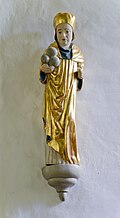
Saint Edith of Polesworth (Editha, Eadgyth, Ealdgyth) was an Anglo-Saxon abbess venerated in the kingdom of Mercia. Tradition links her to Polesworth Abbey in Warwickshire and to the royal centre of Tamworth in Staffordshire. Although widely venerated as a saint, her historical identity and the time in which she lived remain uncertain; according to some sources she died around the 960s. Her feast, and probably her death day, is 15 July, and her cult was especially strong in the Midlands, where several churches bear her name.
The sources and the difficulties
Edith (Ealdgyth) is entered in the first part of a late Old English list of saints called Secgan, which locates her burial at Polesworth. Later medieval sources give conflicting accounts of her. Some traditions make her a daughter of King Edward the Elder (899-924), possibly by his first wife Ecgwynn or his second, Ælfflæd, while others say she was the daughter of Ecgberht, king of Wessex (802-839).
Sister of King Æthelstan
The tradition written down in the twelfth century at the monastery of Bury St Edmunds and later retold by Roger of Wendover (died 1236) and Matthew Paris (died 1259) says that she was a sister of King Æthelstan, who gave her in marriage to Sihtric Cáech, a Hiberno-Scandinavian king of southern Northumbria and Dublin. The story adds that the marriage was never consummated. Sihtric broke his part of the agreement by renouncing the Christian religion and died soon afterwards. Edith returned south and founded a nunnery at Polesworth, not far from the Mercian royal seat at Tamworth, where she spent the rest of her life as a devout nun and virgin.
The story seems to take its cue from an earlier source, the D-version of the Anglo-Saxon Chronicle, which confirms that on 30 January 926 King Æthelstan gave his sister in marriage to Sihtric (died 927) and attended the wedding feast at Tamworth. The Chronicle, however, gives no name. In the twelfth century William of Malmesbury calls her a daughter of Edward the Elder and Ecgwynn, and so a full sister of Æthelstan, but says he could not find her name in the sources available to him. A variant of the Bury tradition, which places her burial at Tamworth rather than Polesworth, makes her a daughter of Ælfflæd, and so Æthelstan's half-sister. The thirteenth-century Chronicle of John of Wallingford names Sihtric's wife Orgiue.
Modern historians are divided. Some favour Roger's identification or at least the possibility that her name was Eadgyth. Alan Thacker says that, given Æthelstan's strong Mercian connections, it is not at all unlikely that such a woman, if repudiated, should have ended her days in a community in the old heartland of the Mercian royal family, perhaps brought up, like Æthelstan, at the Mercian court. Barbara Yorke argues, however, that the name Eadgyth is unlikely to have belonged at the same time to two daughters of Edward, the other by Ælfflæd, who married Otto I.
An older saint?
An earlier if largely legendary source, Conchubran's Life of Saint Modwenna, written in the early eleventh century, mentions a sister of King Alfred named Ite, a nun who was the saint's tutor and had a maidservant called Osid. The name Ite has been interpreted as "almost certainly a garbling of Edith" and Osid as a rendering of Osgyth. Barbara Yorke prefers to identify the historical figure with an earlier namesake. Her inclusion in Secgan, grouped with other early saints buried near rivers, may be taken as evidence that she was a Mercian saint of the seventh or eighth century. According to Thacker, on the other hand, the entry in Secgan may be a later addition, along with at least two other items that seem to reflect interests peculiar to Æthelstan's time.
The saint is commemorated in a number of churches around the Midlands, the most notable being Polesworth Abbey and the Collegiate Church of Tamworth, which bears her name. Other churches dedicated to Saint Edith include Church Eaton in Staffordshire, Amington, Monks Kirby in Warwickshire and a number of churches in Lincolnshire.
Commemorated the same day July 15
 Vladimir of KievEqual-to-the-Apostles · Grand Prince of KievJul 15
 Swithun of WinchesterSaint · Bishop of WinchesterJul 15
 Cyricus and JulittaHoly MartyrsJul 15
 Donald of OgilvySaintJul 15
- Abudimus of TenedosMartyr · Martyr of TenedosJul 15
 Job KundriaVenerable · Archimandrite in TranscarpathiaJul 15
 Matrona of ChiosVenerableJul 15
 Jaglika AdžićMartyrJul 15
 Terentius of LuniSaint · Bishop of LuniJul 15
- 28 Child Martyrs of PlavHoly New MartyrsJul 15
- Aeternus of ÉvreuxSaint · Bishop of ÉvreuxJul 15
 AnsverusVenerable Martyr · Abbot of RatzeburgJul 15