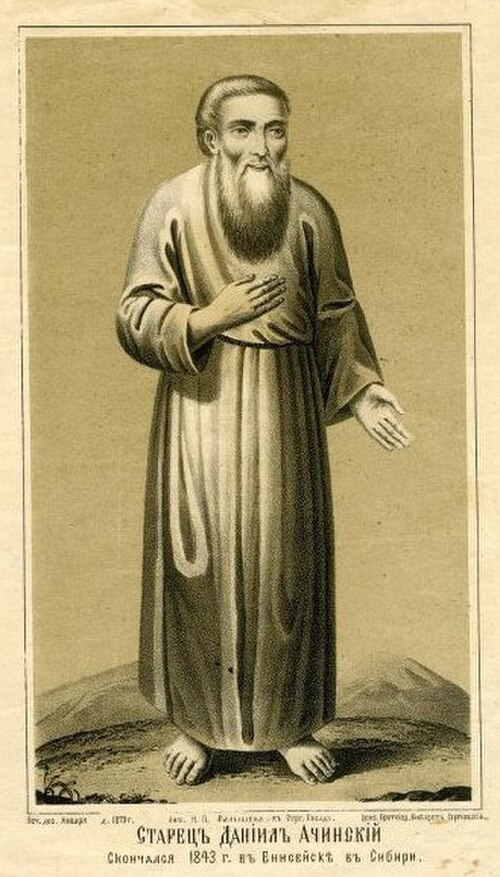
Righteous
Daniel of Achinsk
Born in the Poltava governorate in 1784, an ascetic in Siberia who died in Yeniseysk in 1843; locally canonized in 1999.
- Feast
- April 15old style April 28
- Reposed
- 184319th century
- Place
- Yeniseysk
- Order
- The Righteous
Life
The Righteous Daniel of Achinsk, also called Daniel of Siberia, in the world Danila Kornilovich Delie, was a Russian soldier who fought against Napoleon, then chose a life of prayer, was exiled to Siberia for it, and lived as a hermit near the town of Achinsk. He reposed in 1843 at Yeniseysk and was glorified in 1999 as a locally venerated saint of the Russian Orthodox Church.
Childhood and youth
Daniel was born on 12 December 1784, the day after the commemoration of Saint Daniel the Stylite, in Novi Sanzhary in the Kobeliaky district of the Poltava governorate. His family were Cossacks. He was baptized in the local Church of the Dormition and given the name Danila.
He grew up quiet and gentle, never holding a grudge. His father, Korniliy Delie, lost his reason twenty years before his death but died as a Christian during Bright Week. Of his mother, Agafia, it is known that she was a good housewife and an honest woman.
At fifteen Daniel fell ill with fever, and his family feared he would share his father's fate, but after two months he recovered completely. Having learned to sing bass, he began making music with friends, but at his grandfather's request he gave this up and took over the farm in place of his sick father.
Soldier in the war against Napoleon
In 1807 Daniel was taken into the army, and in 1809 he was assigned to the artillery. In the battery school he learned to read and write.
In the war of 1812 he fought against Napoleon's army and went through the Battle of Borodino, where he was wounded. Of the eight men who served his gun, only two survived, Daniel and one other soldier. With the Russian army he went all the way to Paris. According to his relatives, he sent letters and money home from France in the name of the parish archpriest, Peter Bazilevich.
On his return his battery was quartered in the town of Lebedyan (other sources say Lebedyn). By then he had risen to non-commissioned officer and served as the battery's quartermaster.
Farewell to his family
In August 1820 Daniel came home on leave to Novi Sanzhary. There he lived strictly, prayed much, spoke to his household about the need for daily prayer, and read and retold to them the contents of spiritual books.
He told them that he wished to enter a monastery and gave away his money and his share of land to those close to him. On leaving he gave his brother Ivan twenty-five roubles and said he had given the rest of his money for the adornment of icons. Bowing to his family in farewell, he told them not to expect him home again.
According to local tradition, during this period he lived for a time in a cave in a dense forest and visited the hamlet of Dikanka, where he prayed in the Church of Saint Nicholas before the icon of the Wonderworker.
Trial and exile
Reading the Holy Scriptures and the lives of the saints made a deep impression on Daniel. Service to the tsar and the fatherland gave way more and more to the desire to serve God alone. After much reflection he resolved to follow the example of the righteous and withdraw from the vanity of the world for prayer and ascetic struggle.
In the early 1820s he declined the military career and officer's rank offered him by his regimental commander. After seventeen years of blameless service he asked to be released to a monastery or to the wilderness, but met with no understanding. His commanders tried to dissuade him and even put him in the guardhouse, where he read the Scriptures and the lives of the saints and only grew firmer in his resolve.
His case came before a court-martial. On 9 June 1823 he was tried for his intention to leave the service in order to live in the wilderness and, as one who persisted in his view and refused to serve, he was stripped of his rank and sentenced to exile at Nerchinsk. At the trial he said that he would rather accept death than give up his intention.
The distillery at Bogotol
Daniel went to Siberia in chains together with convicts. In 1824 he was assigned to lifelong labour at the Bogotol distillery, which then belonged to the Tomsk governorate (the town of Bogotol is now in Krasnoyarsk Krai).
The local overseer took a dislike to the humble convict and gave him the hardest work. Daniel stood firm in God: after labouring all day, he spent the night in prayer. The overseer mocked him more and more, and one winter he ordered him stripped, set on a roof and doused with water, while he jeered from below, calling him a saint.
Yet afterwards it was not Daniel who fell ill but his tormentor. The illness brought him to see how gravely he had sinned. He repented sincerely and asked Daniel to pray for him. He soon recovered and sent a report to the governor asking that Daniel be released from penal labour as unfit for heavy work.
The hermit of Zertsaly
Once free, Daniel settled in Achinsk in a small cell belonging to a God-loving merchant. There he led a harsh life of constant work, asceticism and unceasing prayer.
He soon moved to the village of Zertsaly, seventeen versts from Achinsk. His cell there was the size of a coffin, with a window the size of a ten-kopeck coin. He stayed shut inside for weeks at a time, sometimes doing handwork in the entryway. He took no money for his labour, only bread to live on.
At night he went out in secret to work for the poor, tilling their land, reaping, mowing and tending their gardens. To subdue the flesh he wore a belt of birch bark, which later grew into his body and with which he was buried.
He also wore iron chains and a hoop, but shortly before his death he took them off. He explained that his body had grown used to them and no longer felt them, and that ascetic labour is profitable only when it truly restrains the body. He added that it would be better for him if people said he had grown lazy than if they praised him.
Brother Daniel
People began coming to him for blessing and counsel, some only to see him. His very appearance moved souls deeply, and hardened sinners wept and confessed their sins, sensing the grace that dwelt in the elder. He often spoke in parables, so that only the person addressed would understand.
Local bishops and Archbishop Michael (Burdukov) of Irkutsk visited him at Zertsaly, and at times they wept as they talked with him. Daniel would not allow himself to be called father, saying that we have only one Father, God, and that all of us are brothers. So he asked to be called "Brother Daniel".
Those who knew him testified to his gift of foresight. When someone in Achinsk was planning to visit him, he would sometimes come himself to those who were in great need of him. The love in his heart overflowed in tears, without which he could not speak.
Asked about almsgiving, he would say that even a poor man can show mercy: he can work for someone in need, comfort him with a word and pray to God for him. In this way, he said, love for one's neighbour is shown.
He received Holy Communion very often. Fasting had made his body almost waxen, yet his face was pleasant, even cheerful, and his cheeks were often lightly flushed. From constant kneeling he developed sores, which he bore with patience.
His Life also tells of a man who crept up to the window of his cell out of curiosity and was nearly scorched by a flame that burst out from it. Daniel came out at his cry, told him that God would forgive him, and warned him not to test such things again.
Last days in Yeniseysk
In January 1843 Daniel left Zertsaly for Yeniseysk. The abbess of the Convent of the Nativity of Christ there (today the Iveron Convent) was his spiritual daughter, Mother Eugenia (Starikova). She had left the world on his advice. While she still lived in Achinsk she had offered to build him a cell in her garden, but he declined, telling her that he would come to her when she lived on firm ground and that she would bury him. And so it came to pass.
On 15 April 1843 (Old Style), the elder made his last confession and received Communion at the early Liturgy. After the prayers for the departure of the soul were read, he reposed quietly on his knees. It was the Thursday of Bright Week, in the fifty-ninth year of his life. A living, joyful smile remained on his face.
Burial and veneration
The whole town of Yeniseysk attended his funeral. Many had not known him in life, but the report of his righteousness had gone before him. Those present testified that a special light filled the church and that a fragrance was sensed, and the blind predecessor of Abbess Eugenia said she saw a bright light like a flash of lightning.
He was buried near the Church of the Nativity of Christ, where his admirers built a chapel over the grave. The first account of his life was probably written by Schema-Hegumen Parthenius (Ageev) and published in 1855.
Pilgrims kept coming to his grave seeking help and comfort. On 1 May 1920, by order of the authorities, his remains were dug up and put on public display, and the chapel was demolished. Since then the whereabouts of his relics have been unknown.
In 1999 Daniel was glorified as a locally venerated saint in the Diocese of Krasnoyarsk and Yeniseysk. In 2000 a church dedicated to him was built in Krasnoyarsk, in 2008 services began in a house church in his name in the village of Bely Yar, and in 2009 a chapel bearing his name was completed in Achinsk. He is commemorated on 15 April, the day of his repose, and on 10 June with the Synaxis of the Saints of Siberia (Old Style dates).
Commemorated the same day April 15
 Mstislav the GreatRight-Believing · Grand Prince of KyivApr 15
 AristarchusApostle · Apostle of the SeventyApr 15
 Trophimus the EphesianApostle · Apostle of the SeventyApr 15
 PudensApostleApr 15
- Felix of ByzantiumSaint · Bishop of ByzantiumApr 15
 Basilissa and AnastasiaMartyr · Martyrs of RomeApr 15
 Padarn of WalesSaint · British abbot-bishopApr 15
 Abbo II of MetzSaint · Bishop of MetzApr 15
 Maro of PicenumHieromartyr · Martyr of PicenumApr 15
 Sukias the AlanVenerable MartyrApr 15
 Leonidas of AthensHieromartyr · Bishop of AthensApr 15
- Theodore the PresbyterSaintApr 15