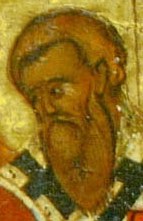
Apostle
Pudens
Christian of Rome mentioned in Second Timothy, counted among the Seventy Apostles.
Life
The Holy Apostle Pudens is one of the seventy apostles, a Christian of Rome mentioned by the Apostle Paul in the second epistle to Timothy (4:21): Eubulus greets you, and Pudens, and Linus, and Claudia, and all the brethren.
According to tradition, Pudens was a Roman senator of distinguished family, perhaps of the Cornelii, the son of the senator Quintus Cornelius Pudens and Priscilla, among the first drawn to the faith by Peter at Rome. He was baptised by the Apostle Peter, who lived in his parents' house, and he had two sons, Novatus and Timotheus, and, according to the legend, two daughters, Praxedes and Pudentiana. His house was a place of lodging for the holy Apostles Peter and Paul and for the gatherings of the Christians of Rome, and later it was turned into a church, called Pastoral, where, tradition says, Peter also served. The acts of the synod of Pope Symmachus (499) show that a titulus Pudentis existed, a church able to administer the sacraments, also called ecclesia Pudentiana, which may explain the name Pudentiana; the church of Santa Pudenziana in Rome is said to stand over his house. The Roman Martyrology names him the father of the holy Pudentiana and Praxedes. Some say his wife was Claudia, named after him in the epistle to Timothy; other sources say Priscilla.
He received a martyr's death under Nero, beheaded with Trophimus and Aristarchus, according to the service of 15 April, which says they suffered together with Paul. Other accounts confuse him with another Pudens, a senator converted by Pope Pius I. He was buried in the Catacomb of Priscilla on the Via Salaria. His relics are said to be kept in the basilica of Santa Pudenziana, but there is no historical confirmation. His image appears in the great apse mosaic of the basilica, with his daughters. The Orthodox Church commemorates him on 15 April, with Aristarchus and Trophimus, and on 4 January, in the Synaxis of the Seventy Apostles; the Roman Catholic Church on 19 May.
Commemorated the same day April 15
 Mstislav the GreatRight-Believing · Grand Prince of KyivApr 15
 AristarchusApostle · Apostle of the SeventyApr 15
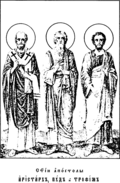 Trophimus the EphesianApostle · Apostle of the SeventyApr 15
- Felix of ByzantiumSaint · Bishop of ByzantiumApr 15
 Basilissa and AnastasiaMartyr · Martyrs of RomeApr 15
 Padarn of WalesSaint · British abbot-bishopApr 15
 Abbo II of MetzSaint · Bishop of MetzApr 15
 Maro of PicenumHieromartyr · Martyr of PicenumApr 15
 Daniel of AchinskRighteousApr 15
 Sukias the AlanVenerable MartyrApr 15
 Leonidas of AthensHieromartyr · Bishop of AthensApr 15
- Theodore the PresbyterSaintApr 15