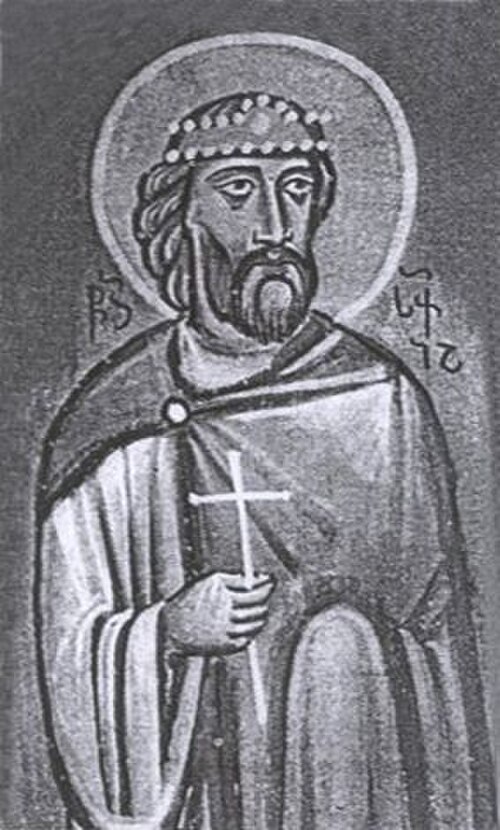
Venerable Martyr
Sukias the Alan
Monk and ascetic of Alan descent from the early centuries, venerated especially in Armenia, Ossetia and Georgia.
Life
Saint Sukias (Sukhiy, called before baptism Barakad) of Alania and his sixteen companions are martyrs of the early Christian centuries, venerated above all in Armenia, Ossetia and Georgia. They are commemorated (Old Style) on 15 April. According to tradition, their prayers kept Armenia from outside enemies. The story rests on the Armenian tradition and on a parchment of the Iviron monastery on Athos of the eleventh century and has the features of a legend; our sources give no particular canonization.
The story
Sukias was at the head of seventeen Alan courtiers who accompanied to Armenia Queen Satenik (the model for Satana, heroine of the Nart epic) for her marriage to King Artashes I. Their names survive: Sukias (Barakad), Andrew, Anastasius, Talale, Theodoret, Ivkhirion, Jordan, Condratus, Lucian, Mimnenos, Nerangios, Polyeuctus, James, Phocas, Domentian, Victor and Zosimus. In Armenia they received Christianity from the disciples of the Holy Apostle Thaddaeus, headed by Saint Voski (Chrysos), and were baptized in the waters of the Jordan. At baptism the newly baptized saw on a mountain Christ standing and set up there a wooden cross, called the "Cross of the Annunciation".
Soldiers sent by King Artashes and Queen Satenik came to Chrysos and demanded that his disciples return. Chrysos answered: "Of their own will they chose what was useful to them". For the bold answer the soldiers cut down with the sword Chrysos and four of his disciples; Sukias and his company they left alive, since he was a relative and right hand of the king of the Alans, the queen's father. Sukias and his brothers buried the martyrs and returned to Armenia, settling on Mount Sukav, in the Bagrevand region, named after them afterwards. The former great men of the court, exchanging golden armour for simple clothing, led an ascetic life, living on herbs and spring water, in unceasing prayer, forty-four years, according to the ancient writer Tatian (second century). At that time the king of Persia, Sapor (Shapur), was ravaging Armenia. Blessed Condratus, seeing the sufferings of the land, asked Sukias to pray for Armenia and its people; they prayed: "Have mercy, Lord, on this land, for great is Thy mercy. And though they have sunk in sins, Thou art Lord and Maker of all creatures... Turn from them the sword of Thy wrath, loving and guileless God." And by their prayers the Persian king left the borders of Armenia and peace was established.
Martyrdom
After some time the king of the Alans, Datianos, remembering his courtiers in Armenia, ordered his subject Barlap to go and bring them back with honour, and, if they did not obey, to kill them. Barlap found them in the forest, on Mount Sukav, marvelling at their appearance, so little like that of great men of a court. To the king's order Sukias answered: "We, in the name of our Lord Jesus Christ, Who is Maker of all that is, have willingly put ourselves to death and rejected all that is fleshly, and for that reason have died to human powers, and we await from our Lord Jesus Christ, the Immortal and Unageing, the departure and eternal glory with His holy angels". Their steadfastness kindled Barlap's anger, and he ordered them bound and burned; dying, the saints sang the Psalms of David (20, 21, 22, 23). Burned alive, they were also cut down with swords, and their charred remains were scattered around the place where they had lived. This took place, according to the parchment of the Iviron monastery of the eleventh century, in the year 100, and according to the "History of the Armenians" of Movses Khorenatsi, in the year 92. Datianos did not allow burial; according to tradition, for two hundred and thirty years they remained unburied and incorrupt, and in the sixth century Christians carried them to Luscum and buried them. The names of the saints were found scratched on the rock of Mount Sukav. Saint Gregory the hieromartyr, enlightener of Armenia (died 355, commemorated 30 September), raised a church at the place of martyrdom of Sukias and his brothers and founded a monastery; later a wonderworking spring gushed forth there.
Commemorated the same day April 15
 Mstislav the GreatRight-Believing · Grand Prince of KyivApr 15
 AristarchusApostle · Apostle of the SeventyApr 15
 Trophimus the EphesianApostle · Apostle of the SeventyApr 15
 PudensApostleApr 15
- Felix of ByzantiumSaint · Bishop of ByzantiumApr 15
 Basilissa and AnastasiaMartyr · Martyrs of RomeApr 15
 Padarn of WalesSaint · British abbot-bishopApr 15
 Abbo II of MetzSaint · Bishop of MetzApr 15
 Maro of PicenumHieromartyr · Martyr of PicenumApr 15
 Daniel of AchinskRighteousApr 15
 Leonidas of AthensHieromartyr · Bishop of AthensApr 15
- Theodore the PresbyterSaintApr 15