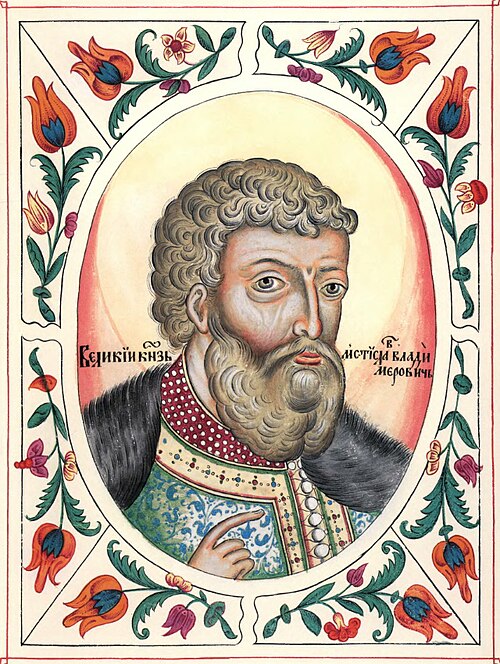
Right-Believing
Mstislav the Great
Grand Prince of Kyiv
Grand Prince of Kyiv, son of Vladimir Monomakh, who reposed in 1132.
- Feast
- April 15old style April 28
- Reposed
- 113212th century
- Place
- Kyiv
Life
Saint Mstislav the Great, right-believing prince, baptized Theodore, was Grand Prince of Kyiv from 1125 to 1132 and the eldest son of Vladimir Monomakh. A tireless soldier and a builder of churches, he held the lands of Rus together during his reign. The Church remembers him on 15 April as a faithful ruler who loved peace and the house of God.
Family and youth
He was born in 1076, according to most sources at Turov. His mother was Gytha, daughter of Harold II, the last Anglo-Saxon king of England, and after this grandfather the Norse sagas call him Harald. At baptism he received the name of Saint Theodore.
He was only twelve when his grandfather, Grand Prince Vsevolod of Kyiv, sent him to rule Novgorod in 1088. The people of Novgorod grew fond of the young prince. After a short time in Rostov, they drove out Prince David, who had been given to them in his place, and went to Rostov expressly to bring Mstislav back, in 1095. Around the same time he married Christina, daughter of King Inge I of Sweden.
The war with Oleg and the peace
In 1096 Prince Oleg Sviatoslavich, his father's cousin and Mstislav's own godfather, took Murom, where Mstislav's brother Izyaslav fell, and then seized Rostov and Suzdal. Mstislav did not want innocent blood to be shed. He offered Oleg peace and asked him to be content with his own inheritance, Ryazan. But Oleg had already set out with an army against Novgorod.
Mstislav defeated him and forced him back to Murom, then again offered peace, asking only that the captives be freed. Oleg pretended to agree, and Mstislav sent his men home. On the Saturday of the first week of Great Lent, the day of the Great Martyr Theodore the Recruit, the prince was at table in Suzdal when he learned that Oleg had come with an army to the river Klyazma.
Within a single day he gathered his forces again. His brother Vyacheslav brought help from the south, sent by their father, and the armies met on the river Koloksha. Oleg was beaten and fled to Ryazan. Mstislav set the captives free, withdrew from the land of Murom, and then brought about Oleg's reconciliation with Grand Prince Sviatopolk and with Vladimir Monomakh. The peace among the princes was sealed at the meeting of Lyubech in 1097.
From these years also comes a story told by the twelfth-century German theologian Rupert of Deutz: Mstislav was mauled by a bear while hunting and carried home close to death. His mother Gytha prayed for him to the Great Martyr Panteleimon, and according to this account the saint appeared to the prince and healed him. Mstislav later built a monastery of Saint Panteleimon near Novgorod, and his son Izyaslav received Panteleimon as his baptismal name.
Prince of Novgorod
The people of Novgorod held him so dear that in 1102, when Grand Prince Sviatopolk wanted to put his own son in Mstislav's place, they answered that if his son had two heads he could send him. Mstislav remained in Novgorod until 1117.
He fought beside his father against the Cumans in 1107 and 1111 and campaigned against the Chud, the Estonians, in 1113 and 1116. After the victory of 1116 he enlarged the fortress of Novgorod and built a more spacious residence for the city's bishop. At his command the posadnik Pavel then raised the stone fortress of Ladoga with its church of the Great Martyr George.
At Gorodishche near Novgorod he built the church of the Annunciation. For it the Mstislav Gospel was written by the scribe Alexa Lazarevich, and its precious cover was made in Constantinople. The book survives to this day.
In 1113 he laid the foundations of the cathedral of Saint Nicholas at Yaroslav's Court in Novgorod, which still stands. According to tradition he built it in thanksgiving for his healing. Gravely ill, the prince is said to have seen Saint Nicholas, who told him to send to Kyiv for a round icon of the saint. His messengers, held up by a storm on Lake Ilmen near the island of Lipno, found on the water the very icon of the vision, and the prince was healed when he kissed it. A monastery of Saint Nicholas was later founded at Lipno where the icon had been found.
Grand Prince of Kyiv
In 1117 Vladimir Monomakh called his son close to Kyiv and gave him Belgorod, so as to have him as a helper in government. His eldest son Vsevolod stayed on in Novgorod. In 1123 Mstislav stood against Prince Yaroslav of Volhynia, his own son-in-law, who was trying to take Kyiv with Polish and Hungarian troops.
When Vladimir Monomakh died in 1125, Mstislav succeeded to the throne of Kyiv without any opposition, and his brothers acknowledged his seniority. Early in his reign he repelled the Cumans, and the sources say he drove them beyond the Volga.
In 1127 Prince Yaroslav of Chernigov was expelled by his nephew Vsevolod Olgovich, who was Mstislav's son-in-law and had called in the Cumans. Mstislav had bound himself by kissing the cross to defend Yaroslav. The clergy and all the people begged him not to shed Christian blood, and he obeyed them. To the end of his life he wept for having broken his oath.
The princes of Polotsk, who had refused him support, were subdued after the campaigns of 1127 and 1129, and Mstislav sent them into exile in Constantinople. He also fought the Chud and the Lithuanians, not always with success.
In Kyiv he built in 1128-1129 the church and monastery of Saint Theodore, his patron saint, which became the resting place of his descendants. After the campaign against Lithuania he founded the church dedicated to the Pirogoshcha icon of the Mother of God in the Podil.
Repose and family
Mstislav reposed in Kyiv on 14 April 1132, in Bright Week, and was buried in the church of Saint Theodore that he had built. He left the throne to his brother Yaropolk. The chronicler wrote that after his death the land of Rus was torn apart, and historians usually take 1132 as the beginning of the division of Kyivan Rus into separate principalities.
The name "the Great" does not appear in the old chronicles. It was made popular in the eighteenth century by the historian Vasily Tatishchev, who described him as a just judge, a brave soldier and a ruler merciful to his people.
With Christina, who died in 1122, he had many children. His sons Vsevolod, Izyaslav, Rostislav and Sviatopolk were princes, and Izyaslav and Rostislav in turn became Grand Princes of Kyiv. His daughters married into the ruling houses of Norway, Denmark, Byzantium and Rus: Ingeborg was the mother of King Valdemar I of Denmark, and Eupraxia was the wife of Alexios Komnenos, son of Emperor John II.
After Christina's death Mstislav married Lyubava, daughter of the Novgorod posadnik Dmitry Zavidich. Among the children of this marriage were Vladimir and Euphrosyne, who became Queen of Hungary as the wife of Géza II. Two of Mstislav's sons, Vsevolod and Rostislav, are also venerated as saints.
Veneration
Mstislav was honoured even in his lifetime. The scribe of his Gospel called him right-believing and Christ-loving, and the craftsman Naslav, who made the cover, wrote that God had comforted him in his labours through the prayer of the good prince.
A short life of him entered the Russian Prologues under 15 April, and from there passed into a Serbian Prologue of the late thirteenth century and a Bulgarian synaxarion of 1340, where his memory stands beside those of Saint Olga and Saints Boris and Gleb. He is celebrated on 15 April and also in the Synaxis of the Saints of Novgorod, and the cathedral of Saint Nicholas that he founded in Novgorod still stands today.
Commemorated the same day April 15
 AristarchusApostle · Apostle of the SeventyApr 15
 Trophimus the EphesianApostle · Apostle of the SeventyApr 15
 PudensApostleApr 15
- Felix of ByzantiumSaint · Bishop of ByzantiumApr 15
 Basilissa and AnastasiaMartyr · Martyrs of RomeApr 15
 Padarn of WalesSaint · British abbot-bishopApr 15
 Abbo II of MetzSaint · Bishop of MetzApr 15
 Maro of PicenumHieromartyr · Martyr of PicenumApr 15
 Daniel of AchinskRighteousApr 15
 Sukias the AlanVenerable MartyrApr 15
 Leonidas of AthensHieromartyr · Bishop of AthensApr 15
- Theodore the PresbyterSaintApr 15