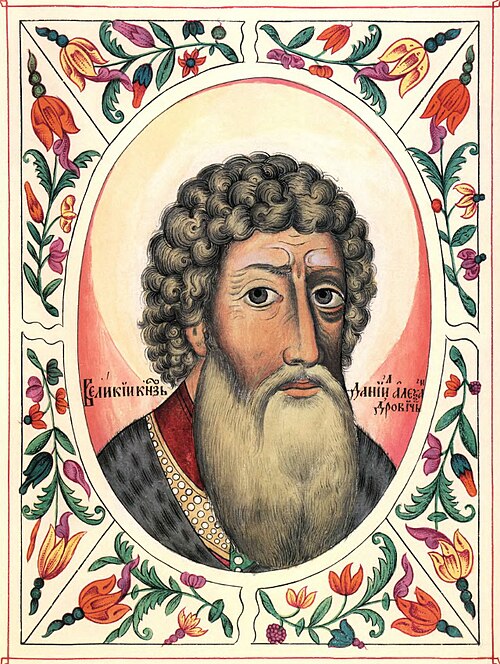
Right-Believing
Daniel of Moscow
Prince of Moscow
Youngest son of Saint Alexander Nevsky and first prince of Moscow, ancestor of her rulers.
- Feast
- March 4old style March 17
- Reposed
- 130314th century
- Place
- Moscow
Life
Saint Daniel of Moscow, the right-believing prince, was the youngest son of Saint Alexander Nevsky and the first prince of the line of Moscow. All the later princes of Moscow, and through them the tsars of Russia, descend from him. He is honoured for his peacefulness, his refusal to take other princes' lands by force, and his foundations. The Russian Orthodox Church commemorates him on 4 March (Old Style), the day of his repose, and on 30 August, the day his relics were found.
He was born at Vladimir in late 1261, the fourth son of Alexander Nevsky and his second wife, Vassa, and he was named after Saint Daniel the Stylite. His father died on 14 November 1263, when Daniel was two. Of his father's lands he received Moscow, the least valuable. In his childhood it was governed for him by his uncle, Prince Yaroslav of Tver, and he seems to have ruled in his own right from about 1282. In 1272 he is said to have received the town as his portion.
Moscow was then a small and unnoticed principality, but it lay on the Moskva river between important trade and military routes. The age was one of strife among the Russian princes. Daniel strengthened his lands not by injustice or violence but peacefully, and he is remembered for his constant effort to keep unity and to avoid bloodshed. In 1293, when his brother Prince Andrei and Tatar forces from the Horde laid waste to Russian towns, Daniel came out against his brother near Yuryev, but his desire for peace prevailed and no battle took place.
In 1300, when Prince Constantine of Ryazan prepared to attack Moscow, Daniel marched against him, defeated a Tatar force and took Constantine prisoner. The chronicle says that he did not take booty or the lands of other princes, as was the custom. His Moscow gained the town of Kolomna, which Constantine yielded for his release, so that Daniel now held the whole length of the Moskva river. In 1302 his nephew Ivan of Pereslavl, who died childless, left him his principality, and Daniel kept Moscow as his capital. This union of lands was the beginning of Moscow's rise.
He built a church and a monastery in honour of his patron on the bank of the Moskva river, the Danilov monastery, among the first in Moscow, and he is credited with the first stone church in the Kremlin, in honour of Saint Demetrius of Thessalonica. His wife was Maria Glebovna, and their sons included Yuri and Ivan, called Kalita, who made Moscow great.
Daniel fell gravely ill in 1303, took the great schema and died on 4 March of that year (5 March in some sources), aged forty-two. In his humility he asked to be buried in the common cemetery of the monastery, not inside the church. Less than thirty years later the monastery was moved to the Kremlin, the church became a parish church, and the cemetery was opened to all, so that his grave was lost.
Tradition tells that in the time of Ivan III he appeared to a youth in the grand prince's service and asked to be remembered, after which memorial services for the princes were ordered. Under Ivan the Terrible a dying merchant's son was healed at his grave, and the tsar rebuilt the monastery. On 30 August 1652 his relics were found incorrupt and placed in a reliquary. He was recognized for local veneration by the Russian Church in the eighteenth century, and Metropolitan Platon, who wrote his life, compared him to a sapling that slowly grows into a tall tree, as Moscow grew from small beginnings.
Commemorated the same day March 4
 Lucius ISaint · Bishop of RomeMar 4
 Gerasimus of the JordanVenerable · Abbot in the Jordan desertMar 4
 Vasilko of RostovRight-Believing · Prince of RostovMar 4
 Paul and JulianaHoly MartyrsMar 4
 Gerasimus of VologdaVenerable · First wonderworker of VologdaMar 4
 Felix of RhuysVenerable · Abbot of Saint-Gildas-de-RhuysMar 4
 Joasaph of PskovVenerable · Founder of Snetogorsk MonasteryMar 4
- Gregory of AssosSaint · Bishop of AssosMar 4
- Paul I of BresciaSaint · Bishop of BresciaMar 4
- Peter of TomskRighteousMar 4
- Acacius of PtolemaisMartyrMar 4
- Adrian and CompanionsHoly MartyrsMar 4