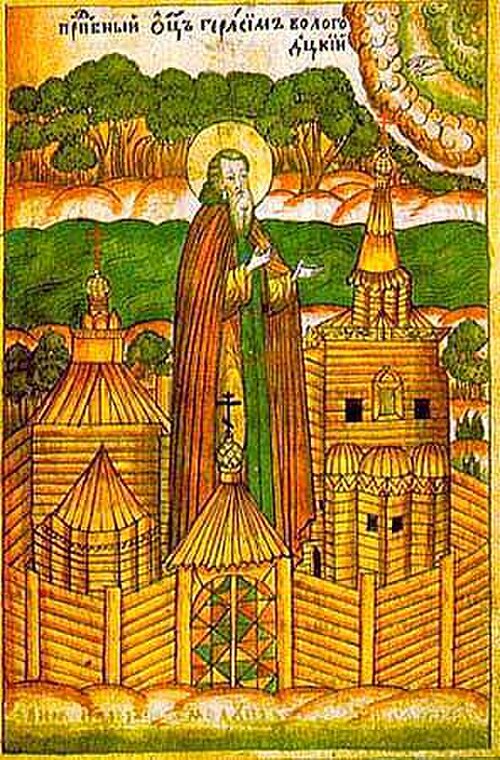
Venerable
Gerasimus of Vologda
First wonderworker of Vologda
Monk, the first wonderworker of Vologda, who died in 1178; commemorated on March 4.
- Feast
- March 4old style March 17
- Reposed
- 117812th century
- Place
- Vologda
- Order
- Venerables
Life
Venerable Gerasimus of Vologda (died 1178) was a monk, founder of the men's monastery of the Holy Trinity on the Kaisarov stream, and is regarded as the first wonderworker of Vologda. According to tradition he laid the foundation of the city of Vologda. He is commemorated on 4 March (old style) and on the third Sunday after Pentecost, in the Synaxis of the Saints of Vologda.
His life
The main source for his life is the "Tale of the Miracles of Gerasimus of Vologda", written by a certain Thomas around 1666 with the blessing of Markel, archbishop of Vologda and Great Perm. According to the tale, Gerasimus was born in Kiev and was then a novice in a monastery which the life calls "Glushensky". Scholars think the document is mistaken here, since "no such monastery existed either in the twelfth century or later in the Kiev province"; they suppose it means the Gnilets Dormition hermitage or the Glushitsa monastery near the Kiev Caves Lavra. The English source says he was drawn to the Gniloe Dormition monastery in Kiev because Saint Theodosius had spent Great Lent there in silence. At thirty he received the rank of presbyter. The tale says that the saint came from Kiev to the river Vologda in 1147 (19 August, according to one source) and founded on the Kaisarov stream a men's monastery in honour of the Holy Trinity. He found there a small settlement, blessed it and foretold that it would become a flourishing city; Vologda later grew from it. Gerasimus chose to withdraw into the dense forest near the Kaisarov stream to live in quiet and prayer, and built there a church of the Holy Trinity, regarded as the first monastery in the North dedicated to the Trinity.
The dating of the foundation is doubted by scholars. The historians A. N. Bashenkin and I. P. Kukushkin note that the practice of monastic life did not yet exist in north-eastern Rus in the twelfth century. Nothing is known of his deeds after the foundation until his death. He died in 1178. A charter of Patriarch Adrian of 1691-1692 speaks of his resting place. The canonical date of his death is 4 March, but historians question its accuracy: the day suspiciously coincides with the one the whole Church keeps for another, better known saint, Gerasimus of the Jordan, who died on 4 March 475. The English source adds that he was tonsured on the same day and so took the name Gerasimus; the other sources do not confirm this.
Copies of the saint's life are very rare. It is supposed that an earlier life existed and was lost when Vologda was plundered by Polish-Swedish bands in the Time of Troubles in 1612, when the Trinity monastery founded by Gerasimus was destroyed. One copy is now in the State Historical Museum in Moscow, another in a miscellany from the library of the Spaso-Prilutsky Monastery, a third in the museum at Yaroslavl. In the last it is said that its author, the monk Jonah of Kerzhenets, had at hand a "special little book of ancient writing" in which the saint's miracles were set out in thirty-seven articles. Scholarly study of the text has not been done.
Veneration and canonization
After the Poles plundered the Trinity monastery in 1612, the place of the founder's burial was lost and found again only after some decades. Many miracles are linked with this: according to the notes of the priest Gregory Popov, there were thirty-seven between 1649 and 1666. One miracle of 6 July 1649 was attested by Archbishop Markel. In 1690 the brethren of the Holy Spirit Monastery of Vologda petitioned Patriarch Adrian to allow the glorification of Gerasimus as a saint, but in 1699, after an inquiry by Archbishop Gabriel, the request was refused; Gabriel doubted the reality of the miracles. Despite the prohibition, the veneration of the local people continued. In 1717 the wooden Trinity church, where his relics lay, was replaced by a stone one, and the relics were placed in a shrine. In 1811 Gerasimus was already in the official list of the saints of Vologda compiled by Bishop Eugene (Bolkhovitinov), and in 1841 the local canonization was confirmed by including his name in the Synaxis of the Saints of Vologda. In 1894 the city duma of Vologda resolved to mark the day of Gerasimus's coming to Vologda with a procession.
The stone church of the Trinity on the Kaisarov stream, known as "Trinity-Gerasimov", in a style called "provincial baroque", stood for less than a century and a half. It was closed in 1930 and torn down in the 1940s, and the shrine with the relics was lost irretrievably. In 2008 a memorial cross was set on its site, and in 2013 a chapel in the saint's honour was consecrated, built from the donations of the people of Vologda.
Iconography and monument
The oldest icon of the saint, of the second half of the seventeenth century, hung before the revolution in the iconostasis of the Trinity-Gerasimov church, to the left of the royal doors, and is now kept in the museum at Vologda; with Gerasimus it shows Demetrius of Priluki and John the Almsgiver. The saint is painted in full monastic dress, in boots, his right hand blessing and a scroll in his left. According to Filimonov's painter's manual, Gerasimus is "grey in appearance, with a beard like that of Basil the Great, in venerable robes". A monument to him was unveiled on 28 June 2012 in Vologda, the work of the sculptor Oleg Uvarov.
Commemorated the same day March 4
 Lucius ISaint · Bishop of RomeMar 4
 Daniel of MoscowRight-Believing · Prince of MoscowMar 4
 Gerasimus of the JordanVenerable · Abbot in the Jordan desertMar 4
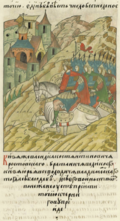 Vasilko of RostovRight-Believing · Prince of RostovMar 4
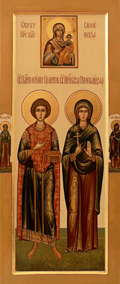 Paul and JulianaHoly MartyrsMar 4
 Felix of RhuysVenerable · Abbot of Saint-Gildas-de-RhuysMar 4
 Joasaph of PskovVenerable · Founder of Snetogorsk MonasteryMar 4
- Gregory of AssosSaint · Bishop of AssosMar 4
- Paul I of BresciaSaint · Bishop of BresciaMar 4
- Peter of TomskRighteousMar 4
- Acacius of PtolemaisMartyrMar 4
- Adrian and CompanionsHoly MartyrsMar 4