Confessor
Demetrius Kryuchkov
A Russian confessor of the faith, who died in 1952.
- Feast
- September 26old style October 9
- Reposed
- 195220th century
- Order
- Confessors
Life
Holy Confessor Demetrius Kryuchkov, a priest, was born on 10 September 1874 in the village of Lyakhovka, in the Glukhov district of the Chernigov province, in the family of the peasants Ivan and Evdokia Kryuchkov. He died in exile, near Abakan, on 9 September 1952. He is commemorated on 9 October, on 7 February, in the Synaxis of the New Martyrs and Confessors of the Russian Church, and on 5 September, in the Synaxis of the Saints of Moscow.
Youth
In 1882 the Kryuchkov family, together with other peasants with little land, left for the Omsk province and settled in the village of Rozhdestvenka, near Tatarsk. But Dmitry, aged eight, did not go with his parents: on the day of departure he ran away and hid. To feed himself he took a job with a landowner, Ratchenko, in the village of Zarudskoe, to care for the bees, and worked there for about five years. At thirteen he moved to another landowner, Trofimenko, in the town of Glukhov, where he learned gardening and stayed about six years. In 1893, at nineteen, he left for Moscow, intending to study. Having no means, he had to earn them and took a place in a church choir. In 1908 he became a psalm-reader at the church in the village of Kraskovo, near Moscow, and in the same year married Anastasia Semyonovna, from the Smolensk province. The marriage remained childless. He was a psalm-reader seven years, and in 1915 was ordained deacon at the same church.
In 1917 he was moved to Moscow, to the church of the Exaltation of the Holy Cross on Vrazhek. The summer of 1918 remained in his memory, for then he found his spiritual father. The priest Vladimir Bogdanov came to the church of the Exaltation to perform the funeral service of his niece. Father Demetrius served with him, as deacon. During the service Father Vladimir made him a few remarks. This brief meeting in prayer made a very deep impression on Father Demetrius. At the end of the service he asked permission to come to Father Vladimir's home, to learn to serve and not to make mistakes any more. Father Vladimir agreed, and soon Demetrius became a regular visitor, and then a spiritual son. In 1920 he was ordained priest at the same church. In 1922, at the request of the clergy of the church of Venerable Sabbas the Sanctified, he was moved there. It was the year in which church valuables were confiscated. Mass arrests touched the clergy of the church of Saint Sabbas, all the clergy being arrested, with Father Demetrius. The priests were accused of anti-Soviet acts, for reading from the ambo the message of Patriarch Tikhon. He was sentenced to three years in a camp. In prison he worked at cobbling and beekeeping, crafts learned from childhood. He was released early, in 1924.
The arrests
In 1925, at the panikhida for Archpriest Alexei Mechev, he met his son, the priest Sergei Mechev, who would later bear witness to Christ by martyrdom. In 1927, because of misunderstandings with the church warden, he was dismissed from his post and fell gravely ill, the illness lasting a year. In 1928-1929 he was invited unofficially to serve for a time as an extra priest at the church of the Holy Martyrs and Unmercenaries Cyrus and John, on Solyanka. In November 1931 Archpriest Vladimir Bogdanov died. Father Demetrius buried him and went to the cemetery to serve panikhidas. He lost his spiritual father at a hard time, on the eve of new trials. On 5 May 1932 he was arrested a second time and held at Butyrka, being implicated in the case of Bishop Seraphim Zvezdinsky of Dmitrov. He did not admit guilt: he said at the investigation that he had no political views, knew almost no one and was interested only in the inner life. By decision of the Special Council of the OGPU of 7 July 1932, he was exiled for three years to Western Siberia, to the village of Timsk in the Narym region. After serving, in 1935, he settled in the town of Gzhatsk and took a job as a lumberjack.
At the end of 1937, at sixty-three, he moved closer to Moscow, to the settlement of Tomilino. He built himself, with the money he earned, a house of seven square metres, which acquaintances called a shed, and took a job as a gardener at a kindergarten. In Moscow lived his spiritual children and friends; at the risk of being arrested, Father Demetrius took on the care of them. He went regularly to Moscow and the settlements around, and in apartments and dachas served the Liturgy, heard confessions, communed, baptised and buried. By a wonder the persecution of that time did not touch him. In 1941, when the Germans advanced on Moscow, the kindergarten was evacuated, but the director did not offer him to leave with them, though he wished it. During the war he remained gardener at military hospitals, then at a nursery. In 1946 a new wave of arrests began. He would never have been found if he had not been betrayed by those for whom he had risked his life in the years 1937-1939. He was arrested a third time on 17 May 1946, at seventy-two, and imprisoned in the internal prison of the MGB. Here he had to see that almost all his acquaintances who had been arrested, fathers, brothers and children, had given him away. For example, a spiritual daughter told the investigation that the priest Demetrius systematically held illegal services. Each time, even at the most convincing testimony, when the investigation considered him exposed, Father Demetrius said that he did not confirm the charges and denied them all. Asked what the purpose was of the visitors who came to him, he answered: for seeds for the garden, for flowers. Of the purpose of his visits to Moscow he said: for household matters, to repair a primus stove. The investigation did not succeed in tangling him in the web of repeated questions. In detention he had twenty interrogations, of two to eight hours. At one of the last he said that he would never confess to any political crime. He was moved to Lefortovo. On 30 September 1946 he was sentenced to five years of exile. He died in exile on 9 September 1952 and was buried in a grave now unknown, in the vicinity of the city of Abakan.
Commemorated the same day September 26
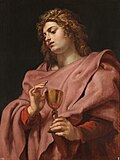 John the TheologianApostle · Apostle and EvangelistSep 26
 Eusebius of RomeSaint · Bishop of RomeSep 26
 GideonProphet · Judge of IsraelSep 26
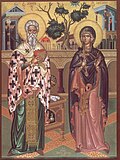 Cyprian and JustinaHoly MartyrsSep 26
 Neagoe BasarabRight-Believing · Prince of WallachiaSep 26
 Platonida of ArgeșVenerable · Princess of WallachiaSep 26
 Nikolai GashevHieromartyr · Archpriest in PermSep 26
- Alexander LevitskyHieromartyrSep 26
- AmantiusSaintSep 26
- Athanasius DokukinHieromartyr · Russian priestSep 26
- Colman EloVenerableSep 26
- Colman of Ros BranduibhSaintSep 26