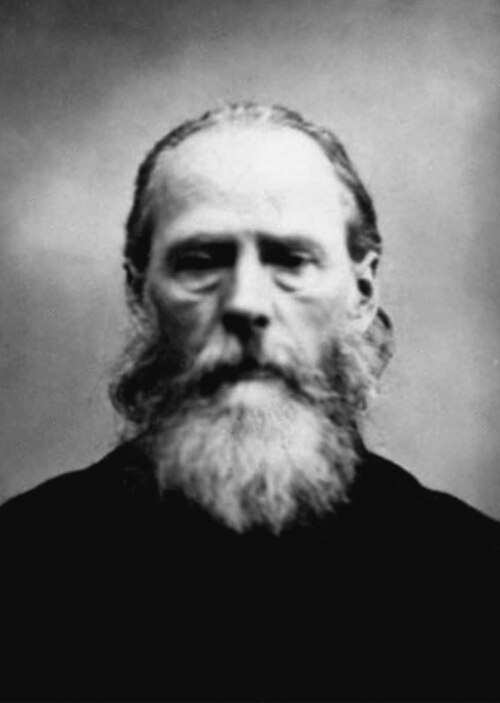
Hieromartyr
Nikolai Gashev
Archpriest in Perm
Archpriest of the Elijah Cathedral in Perm, who died in 1930 and was glorified as a new martyr in 2000.
- Feast
- September 26old style October 9
- Reposed
- 193020th century
- Place
- Russian Soviet Federative Socialist Republic
- Order
- Martyrs
Life
Saint Nikolai Gashev (1869-1930) was archpriest of the Elijah Cathedral at Ilinskoe in the diocese of Perm, a country priest who stayed beside his flock in the time of persecution and died in exile in the northern Urals in 1930. He was glorified by the Jubilee Council of the Russian Church in August 2000 as a hieroconfessor, in the synaxis of the New Martyrs and Confessors of Russia, and is called by the people "the wonderworker of Ilinskoe". His memory is kept on 26 September.
His life
He was born on 26 November 1869 in the village of Uspenka, Perm governorate, in the family of the peasant Mikhail Gashev. He finished primary school in 1880, and between 1885 and 1890 was a church servant at the Dormition church at Chusovaya in the Perm district. In 1890 he graduated from the psalm-readers' courses of the Brotherhood of Saint Stephen of Perm and was appointed psalm-reader at the church of Saint Elijah in the village of Ilinskoe. On 30 August 1902 he was ordained deacon at the same church. From 1905 to 1917 he was a teacher of religion in the zemstvo schools.
In December 1918 a mutiny of the 10th Red Army cavalry regiment quartered there broke out at Ilinskoe. When the Bolsheviks entered the Perm governorate in 1919, some, fearing reprisals for the shooting of 800 supporters of Soviet power, went off with Kolchak's troops to Siberia. Many advised Father Nikolai to go with the Whites, as the priest of the church at Ilinskoe, Father Evgraf, did, since the Reds would not spare a priest, but he stayed. When units of the northern expeditionary corps fought their way into the village, Father Nikolai did not even try to hide, but walked freely and openly through the village in his cassock as before, to the no small amazement of the Red soldiers, who looked on every minister of the altar as a counter-revolutionary. In 1919 he was ordained priest at the church of Ilinskoe, a church built by the same builder who raised the Kazan cathedral in Saint Petersburg, and served in the village another ten years.
Arrest and exile
On 6 January 1930 he was arrested on the charge of anti-Soviet agitation (art. 58, p. 10). He was taken from Ilinskoe to Shabunichi, then by train to the "Razgulyai" prison in Perm. At the interrogations witnesses stated that the priest Gashev "carried on furious agitation among believers, said that the church must be defended at all costs and called on them to fight for it with Soviet power to the last drop of blood, citing the example of the first Christians who accepted death for the faith", and that "he went around the parish with an icon of the Mother of God and told parents not to let their children join the Komsomol, because they would learn nothing good there".
At the investigation Nikolai Gashev did not agree with the charges. He said that, like every citizen, he was loyal to Soviet power, but did not deny that as a minister of the altar he had to defend the faith of Christ zealously and set an example to his parishioners. So he did call the faithful in church to strengthen their faith in God and to pray more often, citing the example of the first Christians who suffered and were persecuted for their great devotion to the faith. He said nothing against Soviet power in his sermons, served by the typikon and avoided any conflict with the authorities, so he did not plead guilty. His son Vladimir, visiting him in Perm prison, found him gravely ill, walking with difficulty. Father Nikolai, on the contrary, comforted him and told him to tell everyone that he felt well, that no one had done him any harm and could do none.
On 16 February 1930 the "troika" of the Ural Special Board of the OGPU sentenced him to three years of exile in the northern Urals, counted from January 1930. In exile he was kept in a barracks, in conditions close to those of a camp. After a time his wife, Kapitolina Andreevna, who visited him, was warned by the authorities of his poor state and that he might die soon. On the recommendation given her, she took the measure for a coffin, ordered a coffin and a grave. After a short time Nikolai Gashev died. The date of his death and the place of burial are unknown.
Family and veneration
His wife was Kapitolina Andreevna Gasheva. They had nine children, six sons and three daughters. His son Nikolai was a Red commander in the civil war, a doctor at the front in the war of defence, an honoured doctor of the RSFSR and a holder of the Order of Lenin. His son Vladimir was a chief forester; among his grandsons, Boris Gashev (1939-2000) was a poet, prose writer and journalist. His son Sergei was a sailor on a barge, and Sergei's daughter, Rufina Gasheva (1921-2012), was a navigator in the night bomber regiment, the "Night Witches", and a Hero of the Soviet Union. The youngest of the sons, Alyosha, shot himself at sixteen; it is said that the girl he loved laughed at him in front of people, throwing in his face that she wanted nothing to do with a "priest's child". His priestly origin also struck Vladimir in his youth: he dreamed of becoming a doctor but was expelled in 1922 from Perm University with the label "socially alien element". A grandson, Boris, writes in his memoir that he never knew his grandfather, being born three years after his death, and that until Stalin's death in 1953 his grandfather's name was not mentioned in the family, as if he had never been on earth.
By the decree of the Presidium of the Supreme Soviet of 16 January 1989 he was rehabilitated by the Prosecutor's Office of the Perm region on 12 September 1989. On 20 August 2000, on the proposal of the diocese of Perm, he was canonized by the Council of Bishops of the Russian Church. On the icon "Synaxis of the New Martyrs and Confessors of Russia" he is depicted in the third row on the left, second from the right. His troparion calls him a warrior for the confession of the true faith, a victor over the hosts of demons and a wonderful flute of the land of Perm and Ilinskoe, and the kontakion says that the holy city of Perm rejoices because it has found a source of eternal goods and a wonderful keeper of the Gospel manuscripts.
Commemorated the same day September 26
 John the TheologianApostle · Apostle and EvangelistSep 26
 Eusebius of RomeSaint · Bishop of RomeSep 26
 GideonProphet · Judge of IsraelSep 26
 Cyprian and JustinaHoly MartyrsSep 26
 Neagoe BasarabRight-Believing · Prince of WallachiaSep 26
 Platonida of ArgeșVenerable · Princess of WallachiaSep 26
- Alexander LevitskyHieromartyrSep 26
- AmantiusSaintSep 26
- Athanasius DokukinHieromartyr · Russian priestSep 26
- Colman EloVenerableSep 26
- Colman of Ros BranduibhSaintSep 26
- Demetrius KryuchkovConfessorSep 26