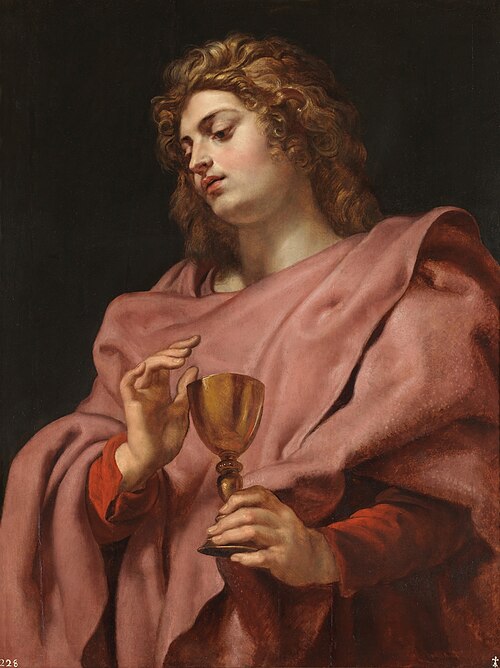
Apostle
John the Theologian
Apostle and Evangelist
The beloved disciple of the Lord, author of the fourth Gospel and Revelation, who died at Ephesus.
- Feast
- September 26old style October 9
- Reposed
- 991st century
- Place
- Ephesus
- Order
- Apostles
Life
The holy Apostle and Evangelist John the Theologian was the disciple whom Jesus loved. The Church honours him as the author of the fourth Gospel, of the three epistles that bear his name, and of the Book of Revelation. He lived to a great old age and reposed in the Lord at Ephesus, toward the end of the first century. Among the immediate disciples of the Lord, only he has received from the Church the name "Theologian".
The beloved disciple
He was the son of Zebedee and of Salome, who according to the synaxarion was a daughter of Saint Joseph the Betrothed, and the brother of the holy Apostle James. The Lord called both brothers by the Sea of Galilee, and they left their father and followed Him. The Lord named them "sons of thunder". John was loved in a special way for his self-sacrificing love and his virginal purity.
John was one of the three apostles closest to Christ: he was present at the raising of the daughter of Jairus and at the Transfiguration on Mount Tabor. At the Mystical Supper he leaned on the Lord's breast and asked who the betrayer was. He followed the bound Lord to the courtyard of the high priests Annas and Caiaphas and then to Golgotha. At the foot of the Cross he stood with the Mother of God and heard the words "Behold thy mother". From then on he cared for the Most Holy Virgin until her Dormition.
Preaching at Ephesus and exile
After the Dormition of the Mother of God, John set out to preach the Gospel at Ephesus and in other cities of Asia Minor, with his disciple Prochorus. Their ship was struck by a storm, and John remained in the depths of the sea. Prochorus reached the shore alone, and on the fourteenth day he saw the waves cast up a man in whom he recognized John, kept alive by the Lord. At Ephesus his preaching was accompanied by so many miracles that the number of believers grew every day.
During a persecution, which the Greek and American Orthodox synaxaria place under Nero, John was brought for trial to Rome and condemned to death. He drank a cup of poison and was unharmed, and came out untouched from a cauldron of boiling oil. He was then sent into exile on the island of Patmos, where he stayed many years, healed the sick, drove the evil spirits from the pagan temples, and enlightened the islanders with the Gospel. Other sources place his exile under the Emperor Domitian.
The Revelation, the Gospel and the epistles
On Patmos, withdrawn with Prochorus to a desolate height and after a three-day fast, John received the revelation that he told his disciple to write down. In this way the Book of Revelation was written, around the year 67 according to the synaxarion, with its prophecies of the trials of the Church and of the end of the world. After his release he returned to Ephesus and taught Christians to beware of false teachers. Around the year 95, at the request of the faithful, he wrote the Gospel, which begins with the words "In the beginning was the Word". The depth of his teaching about the Son of God won him the name Theologian. The eagle, a sign of the height of his thought, is his symbol in iconography.
In his three epistles he speaks of the love of God and of one's neighbour, and for this the Church calls him the Apostle of love. In old age, the Greek synaxarion says, he kept repeating to his disciples, "Little children, love one another", and when they asked why, he answered that it is the Lord's commandment and that if it alone is fulfilled, it is enough. The synaxarion also tells that in old age he went into the wilderness after a young man who had strayed and joined a band of robbers, and brought him back to repentance by his love.
Repose and veneration
Saint John reposed in the Lord when he was more than a hundred years old, the last eyewitness of the earthly life of the Saviour; according to tradition, in the time of Trajan. He was the only one of the apostles who did not die a martyr's death. Before the end he went outside Ephesus with his disciples and told them to dig him a cross-shaped grave. He lay down in it and asked them to cover him with earth. When others later opened the grave, they found it empty. Every year on 8 May a fine dust came out of the tomb, which believers gathered and were healed of sickness.
For this reason the Church celebrates the repose of the Apostle on 26 September and on 8 May commemorates the healing dust from his tomb. The tomb is thought to lie in the former Basilica of Saint John at Ephesus. The Greek synaxarion records that a church of the Theologian stood at the Hebdomon in Constantinople from the fourth century and was rebuilt from its foundations in the ninth century by the Emperor Basil the Macedonian. On Patmos stand the Monastery of Saint John the Theologian and the Cave of the Apocalypse.
Commemorated the same day September 26
 Eusebius of RomeSaint · Bishop of RomeSep 26
 GideonProphet · Judge of IsraelSep 26
 Cyprian and JustinaHoly MartyrsSep 26
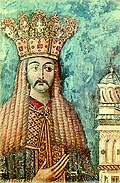 Neagoe BasarabRight-Believing · Prince of WallachiaSep 26
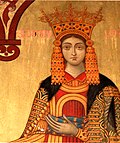 Platonida of ArgeșVenerable · Princess of WallachiaSep 26
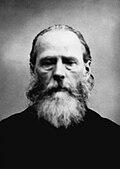 Nikolai GashevHieromartyr · Archpriest in PermSep 26
- Alexander LevitskyHieromartyrSep 26
- AmantiusSaintSep 26
- Athanasius DokukinHieromartyr · Russian priestSep 26
- Colman EloVenerableSep 26
- Colman of Ros BranduibhSaintSep 26
- Demetrius KryuchkovConfessorSep 26