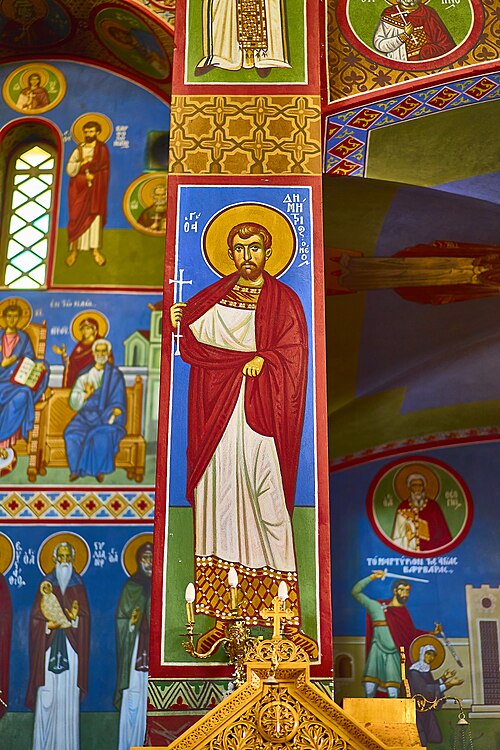
New Martyr
Demetrius the Neomartyr
Greek new martyr born in 1779 and martyred at Tripoli in 1803; commemorated on 14 April.
Life
Holy New Martyr Demetrius was born in 1779 at Floka, in Messenia, in Greece, in the time of Ottoman rule, and was put to death by beheading at Tripolitsa in 1803, after he, having renounced his faith, repented and publicly confessed Christ. He is remembered on 14 April in the Church of Greece and, according to a Serbian source, also on 27 January.
Childhood and fall
Demetrius was a Greek Orthodox boy, born at Floka and raised at Ligoudista, both in Messenia, near the city of Tripolitsa. His mother died when he was very young, and his father, Elias, remarried. Because of ill-treatment by his stepmother, Demetrius left home to seek work at Tripolitsa, where he was apprenticed to a mason. Though baptized and raised a Christian, he accepted Islam, but later repented. He worked for a time as a barber, until the abbot of the monastery of the Precious Forerunner recommended him to a monastery on the island of Chios, where he stayed for a while.
Confession and martyrdom
Demetrius fell into deep despair when the weight of his sin settled fully upon him and decided that, to atone for the fault, he must do a great penance: to return to Tripolitsa and confess publicly that he renounced his conversion to Islam. The abbot tried to stop him, in vain, and Demetrius returned to Tripolitsa and publicly confessed his return to Christianity several times. Among other things, he went to his former barber master and asked him to cut his throat on the spot, but neither the master nor the other barbers did so. Since even so nothing came of it, he went to the guards of a leader nearby and told them he had apostatized, and was detained.
Demetrius was taken before a Turkish judge, tried for apostasy from Islam, found guilty and sentenced to death in 1803, despite the pleading of a Turkish friend, who tried to defend him by altering the record of Demetrius's confession. Demetrius noticed and demanded to be put to death, paying no heed to the judge's own wish to let him go. At last Demetrius was taken to the market of the city (it is said that he went cheerfully singing Christian hymns) and was put to death in the sight of all by beheading. Though it had been ordered that he be burned, his severed head and body were hidden and preserved by the local Christians as relics.
Commemorated the same day April 14
 Martin the ConfessorConfessor · Bishop of RomeApr 14
 Anthony, John and Eustathius of VilniusHoly Martyrs · Martyrs of VilniusApr 14
 Dimitri KipianiSaint · Georgian statesmanApr 14
 Thomais of AlexandriaMartyr · Martyr of AlexandriaApr 14
- Lambert of LyonSaint · Bishop of LyonApr 14
 TassachSaintApr 14
- Alexander OrlovConfessor · PriestApr 14
- Abundius the SacristanSaintApr 14
 AnthonySaintApr 14
- Anthony of VilniusMartyrApr 14
- ArdalionMartyr · ActorApr 14
- Azat of PersiaMartyrApr 14