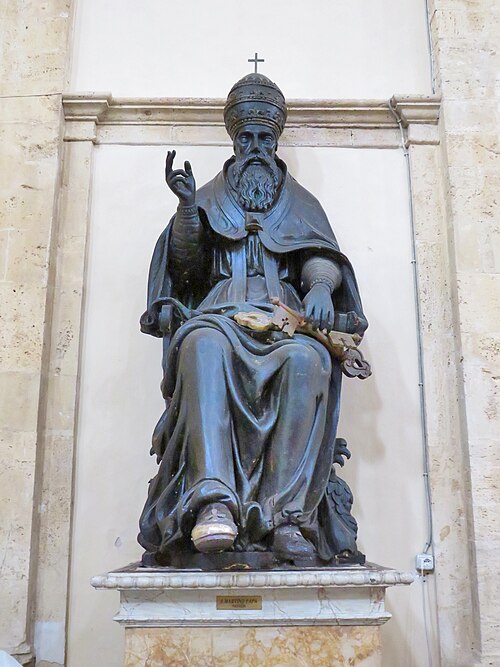
Confessor
Martin the Confessor
Bishop of Rome
Bishop of Rome from 649 to 653, exiled to Cherson for defending the faith against Monothelitism.
- Feast
- April 14old style April 27
- Reposed
- 6557th century
- Place
- Chersonesus
- Order
- Confessors
Life
Saint Martin the Confessor was bishop of Rome from July 649 until 653 or 654. He suffered persecution, trial and exile because he defended the Orthodox faith against Monothelitism, the heresy that confessed only one will in Christ, and he died far from his flock at Cherson in Crimea. The Orthodox Church honours him as a confessor of the right faith.
He was born near Todi in Umbria, sometime between 590 and 600. He was of noble birth, keen of mind and charitable to the poor. He served as an abbot, then as envoy of Pope Theodore I to Constantinople, where he came to know the theological troubles of the time at first hand. In 649 he was elected bishop of Rome without waiting for the consent of Emperor Constans II.
At that time the Church was troubled by Monothelitism, which the emperor and Patriarch Paul of Constantinople embraced. Constans had issued the Typos, a decree forbidding any discussion about the wills of Christ. In October 649 Martin gathered the Lateran synod, attended by 105 bishops, which condemned Monothelitism, the Ecthesis and the Typos. He also wrote to Patriarch Paul, urging him to return to the Orthodox faith.
The enraged emperor ordered his trial. According to his life in the synaxarion, the soldier sent by Olympius to murder him was struck blind as he approached. In June 653 the exarch Theodore Calliopas took him from the Lateran together with Saint Maximus the Confessor. Sick, he was carried to Naxos, where he spent a year amid privation and abuse, and then to Constantinople, where he arrived on 17 September 653.
He was accused of secret dealings with the Saracens, of blasphemy against the Theotokos, and of taking the throne uncanonically. His judges did not listen to him; false witnesses slandered him and the crowd shouted anathema against him. He was sentenced to be deposed and put to death. Patriarch Paul, himself ill, asked that the torments be stopped. The death sentence was changed to exile at Cherson. Meanwhile the Romans had been forced to elect another bishop, Eugene, on 10 August 654, and Martin accepted this.
He reached Cherson on 15 May 655. His letters from exile show the sorrow of abandonment and hunger. He reposed in the Lord on 16 September 655 and was buried near the city, in the church of the Mother of God at Blachernae. Miracles took place at his tomb, and his relics were later moved to Rome, to a church dedicated to Martin of Tours. The transfer of the relics is commemorated on 12 November.
The decisions for which he suffered were confirmed by the Sixth Ecumenical Council in 680. Slavic churches and the Romanian Church commemorate him on 14 April, and Greek usage on 13 April and 20 September.
Commemorated the same day April 14
 Anthony, John and Eustathius of VilniusHoly Martyrs · Martyrs of VilniusApr 14
 Dimitri KipianiSaint · Georgian statesmanApr 14
 Thomais of AlexandriaMartyr · Martyr of AlexandriaApr 14
- Lambert of LyonSaint · Bishop of LyonApr 14
 TassachSaintApr 14
 Demetrius the NeomartyrNew MartyrApr 14
- Alexander OrlovConfessor · PriestApr 14
- Abundius the SacristanSaintApr 14
 AnthonySaintApr 14
- Anthony of VilniusMartyrApr 14
- ArdalionMartyr · ActorApr 14
- Azat of PersiaMartyrApr 14