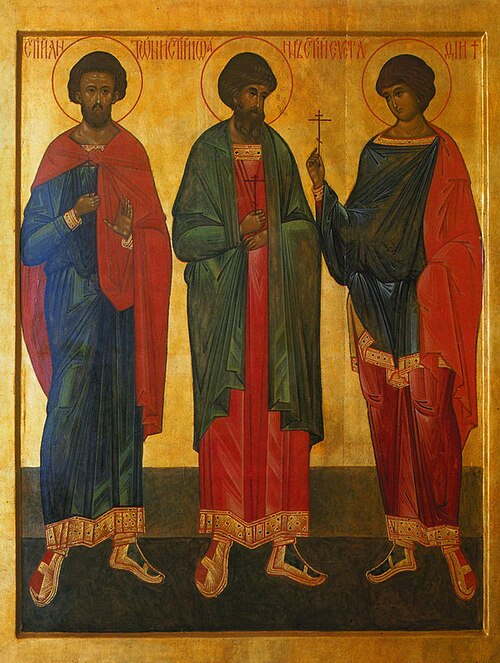
Holy Martyrs
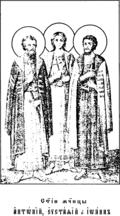
Anthony, John and Eustathius of Vilnius
Martyrs of Vilnius
Orthodox martyrs put to death at Vilnius in the fourteenth century, around 1347.
Life
The holy martyrs Anthony, John and Eustathius of Vilnius were three Lithuanian courtiers of the Grand Duke Algirdas, baptized from paganism into the Orthodox faith and put to death for Christ in 1347. They are honoured by the Orthodox Church, which commemorates them on 14 April and on 13 July.
Their life
Before baptism they were named Kumetis, Nežilas and Krulis. Kumetis and Nežilas were brothers, and Krulis was their cousin. They came from the pagan Baltic world and served at the court of Algirdas, Grand Duke of Lithuania. Algirdas had been married to an Orthodox princess, Maria of Vitebsk, who had brought with her a priest named Nestor. Maria asked for an Orthodox church to be built, and in this church the three were baptized by Nestor and received the names Anthony (Kumetis), John (Nežilas) and Eustathius (Krulis). After Maria's death Algirdas again openly supported paganism, along with the pagan priests who were persecuting Christians.
John and Anthony took no part in pagan worship, kept the Orthodox fasts, and did not cut their hair and beards like the pagans. The Lithuanian nobles grew suspicious and questioned them. When Algirdas ordered them to eat meat, they refused, because it was Great Lent. They were tortured and thrown into prison. According to some sources, John yielded to the prince's will for a time but repented, and later declared himself a Christian publicly and was imprisoned again, beside Anthony.
Martyrdom
On 14 April 1347 Anthony was hanged on an oak tree that the pagans held sacred. John was seized by a crowd and strangled, and on 24 April 1347 his body was hung on the same tree. Christians buried them both in the church of Saint Nicholas in Vilnius.
Eustathius, a young man distinguished for courage, intelligence and kindness, declared himself a Christian during the Nativity Fast, while on a hunt with the prince. He was tortured for three days, his legs were broken, his hair was cut away with the skin, his nose and ears were cut off, and he was hanged on the same oak on 13 December 1347. It is said that the beasts did not touch his body for three days. The newly enlightened sons of the persecutor took it secretly and brought it to Vilnius, where it was laid beside John and Anthony.
The Christians cut down the oak and built on the spot a church dedicated to the Holy Trinity, where a monastery of the Holy Trinity later stood, and from the stump of the oak they made the holy table.
Veneration and relics
Their relics were found incorrupt. Veneration spread in western Rus and in Lithuania, and in 1374 portions of the relics were carried to Constantinople, where Patriarch Philotheus canonized them. The patriarch sent a cross containing relics to Saint Sergius of Radonezh. A service and a life of them were composed in Greek, and veneration throughout the Russian Church was established by the Council of 1549.
The relics are kept at the Monastery of the Holy Spirit in Vilnius, in the crypt chapel under the altar of the cathedral. On 9 August 1915, as the Germans advanced, they were taken to Moscow. In 1947 they were brought back to Vilnius, in 1997 they were placed again in the Monastery of the Holy Spirit, and today they rest in the cathedral's main sanctuary. On 13 July the day of their return is commemorated.
Commemorated the same day April 14
 Martin the ConfessorConfessor · Bishop of RomeApr 14
 Dimitri KipianiSaint · Georgian statesmanApr 14
 Thomais of AlexandriaMartyr · Martyr of AlexandriaApr 14
- Lambert of LyonSaint · Bishop of LyonApr 14
 TassachSaintApr 14
 Demetrius the NeomartyrNew MartyrApr 14
- Alexander OrlovConfessor · PriestApr 14
- Abundius the SacristanSaintApr 14
 AnthonySaintApr 14
- Anthony of VilniusMartyrApr 14
- ArdalionMartyr · ActorApr 14
- Azat of PersiaMartyrApr 14