Martyr
Anthony of Vilnius
A martyr of Vilnius in Lithuania, put to death for his faith in Christ.
Life
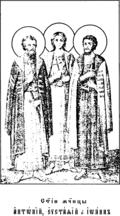
Holy Martyr Anthony of Vilnius (Lithuania) is commemorated together with the Holy Martyrs John and Eustace of Vilnius. They served at the court of the grand prince of Lithuania Algirdas (1345 to 1377) and were put to death in 1347. They are commemorated on 27 April and on 11 July, in the Synaxis of the Saints of Belarus.
Algirdas and the brothers
Algirdas accepted Christianity out of calculation, so as to marry an Orthodox princess of Vitebsk, Maria Yaroslavna (died 1346), and enlarge his domains. At first the prince supported the Orthodox faith: he allowed the priest Nestor, confessor of Princess Maria, to preach and allowed several churches to be built, two at Vitebsk and one at Vilnius, in honour of the Holy Martyr Paraskeva. Father Nestor turned several pagan Lithuanian courtiers to Orthodoxy. Among them were two brothers of the local nobility, Nezhilo and Kumets, named at Baptism Anthony and John. After his wife's death Algirdas, under pressure of the pagan Lithuanian priests, who had great influence over the people, renounced Christianity and again worshipped idols. Saints Anthony and John went on keeping all the Christian customs, among others they did not eat meat on fast days. The priests demanded that the grand prince punish them. Algirdas urged them to abandon Christianity, but the brothers did not change their faith. Then the prince, angered, ordered them thrown into prison. A whole year they languished in captivity. The younger, Saint Anthony, bore it with courage and patience, while the elder, John, could not endure the trial: secretly from his brother, he told Algirdas that he was ready to submit to his will, if only freedom were given him. Glad of his denial, the prince released not only John but also Saint Anthony. John, although outwardly he performed the pagan rites and customs, in his heart remained a Christian. Saint Anthony, however, by his whole manner of life openly confessed Orthodoxy. He rebuked his brother for weakness and fear and urged him to repent and openly confess the Name of Christ again.
The test at the table
Once, at the prince's table, to which the holy brothers had also been invited, a meat dish was served. John, although it was a fast day, for fear of torments did not dare refuse the meat. Anthony, however, openly confessing himself a Christian, refused the meat. The prince, angered, threw Anthony into prison again. The brother who had denied stayed free, but with him, as with a traitor, not only Christians but pagans too ceased to speak. John realised his grave sin and began to repent with tears of his weakness. Saint Anthony told him that brotherly relations could exist between them only if he openly confessed faith in the Lord Jesus Christ. John sought a suitable occasion and, when the prince was surrounded by a great crowd of courtiers, confessed himself a Christian aloud. This filled Algirdas and all present with such fury that they at once cruelly beat the confessor, and by the prince's order he was thrown into the same prison where his brother was. Crowds of people came to the prison to see the fearless confessors. The power of the truth they preached, their unshaken faith and their firmness in confinement so struck the people that many received Baptism. The pagan priests demanded that Algirdas kill the saints, to cut short the faith of Christ spreading quickly. The grand prince yielded, but decided first to execute Anthony alone, hoping that John would again deny Christianity.
Martyrdom
The whole night before the execution Saint Anthony spent in prayer, thanking God for the martyr's crown and asking Him to strengthen his brother in the trials awaiting him. In the morning, on 14 April, both martyrs received the Holy Mysteries, then Saint Anthony was led to death. The pagans hanged him on an oak. Saint John remained unshaken in the faith and went on preaching to the people gathering at the prison. The enraged pagans dealt with him cruelly: on 24 April 1347 they first strangled him and then, dead, hanged him on the same oak, as Anthony had foretold before his death. The bodies of the holy martyrs were buried with honour by the Christians in the church of Saint Nicholas the Wonderworker.
Eustace
The martyrs' death of Saints Anthony and John bore spiritual fruit. A relative of the saints, Kruglets, a courtier of Prince Algirdas, shaken by the martyrs' firmness, received Baptism from the priest Nestor with the name Eustace. After Baptism he led a truly Christian life, fulfilling all the rules of the Orthodox Church. Once the grand prince, who loved the young courtier greatly, noticed that he had let his hair grow and asked whether he was a Christian; Eustace openly confessed himself a Christian. The prince grew angry and wished to turn him from the faith of Christ, forcing him to eat meat. It was a Friday of the Nativity Fast. The holy martyr refused. Then Algirdas ordered him beaten with iron rods. He did nothing but glorify and thank God for having made him worthy to suffer for His holy Name. The embittered prince ordered him brought out naked in a hard frost and ice-cold water poured into his mouth. The sufferer's body turned blue with cold, his breathing sometimes stopped, but he bore this torment too with God's help. Algirdas, in rage, ordered the bones of his legs crushed from the soles to the knees, the skin torn from his head with the hair, his ears and nose cut off. So they tormented him for three days. Saint Eustace comforted the Christians who wept at seeing his torments: "Do not weep for me, brethren, that this earthly dwelling of my soul is being destroyed, for soon I hope to receive for it from the Lord a dwelling not made with hands in heaven."
Algirdas sentenced him to death. The holy martyr, although his legs were crushed, strengthened by God's help, went to the place of execution so briskly that the torturers leading him could hardly keep up with him, amazed at the evident wonder. On 13 December 1347 Saint Eustace was hanged on the same oak as his kinsmen, saints Anthony and John. His honoured body was left on the tree close to the ground, so that wild beasts and birds of prey might eat it, but no beast and no bird could approach the body: a pillar of cloud guarded it from predators. After three days the remains of Saint Eustace were buried in the church of Saint Nicholas, beside the bodies of the holy brothers Anthony and John. On the spot where the oak had grown a church in the name of the Holy Trinity was later raised. At the moving of the bodies of the holy passion-bearers to this church their relics were found incorrupt, and miracles and healings came from them. At the request of the Orthodox Lithuanians, Saint Alexis, Metropolitan of Moscow (died 1378), appealed to Patriarch Philotheus of Constantinople to bless the numbering of the martyrs among the saints. The patriarch already in 1364 sent to Venerable Sergius of Radonezh a cross with relics of Saints Anthony, John and Eustace.
Veneration
The martyrs' struggle had great significance for all of Lithuania. Prince Algirdas himself returned to the Christian faith and at the end of his life took monastic vows. All his twelve sons were Christians. By the end of the fourteenth century half the inhabitants of Vilnius professed Orthodoxy. Later, over the centuries, the relics of the holy passion-bearers were not only glorified by the miracles that came from them, but also endured many trials. In 1915, at the German advance, the holy relics, as the most precious treasures of Orthodoxy in the Baltic region, were taken to Moscow by Metropolitan Tikhon, later patriarch. In the memory of the believers of Vilnius there live to this day the sad memories of parting with the holy martyrs and the joyful memories of the solemn welcome of the relics of Saints Anthony, John and Eustace in 1946, in the Holy Spirit Monastery in Vilnius. The date of their return, 13 (26) July, has since been solemnly kept every year in this monastery.
Commemorated the same day April 14
 Martin the ConfessorConfessor · Bishop of RomeApr 14
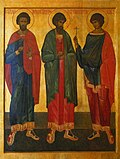 Anthony, John and Eustathius of VilniusHoly Martyrs · Martyrs of VilniusApr 14
 Dimitri KipianiSaint · Georgian statesmanApr 14
 Thomais of AlexandriaMartyr · Martyr of AlexandriaApr 14
- Lambert of LyonSaint · Bishop of LyonApr 14
 TassachSaintApr 14
 Demetrius the NeomartyrNew MartyrApr 14
- Alexander OrlovConfessor · PriestApr 14
- Abundius the SacristanSaintApr 14
 AnthonySaintApr 14
- ArdalionMartyr · ActorApr 14
- Azat of PersiaMartyrApr 14