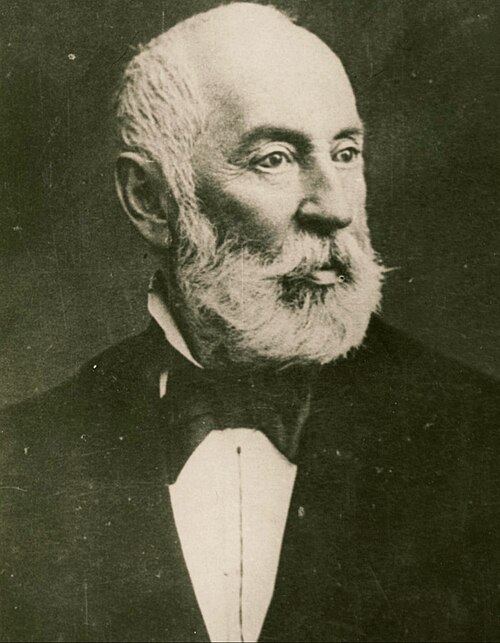
Saint
Dimitri Kipiani
Georgian statesman
Georgian statesman, publicist, writer and translator, leader of the liberal nobility; died in 1887.
- Feast
- April 14old style April 27
- Reposed
- 188719th century
- Place
- Stavropol
Life
Prince Dimitri Kipiani was a Georgian statesman, publicist, writer and translator, the leader of Georgia's liberal nobility. For defending the Georgian language and culture he was exiled in 1886 and killed in unclear circumstances in 1887. The Synod of the Georgian Orthodox Church numbered him among the saints, as a martyr for his homeland, on 26 April 2007. He is commemorated on 14 April.
Youth
He was born on 14 April 1814 in the village of Mereti near Gori, into a noble family, when Georgia was already part of the Russian Empire. His father, Ivane (Kocho) Kipiani, died early, and his mother, Varvara Purtseladze, could give him only a basic education. When he was eight, his brother Kaikhosro, who worked at the customs in Surami, took him to Tiflis and placed him in the school of the nobility, which he finished in 1830. From 1831 he taught there Georgian and Russian, geography and arithmetic.
In 1832 he took part in the conspiracy of the Georgian nobility against tsarist rule, aimed at winning independence for the country. After the plot was discovered he was exiled to Vologda, where he worked for a time in the governor's chancellery and rose to be secretary and then head of the chancellery.
Service to the state
In 1837, at the request of the governor of Vologda, he was allowed to return to Georgia. He entered state service and until 1864 held various posts in the viceroy's office. In 1854 he was raised to the rank of actual state councillor. He became a known spokesman of the liberal nobility. At the abolition of serfdom in 1861 he was entrusted with negotiating with the Georgian nobility and drawing up the terms of emancipation. Under his plan of 1862 the peasants received no land but were to pay the landowners for its use.
He was marshal of the nobility of Tiflis from 1864 to 1870 and of Kutaisi in 1885 and 1886, and from 1876 to 1879 he was mayor of Tiflis.
For the Georgian language and culture
He took an active part in Georgia's social and cultural life. He was president or vice-president of the Caucasian Agrarian Society and one of the founders of the Society for the Spread of Literacy among Georgians and of the Georgian Dramatic Society. He published essays and articles in the Georgian and Russian press and supported the rediscovery and preservation of Georgian chant. He was the first to translate Shakespeare into Georgian, and he wrote a grammar of the Georgian language, which also carried political weight at a time when the dispute between Georgian intellectuals and the imperial authorities was growing.
Despite his political loyalty, the tsarist officials always viewed him with suspicion. He regarded the Treaty of Georgievsk of 1783 as the only fair model for relations between Georgia and Russia, and he stubbornly defended the Georgian language and culture. In the 1870s he opposed limiting the status of Georgian in state schools. In October 1885, at Borjomi, at a meeting with Grand Duke Michael Nikolayevich, he sharply criticized the viceroy, Prince Dondukov-Korsakov, for persecuting Georgian culture. He drew up a report, but under strong pressure from Saint Petersburg he had to moderate his activity.
Exile and death
In 1886 a student, Ioseb Laghiashvili, was expelled from the Tiflis theological seminary and killed the rector of the seminary, Archpriest Pavel Chudetsky. The Russian exarch of Georgia, Pavel Lebedev, then pronounced an anathema on the Georgian people. Kipiani wrote to him, urging him to leave Georgia in order to save the honour of his office. On 6 August 1886, by order of Alexander III, he was removed from his post and exiled to Stavropol, where he was killed in October 1887 in unclear circumstances. According to other reports, he was killed by robbers.
He was buried in Tiflis, in the Mtatsminda Pantheon, on 8 November, with great honour and a great crowd present. In the funeral oration Akaki Tsereteli called him, like the martyr king of Georgia of the thirteenth century, Demetre the Self-Sacrificer. The funeral became a demonstration of protest against the government. The sculptor Felix Chodorowicz made the monument for his grave.
Veneration
Streets in Tbilisi, Kutaisi and Khashuri bear his name. Akaki Tsereteli dedicated to him the poem "Gantiadi". Since 1990 a house museum has stood in the village of Kvishkheti, and since 2000 a society has existed to study his work. The Synod of the Georgian Orthodox Church numbered him among the saints and martyrs on 26 April 2007.
Commemorated the same day April 14
 Martin the ConfessorConfessor · Bishop of RomeApr 14
 Anthony, John and Eustathius of VilniusHoly Martyrs · Martyrs of VilniusApr 14
 Thomais of AlexandriaMartyr · Martyr of AlexandriaApr 14
- Lambert of LyonSaint · Bishop of LyonApr 14
 TassachSaintApr 14
 Demetrius the NeomartyrNew MartyrApr 14
- Alexander OrlovConfessor · PriestApr 14
- Abundius the SacristanSaintApr 14
 AnthonySaintApr 14
- Anthony of VilniusMartyrApr 14
- ArdalionMartyr · ActorApr 14
- Azat of PersiaMartyrApr 14