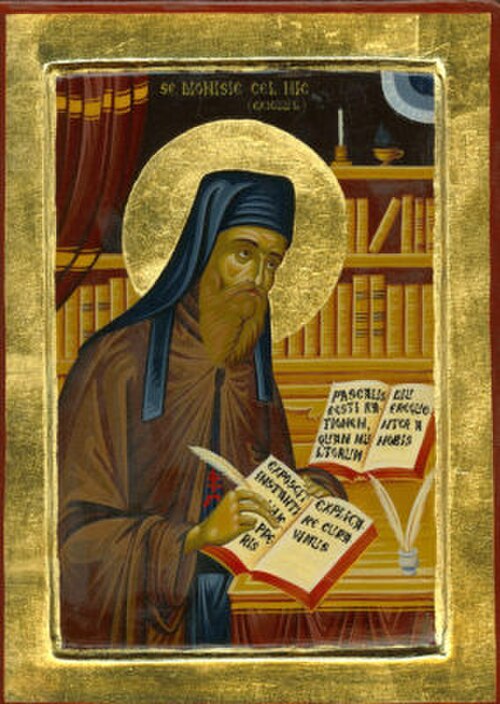
Venerable
Dionysius Exiguus
Monk from Scythia Minor
Monk born in Scythia Minor who lived in Rome and devised the counting of years from the birth of Christ.
- Feast
- September 1old style September 14
- Reposed
- 5446th century
- Place
- Rome
- Order
- Venerables
Life
Venerable Dionysius Exiguus, called Dionysius the Humble or the Small, was a monk born in Scythia Minor, today Dobruja, who lived at Rome and is known for the counting of years from the birth of the Lord Jesus Christ, used today in the Julian and the Gregorian calendars. He translated into Latin collections of canons and writings of the Fathers. The Holy Synod of the Romanian Orthodox Church canonized him at its session of 8 and 9 July 2008, with the feast on 1 September, and the Russian Orthodox Church entered him in its calendar in 2018, on the same day (14 September on the new style).
Origins
He was born around 470 in Scythia Minor, a Byzantine province, today in Romania and Bulgaria. He belonged to the community of Scythian monks gathered at Tomis, today Constanța, the leading city of the province. Cassiodorus, his friend and fellow student, says he was a Scythian by birth but wholly Roman in manners, most skilled in both languages, Latin and Greek, and a perfect scholar of Holy Scripture. The word "Scythian" had a broad sense in the sixth century, and scholars think Dionysius was more likely of Thraco-Roman stock from the region of the Lower Danube, a relative of the general Vitalian.
From the year 500 or a little before, he lived at Rome until the end. Some sources say he was called there in 496, after a stay at Constantinople, and lived in the monastery of Saint Anastasia. Later writers call him a "most learned abbot of the city of Rome", and Bede gave him the title abbas, which means an elder, respected monk. Cassiodorus, however, says he remained an ordinary monk late in life. The name Exiguus, "the Small", shows his humility.
The counting of years
In 525, at the request of Pope John I, Dionysius drew up a table of 95 dates of Easter, for the years 532 to 626, and a set of rules explaining the calculation. The table extended an Alexandrian one, made in the time of Saint Cyril of Alexandria, which stopped at the year 531, and it replaced the table of Victorius of Aquitaine, used at Rome. Dionysius thus followed the principles of Alexandria, set down at the Council of Nicaea.
Until then years were counted from the accession of Emperor Diocletian, in 284. Dionysius did not wish to keep alive the memory of a persecutor of Christians and counted the years "from the Incarnation of our Lord Jesus Christ", saying that the year in which he wrote was 525 after the Incarnation. He does not say in which year of the Roman calendar the Nativity took place, and scholars have argued both for 1 BC and for 1 AD. We now reckon it as off by a few years. Some scholars think he also wished to calm the expectation of an end of the world around the year 500, in the count from the creation.
The system spread slowly: at Rome and in Italy in the seventh century, in England after the Synod of Whitby in 664 and with the help of the Venerable Bede, and among the Franks toward the end of the eighth century, through Alcuin. Almost all the Churches received his table for calculating Easter. The count of years from Christ used today by the whole world owes him its name.
The canons and the translations
Dionysius translated from Greek into Latin four hundred and one canons of the Church, among them the apostolic canons and the decisions of the councils of Nicaea, Constantinople, Chalcedon and Sardica, as well as a collection of decrees of the popes, from Siricius to Anastasius II. The collection, called the Collectio Dionysiana, had great authority in the West and still guides church administration.
He also translated works of the Greek Fathers: On the Making of Man by Saint Gregory of Nyssa, letters of Saint Cyril of Alexandria, the Tome to the Armenians of Patriarch Proclus of Constantinople, the Life of Saint Pachomius the Great, the Wonderful Repentance of Saint Thaïs and the history of the finding of the head of Saint John the Baptist. He also wrote a treatise on elementary mathematics. His friend and companion was Joannes Maxentius, another Scythian monk.
Repose and remembrance
He fell asleep at Rome around 544 or 545 (a Russian source gives an interval between 537 and 556). Many who know nothing of his life use his work every day. The Romanian Orthodox Church honours him as a son of the soil of Dobruja who carried the East to the West, and his troparion says that he showed the course of time after the Nativity of Christ and made known the rules of the holy Fathers.
Commemorated the same day September 1
 JoshuaProphet · Successor of MosesSep 1
 Simeon the StyliteStylite · the ElderSep 1
 GilesVenerable · Abbot in FranceSep 1
 Lupus of SensSaint · Bishop of SensSep 1
 Terentianus of TodiHieromartyr · Bishop of TodiSep 1
 Martha of TambovVenerable · Founder of the Kirsanov ConventSep 1
 Simon MchedlidzeHieromartyr · Priest of Western GeorgiaSep 1
 Tatiana GribkovaVenerable Martyr · NunSep 1
 Innocent TikhonovHieromartyr · Archbishop of VinnytsiaSep 1
 Priscus of CapuaSaint · BishopSep 1
 Regulus of AfricaHieromartyr · African bishopSep 1
 AdamantinaMartyrSep 1