Stylite
Simeon the Stylite
the Elder
Syrian ascetic who lived for decades on top of a pillar near Antioch, died in 459.
- Feast
- September 1old style September 14
- Reposed
- 4595th century
- Place
- Church of Saint Simeon Stylites
- Order
- Stylites
Life
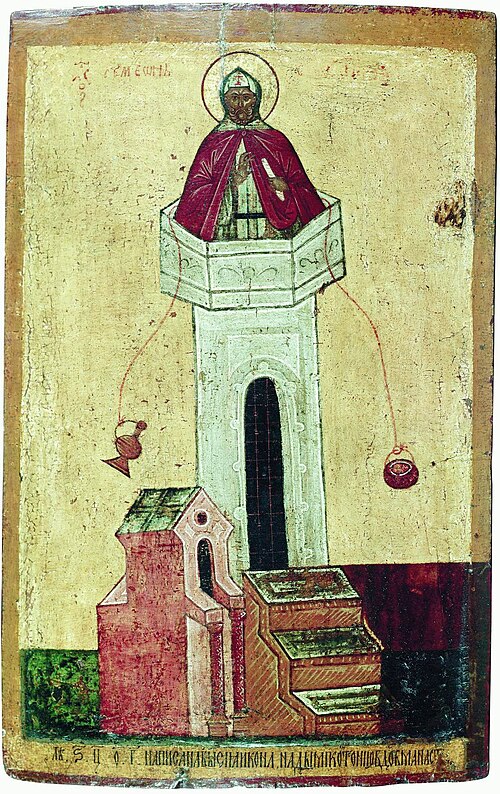
Venerable Simeon the Stylite, called the Elder, was a Syrian ascetic of the fifth century who lived for almost four decades on top of a pillar near Antioch. He opened a new form of ascetic struggle, stylitism, which many followed after him. The Orthodox Church commemorates him on 1 September, and his repose is placed on 2 September 459.
Youth
He was born around 389 at Sis, on the border between Cilicia and Syria, to Christian shepherd parents named Sisotian and Martha. From the age of thirteen he tended his father's flock. Hearing the Beatitudes in church, he was struck by their depth and asked an experienced elder to explain them. The word fell on good soil and strengthened his resolve to serve God.
At eighteen he received the monastic tonsure. His struggles were so severe that the abbot told him either to moderate them or to leave the monastery. Simeon withdrew to a dry well in the mountains. After a time the abbot was told in a vision to bring him back, but the monk did not stay long, settling in a rocky cave near the village of Galanissa, where he spent three years. There he decided to keep the whole of Great Lent without food or drink, and with God's help he endured it. From then on he kept the fast so every year.
On the pillar
Crowds came to him for healing and for a word of edification. To escape human praise and find his solitude again, he chose a way of struggle that had not been known before. He went up on a low pillar with a small cell on top, and gradually raised its height. Accounts of the final pillar give a height of a few metres, the figures differing from one source to another. The top was a small platform with a parapet. According to some sources the pillar stood at Telanissa, near Antioch.
The elders of the desert, hearing of this new and strange struggle, wished to test whether it came from humility or from pride. They sent messengers to order him to come down, and to drag him down by force if he refused. Simeon showed complete obedience, and the elders told him to stay where he was.
His struggle did not cut him off from the world. Each afternoon he spoke with visitors who climbed a ladder to be within earshot. He wrote letters, guided disciples and addressed the crowds beneath him, speaking out especially against swearing and usury. His teaching was gentle and full of common sense, in contrast to the severity of his own life. Peasants and the people of small towns sought him out as a fair judge in their disputes.
Fame and repose
News of him reached the bishops and the imperial court. Patriarch Domninus II of Antioch visited him, served the Divine Liturgy on the pillar and gave him Holy Communion. The emperor Theodosius II and his wife Eudocia respected him and heeded his counsel. When Simeon fell ill, Theodosius sent three bishops to beg him to come down and be treated by physicians, but he left his healing in God's hands and recovered. The emperor Leo I took notice of a letter of his in favour of the Council of Chalcedon. A witness of the time, Bishop Theodoret of Cyrrhus, wrote about him while he was still alive.
A double wall was raised around the pillar to keep the crowds at a distance. Women were not allowed beyond it, not even his own mother, who had searched long for him. He is said to have told her that if they were worthy, they would see each other in the life to come. She stayed nearby and gave herself to the monastic life. When she died, Simeon asked that her coffin be brought to him, and he bade her farewell with reverence.
The sources differ on how long he stood on the pillar, from 35 to 42 years, usually given as about 37. Simeon fell asleep in the Lord on 2 September 459. A disciple found him bowed in prayer. Patriarch Martyrius of Antioch led the funeral before a great crowd. Antioch and Constantinople contended for his relics, and most of them stayed at Antioch.
Veneration
A great basilica was built around the pillar. Its ruins, called Qal'at Sim'an in Arabic, can still be seen about 30 km north-west of Aleppo: four basilicas radiate from an octagonal court in the shape of a cross, with the base of the pillar at the centre. Portions of his relics are kept at the monasteries of Hilandar and Saint Panteleimon on Mount Athos and at the Moutsiali monastery near Veria. He had many followers, the best known being Simeon the Stylite the Younger, commemorated on 24 May.
Commemorated the same day September 1
 JoshuaProphet · Successor of MosesSep 1
 Dionysius ExiguusVenerable · Monk from Scythia MinorSep 1
 GilesVenerable · Abbot in FranceSep 1
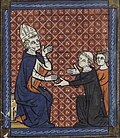 Lupus of SensSaint · Bishop of SensSep 1
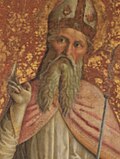 Terentianus of TodiHieromartyr · Bishop of TodiSep 1
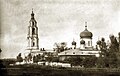 Martha of TambovVenerable · Founder of the Kirsanov ConventSep 1
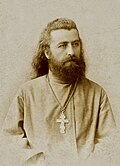 Simon MchedlidzeHieromartyr · Priest of Western GeorgiaSep 1
 Tatiana GribkovaVenerable Martyr · NunSep 1
 Innocent TikhonovHieromartyr · Archbishop of VinnytsiaSep 1
 Priscus of CapuaSaint · BishopSep 1
 Regulus of AfricaHieromartyr · African bishopSep 1
 AdamantinaMartyrSep 1