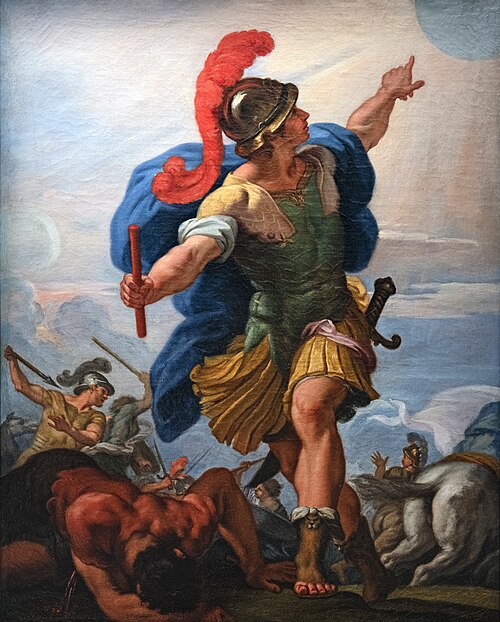
Prophet
Joshua
Successor of Moses
Assistant and successor of Moses, who led Israel into the Promised Land.
- Feast
- September 1old style September 14
- Reposed
- 1245 BC13th century BC
- Place
- Canaan
- Order
- Prophets
Life
The Holy Righteous Joshua, son of Nun (Navi), was the assistant and successor of the Prophet Moses in leading the people of Israel. He led the people across the Jordan into the Promised Land and divided the land among the tribes. His deeds are told in the Book of Joshua, the sixth book of the Old Testament. The Orthodox Church honours him as righteous and as a prophet and commemorates him on 1 September (old style), and his name, Jesus, points to the Saviour, whom he prefigures.
Early life
He came from the tribe of Ephraim, the son of Nun, and was born in Egypt before the Exodus. At first he was called Hoshea, meaning Save, and Moses gave him the name Joshua, meaning the Lord is salvation. In Greek and in the Slavic tradition he is called Jesus son of Nun (Navi), to keep him from being confused with our Lord Jesus Christ. The synaxaria place his life between the sixteenth and fifteenth centuries before Christ; the exact dating differs from source to source.
In the year of the Exodus he proved himself brave in the battle with the Amalekites at Rephidim, which he won at the head of the men Moses chose. Moses trusted him fully: Joshua accompanied him up the mountain when the Lord revealed the Law, was with him on the descent, when the people were celebrating around the golden calf, and guarded the Tent of Meeting during the wandering in the wilderness. The Synaxarion says that through this closeness to the man of God Joshua was enlightened in the letter of the Law and prepared for the service that came later.
He was one of the twelve spies Moses sent into Canaan and, with Caleb, the only one who brought a good report, for which these two alone of that generation entered the Promised Land. Before he died, Moses appointed him as his successor, laying his hands on him and blessing him. According to the Synaxarion he was eighty-five when he took up the leadership.
Entering Canaan
After the death of Moses, the Lord told Joshua to cross the Jordan and promised to be with him. The priests carried the ark before the people, and the waters of the Jordan stood still as the Red Sea had for Moses, so that the people crossed as on dry ground. Before the city of Jericho there appeared to him the Commander of the Lord's host, Saint Michael the Archangel, who told him to take off his sandals, for the place was holy. The walls of Jericho fell after the ark was carried around the city for seven days, and Rahab, the woman who had sheltered the spies, was spared and entered the people of Israel.
At Ai the people were first defeated because of the sin of Achan, who had taken from the spoil of Jericho what was devoted to the Lord; once the sin was brought to light, the city was taken. At Gibeon, in the battle against five Amorite kings, Joshua called on the Lord and, according to Scripture, the sun and the moon stood still until the people had defeated their enemies, and the Lord also sent great hailstones on them. Scripture says there was no day like it before or since, when the Lord heeded the voice of a man. Through these victories Joshua secured most of the land.
The division of the land and his end
Joshua divided the land by lot among the twelve tribes, at the gatherings at Gilgal and Shiloh, and the people gave him as his inheritance the city of Timnath-serah in the hill country of Ephraim, where he settled. The Synaxarion says he led Israel for twenty-five years.
Near the end of his life he gathered the elders and chiefs and told them not to mix with the nations of the land, lest they turn away from the Lord. At the assembly at Shechem he took leave of the people and urged them to serve the Lord, saying that he and his house would serve the Lord, and he set up a great stone under an oak by the sanctuary of the Lord as a witness. He died at the age of one hundred and ten, commanding the people to keep the Law of Moses, and was buried at Timnath-serah.
Veneration
The holy Fathers saw in the crossing of the Jordan a foreshadowing of Baptism, and in Joshua, who leads the people into the land of rest, a foreshadowing of Christ. The Orthodox Church commemorates him on 1 September, and on the Sunday of the Holy Forefathers his name is counted among the righteous of the Old Covenant. He is honoured also by the Jews, and in Muslim belief Yusha bin Nun holds a place of respect. Modern scholarship regards the account of the conquest as a theological narrative composed much later, but for the Church the Book of Joshua remains part of Scripture.
Commemorated the same day September 1
 Dionysius ExiguusVenerable · Monk from Scythia MinorSep 1
 Simeon the StyliteStylite · the ElderSep 1
 GilesVenerable · Abbot in FranceSep 1
 Lupus of SensSaint · Bishop of SensSep 1
 Terentianus of TodiHieromartyr · Bishop of TodiSep 1
 Martha of TambovVenerable · Founder of the Kirsanov ConventSep 1
 Simon MchedlidzeHieromartyr · Priest of Western GeorgiaSep 1
 Tatiana GribkovaVenerable Martyr · NunSep 1
 Innocent TikhonovHieromartyr · Archbishop of VinnytsiaSep 1
 Priscus of CapuaSaint · BishopSep 1
 Regulus of AfricaHieromartyr · African bishopSep 1
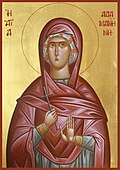 AdamantinaMartyrSep 1