Venerable
Giles
Abbot in France
Hermit of Greek origin, abbot in southern France in the seventh century.
- Feast
- September 1old style September 14
- Reposed
- 7108th century
- Place
- Saint-Gilles
- Order
- Venerables
Life
Saint Giles (Aegidius), according to tradition, was a hermit of Greek origin who lived in southern France in the seventh century, and abbot of a monastery founded in Provence. The story of his life is largely legendary, but his veneration was one of the most widespread in the Middle Ages. He is commemorated on 1 September.
Life according to tradition
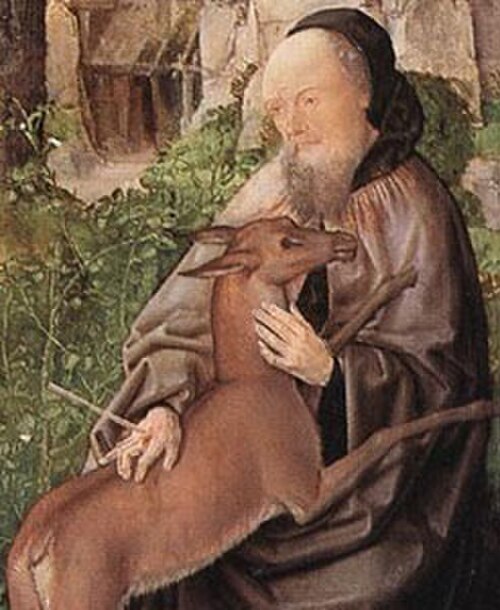
The legend, first written in Latin in the tenth century, says that Giles was born at Athens, son of King Theodore and Queen Pelagia. Historians regard the story as more likely an invention of the hagiographers. He withdrew first to the mouth of the Rhône and the river Gard, in Septimania, then, according to the Golden Legend, near Arles, and later into the deep forest near Nîmes, where he lived many years in solitude. His only companion was a doe which, in some stories, nourished him with her milk.
His refuge was found by the king’s hunters, who were chasing the doe. An arrow meant for the animal wounded the saint, who has since been a patron of the disabled. The king, in the legend Wamba, a Visigoth (which does not fit the period), had great respect for the hermit, who refused all honours except to have a few disciples. The king built him a monastery in his valley, Saint-Gilles-du-Gard, which Giles placed under the Rule of Saint Benedict. He died there at the beginning of the eighth century, with a great reputation for holiness and miracles.
A tenth-century Life tells that, as Giles was serving the Liturgy for the pardon of Charlemagne’s sins, an angel laid on the altar a letter naming a sin so grave that the emperor had never dared confess it. The legend does not fit the period, since Giles lived closer to Charles Martel than to Charlemagne. The story has no historical basis. We know of an abbot Aegidius sent in 514 to Pope Symmachus by Caesarius of Arles, who may be the man at the root of the legend. The tomb in the monastery church at Saint-Gilles bears an inscription from the tenth century.
Veneration
The town of Saint-Gilles-du-Gard grew up around the monastery, which remained the centre of his veneration, especially in Languedoc, and it is now a UNESCO site. He was one of the best-loved saints of the Middle Ages: churches and monasteries bear his name in France, Spain, Germany, Poland, Hungary, Slovakia and Britain, and pilgrims came in crowds to his tomb, on the way to Santiago de Compostela. He is one of the Fourteen Holy Helpers and the only one who was not a martyr, first invoked against the Black Death. In 1562 the relics were secretly taken to Toulouse, to save them from the Huguenots; most returned to the abbey in 1862, and the former tomb was found again in 1865.
In art he is shown with a doe, and the arrow is his emblem. He is patron of those with bodily infirmities and is invoked against childhood fears, convulsions and depression. He is patron of the cities of Edinburgh and Graz; the name of the town of Aiud comes from his dedication. The name Giles spread also as a given name.
Commemorated the same day September 1
 JoshuaProphet · Successor of MosesSep 1
 Dionysius ExiguusVenerable · Monk from Scythia MinorSep 1
 Simeon the StyliteStylite · the ElderSep 1
 Lupus of SensSaint · Bishop of SensSep 1
 Terentianus of TodiHieromartyr · Bishop of TodiSep 1
 Martha of TambovVenerable · Founder of the Kirsanov ConventSep 1
 Simon MchedlidzeHieromartyr · Priest of Western GeorgiaSep 1
 Tatiana GribkovaVenerable Martyr · NunSep 1
 Innocent TikhonovHieromartyr · Archbishop of VinnytsiaSep 1
 Priscus of CapuaSaint · BishopSep 1
 Regulus of AfricaHieromartyr · African bishopSep 1
 AdamantinaMartyrSep 1