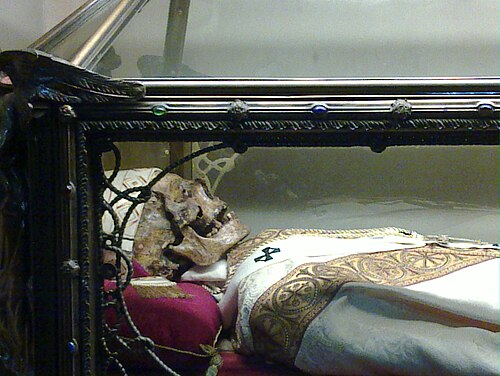
Saint
Dionysius of Milan
Bishop of Milan
Bishop of Milan from 349 to 355, exiled to Cappadocia, where he died around 360.
Life
Saint Dionysius was bishop of Milan from 349 to 355 and suffered exile for the faith of the Council of Nicaea. He departed to the Lord in exile in Cappadocia around 360. He is honoured in both the Orthodox and the Catholic Church, and his feast is 25 May.
Early life
Almost nothing is known of his life before he was elected bishop. He was probably of Greek origin. He is said to have been a friend of the emperor Constantius II before his election as bishop of Milan in 349.
The struggle for the faith of Nicaea
His episcopate fell in the time of the quarrels between the Arians and those who held the faith of the First Council of Nicaea of 325. The emperor Constantius favoured Semi-Arian teachings. In 355, at the request of Pope Liberius, a synod met at Milan in the city's newly built basilica. The emperor entrusted its direction to Arian bishops, among them Ursacius and Valens of Mursa, and their overwhelming number defeated the pope's hopes. The champion of the Nicene faith, Eusebius of Vercelli, was also absent by force at first.
At first Dionysius seemed ready to follow the Arians in condemning Athanasius of Alexandria, who was accused not of heresy but of offence against the emperor. With the arrival of Eusebius the situation changed. Eusebius asked the bishops to sign the Nicene faith at once. Eusebius, the papal legate Lucifer of Cagliari and Dionysius signed, but Valens of Mursa violently tore up the document.
Exile
Constantius, unused to such independence in bishops, moved the synod into his palace. It is related that he sat behind a curtain during the sessions and, when the western bishops protested at the condemnation of Athanasius, threatened them with his sword. Eusebius, Lucifer and Dionysius were harshly treated and all three exiled. Pope Liberius was exiled soon afterward, to Thrace. Dionysius was sent to Caesarea in Cappadocia, and the Arian Auxentius, appointed by the emperor, took his throne at Milan.
The saint died in exile between 360 and 362. A late tradition, without historical foundation, connects him with the Milanese family of the Mariani.
Veneration
According to a late tradition, probably not historical, Saint Ambrose sent a delegation in 375 or 376 to bring back the body of Dionysius to Milan. It is hard to say exactly when his relics were brought there, but an early source says they were in Milan by 744. A shrine in his name near Porta Venezia was destroyed in 1549, rebuilt nearby, and finally pulled down in 1783 to make room for gardens. His relics were moved into the cathedral of Milan in 1532. Three parishes in Lombardy bear his name: San Dionigi in Milan, in Premana and in Carcano di Albavilla.
Commemorated the same day May 25
 Urban ISaint · Bishop of RomeMay 25
 Aldhelm of MalmesburySaint · Bishop of SherborneMay 25
 Zenobius of FlorenceSaint · First Bishop of FlorenceMay 25
 Canius of AtellaHieromartyr · Bishop of AcerenzaMay 25
 Pardus of LarinoSaintMay 25
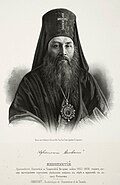 Innocent of KhersonSaint · Archbishop of Kherson and TauridaMay 25
- Dúnchad of IonaVenerable · Abbot of IonaMay 25
 Adela of Orp-le-GrandSaintMay 25
- CelestineMartyrMay 25
- Cruimther Cael of Cill MorVenerableMay 25
- DizanSaintMay 25
- EgilhardMartyrMay 25