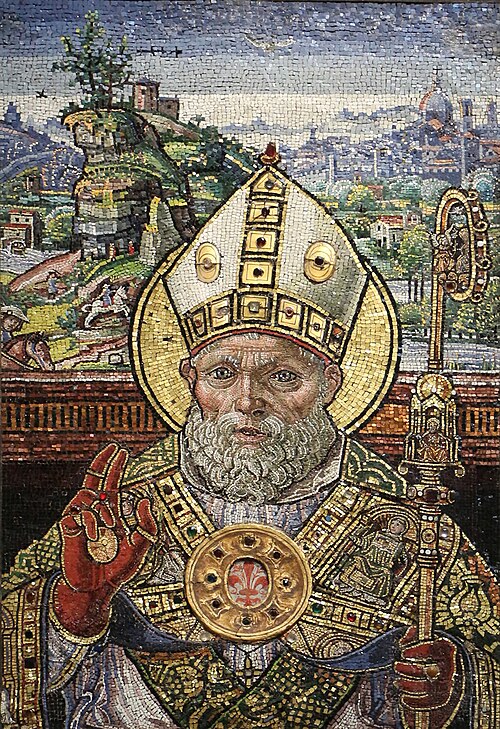
Saint
Zenobius of Florence
First Bishop of Florence
First bishop of Florence, who died in 417, venerated in the West on 25 May.
Life
Saint Zenobius was the first bishop of Florence, in the fourth and the beginning of the fifth century, protector of the city. He fell asleep in 417 or, according to another source, in 424. He is venerated especially in the West and commemorated on 25 May.
He was born into a noble family of Florence, raised by pagan parents. As a young man he came under the influence of Bishop Theodore, who baptised him, and after much resistance he brought his father and mother to Christianity. He entered the clergy and quickly rose to archdeacon; his virtues and his gift for preaching made him known to Saint Ambrose, at whose urging Pope Damasus I called him to Rome and used him in several important missions, among them one to Constantinople. After Damasus's death he returned to his native city and continued his apostolic work; at the death of Bishop Theodore, to the great joy of the people, he was placed in his stead, defeating, according to his life, a candidate of the Arians. He founded a small monastic community; his deacons, Eugene and Crescentius, are venerated as saints. He enlightened Florence and its surroundings and fought Arianism. Tradition says he brought to the city the relics of the holy martyrs Abdon, Sennen, Vitalis and Agricola, although other bishops claim the same honour.
Miracles are told of him, among them several raisings of the dead. Once a child, the only son of a widow, was crushed under the wheels of a cart in a street of the city; the mother brought him weeping to the saint's deacon, and Zenobius, praying, raised him and gave him back to his mother; the scene is painted by Botticelli. It is also said that, after he had raised the deacon Eugene so that Ambrose might know him, Eugene fell asleep a second time after the meeting. His biographer and successor on the see, Antoninus, says he died in the ninetieth year of his life, in 424, but the date is uncertain; there are grounds to believe that he died on 25 May 417, a day on which the ancient tower where he is said to have lived, near the Ponte Vecchio, was decorated every year with flowers.
His body was first buried in the basilica of San Lorenzo in Florence, and in the ninth century Bishop Andrew moved it to the church of Santa Reparata, over which the present cathedral was built. Tradition says that, at this translation, the bier touched a dead elm near the Baptistery and it burst into bloom in midwinter; in memory of it the Colonna di San Zanobi was raised. In the cathedral stands the saint's altar, with the bronze shrine of Ghiberti, from around 1440, which holds the urn with his relics.
Commemorated the same day May 25
 Urban ISaint · Bishop of RomeMay 25
 Aldhelm of MalmesburySaint · Bishop of SherborneMay 25
 Dionysius of MilanSaint · Bishop of MilanMay 25
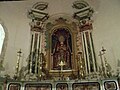 Canius of AtellaHieromartyr · Bishop of AcerenzaMay 25
 Pardus of LarinoSaintMay 25
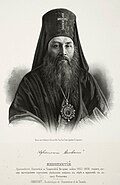 Innocent of KhersonSaint · Archbishop of Kherson and TauridaMay 25
- Dúnchad of IonaVenerable · Abbot of IonaMay 25
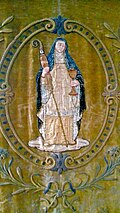 Adela of Orp-le-GrandSaintMay 25
- CelestineMartyrMay 25
- Cruimther Cael of Cill MorVenerableMay 25
- DizanSaintMay 25
- EgilhardMartyrMay 25