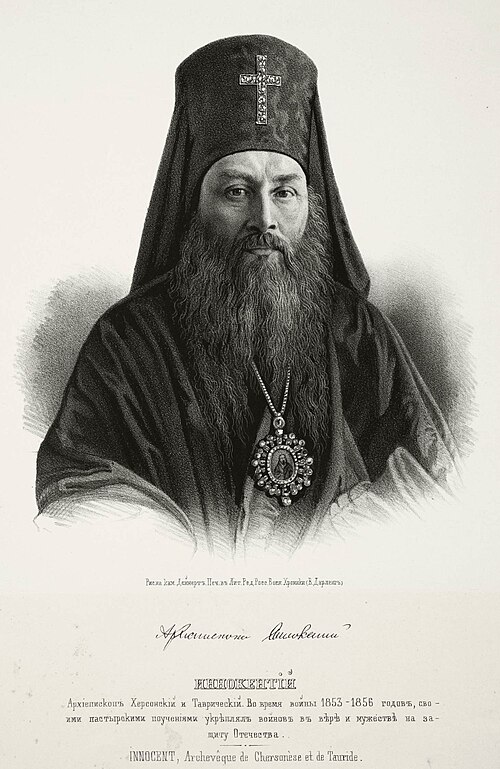
Saint
Innocent of Kherson
Archbishop of Kherson and Taurida
Archbishop of Kherson and Taurida, a renowned preacher and theologian, who died at Odesa in 1857.
Life
Saint Innocent of Kherson, in the world Ivan Alexeyevich Borisov, was one of the greatest preachers and theologians of the Russian Church in the nineteenth century. He lived from 1800 to 1857 and was Archbishop of Kherson and Taurida, with his seat at Odesa, from 1848 until his death.
For his gift of speech he was called "the Russian Chrysostom". The Church honours him as the teacher of a whole generation of theologians, a merciful pastor, and a hierarch who strengthened his flock during the Crimean War.
Family and schooling
Ivan Borisov was born on 15 December 1800 (27 December in the new calendar) in the town of Yelets, Oryol province, in a priest's family. He studied at the district school in Voronezh and finished the Oryol theological seminary in 1819.
At the seminary he shared a desk with Herodion Soloviev, the future Bishop Jeremiah of the Caucasus and the Black Sea, with whom he remained close friends to the end of his life.
At the Kyiv Theological Academy he showed himself early a gifted preacher. Metropolitan Manuel (Lemeshevsky) writes that besides attending lectures he studied a great deal on his own, and sometimes explained a philosopher's teaching to his fellow students more clearly than the professors. Every subject came easily to him, and his fellows unanimously regarded him as the first student of the academy.
In 1823 he completed the academy at the top of his class with the degree of Master of Theology.
Professor in Saint Petersburg
From 28 August 1823 he was inspector and professor of church history and Greek at the Saint Petersburg seminary and at the same time rector of the Saint Alexander Nevsky school. On 10 December 1823 he was tonsured a monk with the name Innocent and ordained hierodeacon, and on 29 December hieromonk.
From 1824 he taught theology at the Saint Petersburg Theological Academy, becoming its inspector in 1825 and extraordinary professor in 1826. On 16 March 1826 he was raised to archimandrite, and in 1829 he received the degree of Doctor of Theology.
Rector in Kyiv
On 27 August 1830 he was appointed rector and professor of theology at the Kyiv Theological Academy. As a teacher he introduced a new historical and comparative way of presenting theology, working directly from the sources and drawing widely on Western theological literature.
In his sixteen years as a professor he taught nearly every branch of theology with great power of exposition and awakened a love of study in his students. In Kyiv he brought an end to the teaching of theology in Latin and introduced new subjects, forming a whole generation of Russian theologians and scholars.
He led the group of professors who compiled a "Dogmatic Collection", used as a textbook, which set out Orthodox teaching from the beginnings of the Church. Some of the more conservative churchmen viewed his work with suspicion, and a secret inquiry into his views ended in his complete vindication.
His book "The Last Days of the Earthly Life of Our Lord Jesus Christ" was judged too liberal and was not reprinted for thirty years. In 1991 it was the first of his books to be published again in modern times.
Bishop of Chyhyryn, Vologda and Kharkiv
On 3 October 1836 he was consecrated Bishop of Chyhyryn, vicar of the diocese of Kyiv and abbot of the Saint Michael Monastery, while remaining rector of the academy. In the same year he became a member of the Russian Academy.
On 1 March 1840 he was appointed Bishop of Vologda and Ustyug. In his short time there he improved the work of the consistory and the church schools, renewed the bishop's residence and the cathedral, and studied the historical monuments of the region.
On 31 December 1840 he was transferred to be Bishop of Kharkiv and Akhtyrka, and on 15 April 1845 he was raised to archbishop. In 1842 he reported to the authorities the book of the historian Nikolai Kostomarov on the church union in western Russia, which he considered hostile to the Orthodox Church. In 1847 he was called to take part in the work of the Holy Synod.
Archbishop of Kherson and Taurida
On 24 February 1848 he was appointed Archbishop of Kherson and Taurida. As ruling bishop he cared both for the livelihood and for the education of the village clergy.
He restored the monasteries of Totma, Akhtyrka, Sviatogorsk and Saint George at Balaklava, opened several sketes in Crimea, established two new solemn processions with the holy icons in Odesa, and built and restored many churches.
Through his efforts a monastic community was founded on the ruins of ancient Chersonesus, the place of Saint Vladimir's baptism. It was destroyed during the siege of Sevastopol, when the French placed batteries and powder stores there, but it was restored and in 1861 became a first-class monastery.
He initiated the cataloguing of monastic libraries and the transfer of manuscripts to the theological academies, as well as the study and restoration of monuments in Crimea, the Caucasus and the other regions he governed.
Friend of the Bulgarians
In Odesa he founded the Bulgarian Board of Trustees and was its first head. Until Bulgaria was freed from Ottoman rule, it gave shelter and education to hundreds of young Bulgarians.
He supported the Bulgarians' desire for their own self-governing Church and channelled Russian help to their churches and schools. He also helped young Bulgarians to study in Russian schools.
The Russian Chrysostom
Metropolitan Manuel (Lemeshevsky) wrote that his true calling was not so much scholarship as the art of the word. His contemporaries praised his bright mind, wide memory, imagination, learning, eloquence and dignified bearing.
His printed sermons spread throughout Russia, and some were translated into French, German, Polish, Serbian, Greek and Armenian. In his art he followed the legacy of Saint John Chrysostom, while also learning from the great Western preachers Bossuet and Massillon.
His collected works, published in Saint Petersburg in 1908 in six volumes, include homilies for the feasts of the Lord and the Mother of God, for saints' days and Sundays, discourses for Great Lent, Holy Week and Bright Week, reflections on death and immortality, lives of the Apostle Paul and Saint Cyprian, talks on nature, and akathists. His meditations for each day of Great Lent have also remained widely read.
During the Crimean War
During the Crimean War Archbishop Innocent showed great courage. He visited the battlefields and Sevastopol, where he crossed the bay under enemy fire on a tugboat, served in field churches, encouraged the soldiers with his sermons and comforted the dying.
After the war he travelled through his diocese, served in the towns that had been damaged, and found means to restore the churches harmed in the fighting. On 26 August 1856 he was appointed a member of the Holy Synod.
Repose
During a journey through his diocese he fell ill and had to return to Odesa. There he reposed on 26 May 1857 (7 June in the new calendar).
Glorification and veneration
In 1997 he was numbered among the locally venerated saints of the diocese of Odesa of the Ukrainian Orthodox Church, and his relics were found at that time. Since June 2007 they have rested in the lower church of the Transfiguration Cathedral in Odesa, consecrated in his honour.
On 8 December 2005, with the blessing of Patriarch Alexy II, his name was entered in the calendar of the Russian Orthodox Church, and on 30 November 2017 the Council of Bishops blessed his veneration throughout the Church. In 2005 the diocese of Edineț and Briceni in Moldova published a collection of his sermons under the title "The Russian Chrysostom".
In 2013 a monument to him was raised beside the cathedral in Odesa, and in 2016 a street in the town of Rozdilna was named after him. Saint Innocent of Kherson is commemorated in May, near the day of his repose.
Commemorated the same day May 25
 Urban ISaint · Bishop of RomeMay 25
 Aldhelm of MalmesburySaint · Bishop of SherborneMay 25
 Zenobius of FlorenceSaint · First Bishop of FlorenceMay 25
 Dionysius of MilanSaint · Bishop of MilanMay 25
 Canius of AtellaHieromartyr · Bishop of AcerenzaMay 25
 Pardus of LarinoSaintMay 25
- Dúnchad of IonaVenerable · Abbot of IonaMay 25
 Adela of Orp-le-GrandSaintMay 25
- CelestineMartyrMay 25
- Cruimther Cael of Cill MorVenerableMay 25
- DizanSaintMay 25
- EgilhardMartyrMay 25