Saint
Eligius of Noyon
Bishop of Noyon
A goldsmith at the Frankish court and later Bishop of Noyon, who reposed around 660.
- Feast
- December 1old style December 14
- Reposed
- 6607th century
- Place
- Noyon
- Order
- Hierarchs
Life
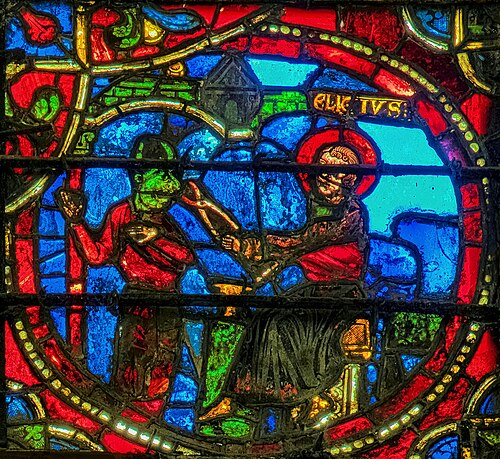
Saint Eligius of Noyon (Eloi) was a goldsmith, a counsellor at the Frankish court and Bishop of Noyon-Tournai. He was born on 11 June 588 at Chaptelat near Limoges in France, of a Gallo-Roman family, and reposed on 1 December 660.
His father, seeing his talent, put him as an apprentice to the goldsmith Abbo, master of the mint at Limoges. He then came to the Frankish court in Neustria, where King Clotaire II entrusted him with a throne of gold adorned with precious stones; from the gold given for one, it is said, he made two, without any fraud. He also made the bas-reliefs for the tomb of Saint Germain of Paris, and the king made him master of the mint at Marseille. His works survived until the French Revolution.
After Clotaire's death in 629, King Dagobert I made him his chief counsellor. His fame grew so much that ambassadors sought his counsel first before going to the king. He induced Judicael of Brittany to make peace with Dagobert at Creil. He used his closeness to the king to obtain alms for the poor and to ransom captives, especially Saxons, brought to the slave market of Marseille. With his friend Audoin (Ouen) of Rouen he lived at court according to the strict Irish monastic rule brought into Gaul by Columbanus. In 632 he founded the monastery of Solignac near Limoges, and a convent in Paris where three hundred virgins were guided by the abbess Aurea. He built the basilica of Saint Paul and restored the basilica of Saint Martial in Paris, and raised fine tombs for the relics of Saint Martin of Tours and Saint Denis.
After Dagobert's death in 639, during the regency of Queen Nanthild, he was ordained priest in 640 and led a successful campaign against simony, which resulted in a royal order forbidding the sale of Church offices. Appointed Bishop of Noyon-Tournai in 642, he founded many monasteries and churches and worked to convert the pagans of Flanders, in the regions around Antwerp, Ghent and Courtrai. A legend tells that he healed a horse possessed by a demon by cutting off its foreleg and miraculously reattaching it. He is the patron of horses and of those who work with them, of goldsmiths and of metalworkers.
He is a saint of the undivided Church and is commemorated on 1 December (New Calendar).
Commemorated the same day December 1
 NahumProphet · The ProphetDec 1
 Simon of CyreneSaint · Bearer of the CrossDec 1
 Castritian of MilanSaint · Bishop of MilanDec 1
 Philaretos the MercifulRighteous · Merciful nobleman of PaphlagoniaDec 1
 Ansanus of SienaMartyr · Patron of SienaDec 1
 BessusMartyr · Of the Theban LegionDec 1
- Ursicinus of BresciaSaint · Bishop of BresciaDec 1
- Anastasia ȘagunaSaint · Mother of St Andrei ȘagunaDec 1
- Agericus of VerdunSaint · Bishop of VerdunDec 1
- Ananias of ArbelaMartyrDec 1
- Ananias of PersiaMartyrDec 1
- Anthony the NewVenerableDec 1