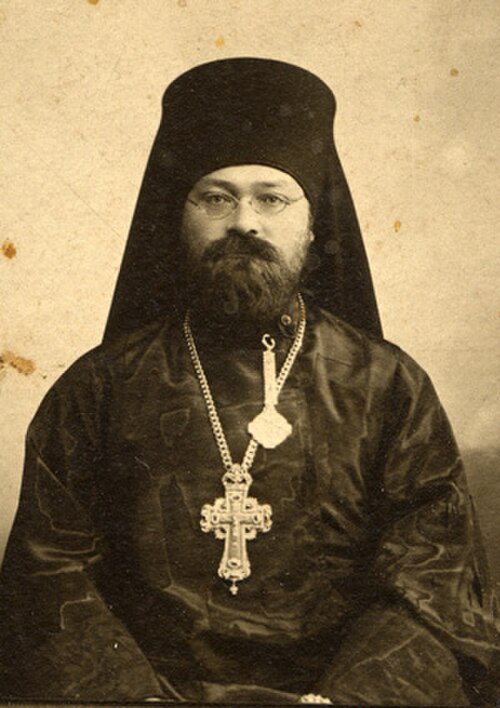
Hieromartyr
Ephraim Kuznetsov
Bishop of Selenga
Bishop of Selenga and vicar of the Transbaikal diocese, who died a martyr in Moscow in 1918.
Life
Saint Ephraim Kuznetsov, the Hieromartyr (1875 to 1918), was bishop of Selenga, vicar of the Transbaikal diocese and a missionary among the Buryats and Koreans of eastern Siberia. He took part as a delegate in the Local Council of the Russian Church of 1917 and 1918 and was shot as a hostage in Moscow on 5 September 1918, on the first day of the Red Terror, together with Archpriest John Vostorgov and other hostages. The Russian Church canonized him in 2000.
Childhood and studies
He was born on 10 May 1875 into a family of Transbaikal Cossacks in the stanitsa of Krasnoyarovskaya, in the Nerchinsk district. His baptismal name was Epiphanius Andreevich Kuznetsov. His father died when he was five, and he lived in bleak poverty with his mother, Evdokia Efremovna, and his younger sister, Lydia. Before his death his father urged him to study. He received his basic education at the village school. The parish priest presented him, when Archbishop Veniamin Blagonravov of Irkutsk passed through their stanitsa, and asked him on his knees to accept the boy at least with half support at the theological school. The archbishop granted the request.
He later recalled that the Lord had sent him orphanhood in childhood, with its poverty, want and illness, but that this cross taught him humility, patience and compassion for his neighbour's suffering. He graduated from the Nerchinsk theological school in 1890, the Irkutsk seminary in 1896 and the Kazan Theological Academy, in the missionary group of the Mongolian section, with the degree of candidate in theology, in 1903. His candidate's thesis, "The History of the Christian Enlightenment of the Peoples of Transbaikalia from the Conquest of the Region to the Present", was praised by the reviewer as a fine and carefully thought-out work.
Village priest and missionary
After seminary he married Maria Vasilievna Sokoshneva, the eighteen-year-old daughter of townspeople of Irkutsk. On 2 August 1896 he was ordained deacon, and on 4 August priest. He served at the church of the Protection of the Mother of God in the village of Kokuy, in the Transbaikal diocese. In 1898 their daughter Elena was born, and his wife died. He then decided to become a missionary.
In 1903 he was sent to the Byrtsyn mission camp, then became chairman of the council of the central mission school in Chita and assistant head of the spiritual mission. From August 1905 he was head of the Transbaikal Spiritual Mission. He zealously resisted the attempts of the Lamaist clergy to induce locals baptized earlier to renounce Christianity. He was inspector of the teachers' courses at the mission school, a member of the diocesan school council, editor of the "Transbaikal Diocesan Gazette", chairman of the examination commission of those seeking to become priests, deacons or readers, and treasurer-member of the brotherhood of Saints Cyril and Methodius and of that of Saint Innocent of Irkutsk.
On his initiative a two-storey building was erected at Chita for the mission school, with four classes, a model school for a hundred and fifty pupils, a boarding house for a hundred and twenty and two flats for the teacher and the director. On the upper floor was a house church of the Saviour's Transfiguration. The school grew from an elementary school into a lower educational institution of the church department. Here readers and deacons were trained for the mission camps, and the Buryat language, the history and the practice of mission were taught.
On 29 April 1907 he was raised to archpriest. In 1908 he was chairman of the Transbaikal branch of the Union of Michael the Archangel, a right-wing organization. In 1909, at the All-Russian Congress of Russian People, he was a rapporteur and one of the secretaries of the section on church questions and called for increasing the strictness of the law toward Jews. On 17 October 1909 he was tonsured a monk, and on 25 October raised to archimandrite.
In 1910 he led the process of conversion to Orthodoxy of the Koreans who had fled to Russia after Japan annexed their country, and himself worked as a missionary among them. For the religious and moral enlightenment of the Koreans and for their learning Russian, he opened in Chita a catechetical school with a boarding house, which was also a centre of the Korean community. In 1911 it was decided to publish the journal "Orthodoxy" in Korean. In 1913, with the well-known preacher Archpriest I. I. Vostorgov, he visited Mongolia to learn the conditions for opening an Orthodox mission there, but the plan was not realized because of the First World War. He was editor of the unofficial section of the diocesan gazette (1913 to 1917), chairman of the committee for collecting aid for the Orthodox and Russian Uniates of Bukovina and Galicia (1914) and a collaborating member of the Imperial Orthodox Palestine Society (1916). He received several church distinctions, among them the pectoral cross (1909) and the Order of Saint Anne second class (1914).
Bishop
From 20 November 1916 he was bishop of Selenga, vicar of the Transbaikal diocese, a see established that year for better organization of missionary work. After the February revolution the liberal part of the Transbaikal clergy and society demanded his resignation, because he had shown himself by all his past activity to be a fierce reactionary and an organizer of the "Black Hundreds", but the Holy Synod did not accept these demands. In 1918 he went to Moscow to take part in the Local Council as substitute for Bishop Meletius (Zaborovsky). He took part in the second session, in section III, and gave a report in which he regarded the events being lived through as God's punishment for the pride, unbelief and rebellion of whole categories of people in public, state and church service, saying that it would not be easier for the Church even when today's persecutors left the stage.
Arrest and killing
During the Council he lived in the home of Archpriest John Vostorgov, where he was arrested by the Cheka on 2 June. On 5 September 1918, together with Vostorgov, the former senator Stepan Beletsky, the former interior ministers Nikolai Maklakov and Alexei Khvostov, the chairman of the State Council Ivan Shcheglovitov and others, he was publicly executed as a hostage, without trial, in Petrovsky Park (by other accounts near the Bratskoe cemetery or on Khodynka field), on the first day after the announcement of the Red Terror. At Vostorgov's request, the executioners allowed the condemned to pray and say farewell. All knelt and prayed fervently, then came in turn for the blessing of Bishop Ephraim and Father John. He was buried in an unknown common grave at the place of execution.
Glorification
On 1 November 1981 the Bishops' Council of the Russian Church Outside Russia canonized the Synaxis of the New Martyrs and Confessors of Russia, without names, and Bishop Ephraim was later included among them, with commemoration on 22 August. In August 2000 the Jubilee Bishops' Council of the Russian Orthodox Church numbered him among the New Martyrs of Russia for veneration throughout the Church. He is commemorated on 23 August (5 September by the new calendar). He left several works on the Transbaikal mission, among them a survey of the Spiritual Mission's activity over forty years (1860 to 1899), a study of the Buryats and their capacity to receive Christianity, a defence of the Orthodox mission against paganism (1907), a book on the holy place Irgen and accounts of the Irgen icon of the Holy Great Martyr Paraskeva.
Commemorated the same day August 23
 Irenaeus of LyonsHieromartyr · Bishop of LyonsAug 23
 Callinicus I of ConstantinopleSaint · Patriarch of ConstantinopleAug 23
- Zacchaeus of JerusalemSaint · Bishop of JerusalemAug 23
 Lupus of NovaeMartyr · Servant of Saint DemetriusAug 23
 Tydfil of MerthyrMartyr · Welsh martyrAug 23
 Asterius, Claudius and NeonHoly MartyrsAug 23
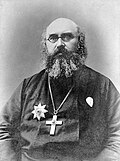 John VostorgovHieromartyr · Archpriest, preacher and missionaryAug 23
- Cyriacus of OstiaHieromartyr · Bishop of OstiaAug 23
- Anthony of GeraceSaintAug 23
 Nicholas VarzhanskyMartyrAug 23
- Antonios of SardisSaint · Bishop of SardisAug 23
- 38 Martyrs of ThraceMartyrAug 23