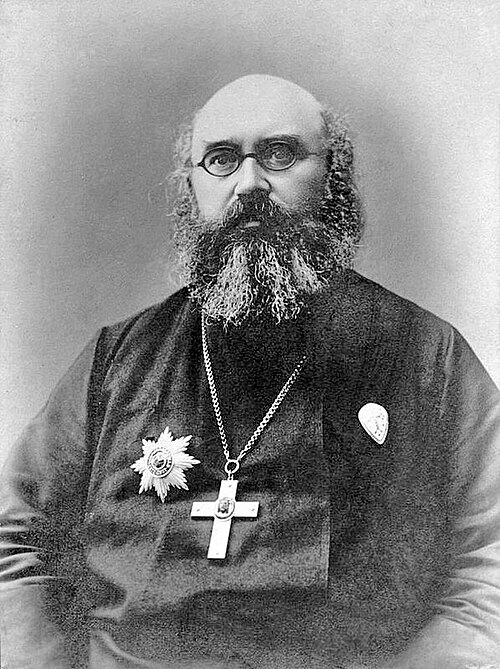
Hieromartyr
John Vostorgov
Archpriest, preacher and missionary
Archpriest of the Russian Church, preacher, church writer and missionary, who died a martyr in Moscow in 1918.
Life
The Hieromartyr John Vostorgov was an archpriest of the Russian Church, one of the best known preachers of his day, a church writer and a tireless missionary in the Caucasus, Siberia and the Far East. He was also a prominent figure in the monarchist movement. He was shot by the Bolsheviks in Moscow on 5 September 1918, among the first victims of the Red Terror. The Church honours him among the New Martyrs and Confessors of Russia.
Origins and early ministry
He was born in 1864, on 20 January Old Style, in the Cossack settlement of Kavkazskaya in the Kuban, into the family of the priest John Alexandrovich Vostorgov and his wife Tatiana. His grandfather, Alexander Vostorgov, had been a master of theology and a professor at the Vladimir seminary. He was orphaned early.
In 1887 he graduated from the Stavropol Theological Seminary. In August of that year he became supervisor at the Stavropol theological school, and from September taught Russian and Church Slavonic there. He married Elena Evplovna Makovkina, who reposed in 1915.
On 1 August 1889 he was ordained deacon for the Church of the Archangel Michael in the village of Kirpilskoye in the Kuban region, and on 6 August priest. At his own expense he opened a parish school and a temperance society in the village and preached a great deal. The young priest's work led many local Old Believers to unite with the Orthodox Church.
From 1890 he inspected the parish schools of a Kuban deanery, then taught religion at the Stavropol boys' gymnasium and from 1891 was rector of its church. From 1893 he sat on the council of the diocesan girls' school and on the board of the Stavropol seminary.
In Transcaucasia
In October 1894 he became religion teacher at the gymnasium in Elisavetpol, today Ganja, and from 1896 also secretary of its teaching council. In 1897 he moved to Tiflis as religion teacher at the First Girls' Gymnasium of Grand Duchess Olga Feodorovna and rector of its church of Saint Olga, and from 1898 also at the First Boys' Classical Gymnasium.
In 1900, in a district of Tiflis inhabited by sectarians, three parish schools with nearly three hundred pupils opened with his help, and their number soon grew to eight. He also helped found a branch of the Society of Zealots of Russian Historical Education. From December 1900 he was diocesan inspector of parish schools, and in three years the number of schools in the diocese doubled. A fifth of the pupils were children of sectarians.
On 6 January 1901 he was raised to the rank of archpriest and became editor of the journal "Spiritual Herald of the Georgian Exarchate". From August to October 1901 he was sent to Urmia in Persia to review the work of the Russian Orthodox Mission and its schools. At that time many Assyrians of Persia who held the Nestorian faith entered Orthodoxy.
Missionary to all Russia
In August 1905 the Chief Procurator of the Holy Synod sent him to examine the needs of the theological schools in the dioceses of Irkutsk, Transbaikalia and the Amur. In January 1906 he was appointed missionary preacher in Moscow, where he became one of the closest collaborators of Metropolitan Vladimir. That same year he visited the church schools of the Samara and Simbirsk dioceses.
He was one of the organisers of the Fourth Missionary Congress in Kyiv in July 1908, where he led the section on countering socialism, atheism and anti-church literature. He wrote many works against socialist and communist teachings. He argued that since socialism denies God, the soul, immortality and the moral law, it has no means left to govern people except violence.
In 1908 he travelled through the Far East preaching among resettled peasants. He initiated the Brotherhood of the Resurrection of Christ, founded for the spiritual care of Russian settlers, and from 1909 was its deputy chairman under Metropolitan Vladimir. In its first year the Brotherhood formed 25 preaching circles and three missionary ones. In 1909-1910 he organised pastoral and missionary courses in Moscow for the priests and teachers of parishes and schools in the settlement regions, and similar courses later opened in Khabarovsk and Tobolsk in 1912 and in Irkutsk and Tashkent in 1913.
In 1909 he became an honorary member of the Kazan Theological Academy and rector of the Church of Saint Prince Vladimir at the Moscow diocesan house. That year he travelled through eight settlement dioceses to arrange the opening of new parishes and schools and the building of churches. He inspected the Orthodox Mission in Beijing and the churches of northern Manchuria and acquainted himself with missionary work in Japan and Korea. In 1910 he crossed Turkestan from the Persian border to the north of the Syr Darya region and took part in the all-Siberian missionary congress in Irkutsk.
From 1910 he directed the Higher Theological Courses for Women in Moscow, transformed in 1913 into the Women's Missionary Institute, and from 1911 the courses training church readers for the dioceses of Siberia and the Far East. On 31 May 1913 he became rector of the Cathedral of the Protection on the Moat, known as Saint Basil's, and was elected chairman of the Moscow council of deans.
He was one of the most celebrated preachers of the time. Saint John of Kronstadt thought highly of him, calling him a wonderful man of extraordinary eloquence, a true Chrysostom, who could bring great benefit to Russia. For his service he received the Orders of Saint Anna and Saint Vladimir in several degrees.
Public life
At the same time he took an active part in political life, becoming one of the leaders of the monarchist movement. He belonged to the Russian Monarchist Party and until 1908 to the Moscow branch of the Union of the Russian People. He edited the newspapers "Tserkovnost" and "Russkaya Zemlya" and the magazine "Vernost" and took part in the monarchist congresses. From 1907 he led the Russian Monarchist Party, later the Russian Monarchist Union.
In the dispute among the leaders of the right he supported Vladimir Purishkevich, for which he was expelled from the Union of the Russian People in 1909. That year he was one of the initiators of the Fifth Congress of Russian People in Moscow, attended by Metropolitan Vladimir and Bishop Seraphim (Chichagov), which failed to unite the forces of the right. In 1913, when the Synod forbade clergy to engage in political activity, he stepped down from the leadership of the monarchist union, and in 1915 from the other organisations.
His political activity was sharply criticised by the liberal press and even by some on the right, who accused him of grave crimes, among them the murder of his wife while she was in fact still alive. Similar rumours linked him to other crimes and to the misuse of the funds of monarchist organisations. The accusations were never proven, but they were one reason why in 1916 he was not consecrated bishop. Another reason seems to have been his opposition to Grigory Rasputin.
After the fall of the monarchy
After the February Revolution of 1917 he convened the Moscow council of deans on 7 March, without the blessing of Metropolitan Macarius, and had it resolve to submit to the Provisional Government and to welcome the Church's non-interference in political life. He explained in the press that under the old order diocesan life had been stifled because the bishops and the Synod were in bondage. In 1917 he was secretary of the Missionary Council of the Synod and took part in the Local Council of the Russian Church of 1917-1918.
After the Bolsheviks came to power he sharply criticised them in his sermons and called on believers to gather in "brotherhoods of the flock" to defend the Church.
Arrest
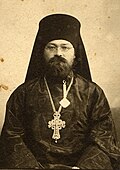
On 30 May 1918 he was arrested at his home together with his old friend Bishop Ephraim (Kuznetsov) of Selenginsk, who had been unable to return to his Siberian diocese. He was accused of having agreed to the sale of the diocesan house, which the new government had already nationalised. On 8 June the newspaper "Izvestia" published an article about the "commercial deal of Patriarch Tikhon, Archpriest Vostorgov and company". He was held in the Cheka's internal prison and then at Butyrka. Later he was also accused of links with the House of Romanov.
Martyrdom
After the murder of Moisei Uritsky and the attempt on Lenin's life, the Bolsheviks declared the Red Terror, and executions of hostages without trial began throughout Russia. Father John was among the first victims. On 4 September 1918 the investigative commission of the revolutionary tribunal decided to "liquidate" his case without trial. The next day, 5 September, he was publicly shot in Petrovsky Park in Moscow, together with Bishop Ephraim, the former chairman of the State Council Ivan Shcheglovitov, the former ministers Nikolai Maklakov and Alexei Khvostov, and Senator Stepan Beletsky. The bodies of those executed, nearly eighty in number, were robbed.
A witness related that, at Father John's request, the executioners allowed the condemned to pray and say farewell. All knelt and prayed fervently, then received the blessing of Bishop Ephraim and Father John and asked forgiveness of one another. Father John went first to the grave, after speaking to the others and urging them to offer their sacrifice with faith in God's mercy and in the rebirth of their homeland. He told the guard that he was ready. The executioner seized his left arm, put the revolver to the back of his head and fired, pushing him into the grave.
Writings
His sermons and addresses were collected in five volumes of works published between 1913 and 1916 and reprinted in 1995. During the war years he published the collections "In Days of War: The Voice of a Patriot Pastor" and addresses on questions of faith in the great war.
Veneration
In August 2000 the Jubilee Council of Bishops of the Russian Orthodox Church numbered him among the New Martyrs and Confessors of Russia for veneration throughout the Church. He is commemorated on 23 August Old Style, that is 5 September, the day of his martyrdom, and in the Synaxis of the New Martyrs and Confessors of the Russian Church. Saint John Vostorgov is one of the heroes of Natalia Irtenina's historical novel "Crimson Vestments", devoted to the New Martyrs.
Commemorated the same day August 23
 Irenaeus of LyonsHieromartyr · Bishop of LyonsAug 23
 Callinicus I of ConstantinopleSaint · Patriarch of ConstantinopleAug 23
- Zacchaeus of JerusalemSaint · Bishop of JerusalemAug 23
 Lupus of NovaeMartyr · Servant of Saint DemetriusAug 23
 Tydfil of MerthyrMartyr · Welsh martyrAug 23
 Asterius, Claudius and NeonHoly MartyrsAug 23
- Cyriacus of OstiaHieromartyr · Bishop of OstiaAug 23
 Ephraim KuznetsovHieromartyr · Bishop of SelengaAug 23
- Anthony of GeraceSaintAug 23
 Nicholas VarzhanskyMartyrAug 23
- Antonios of SardisSaint · Bishop of SardisAug 23
- 38 Martyrs of ThraceMartyrAug 23