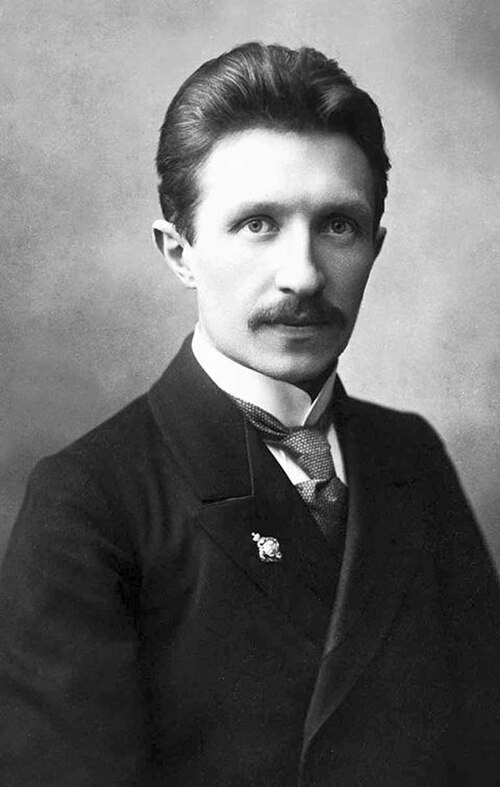
Martyr
Nicholas Varzhansky
Church writer, missionary and teacher of the study of sects in Moscow, who died on 19 September 1918.
Life
Nicholas Georgievich Varzhansky was a church writer, missionary and teacher in the chair of the study of sects at the Moscow theological seminary, candidate in theology and new martyr of the Russian Church. He was born on 25 November 1881 in the Ovruch district, Volhynia province, and was shot on 19 September 1918 in Moscow. In 2000 he was glorified among the new martyrs of the Russian Church. His commemoration is on 5 September, which is 23 August by the old calendar.
He was born into the family of a district clerk. He graduated from the theological school at Zhitomir (1897), the Volhynia seminary (1903) and the Moscow Theological Academy, with the degree of candidate in theology (1907). He was assistant to the Moscow diocesan missionary against sects (1908), diocesan missionary-preacher of Moscow, member of the diocesan school council and of the board of the Brotherhood of the Resurrection of Christ, and teacher of the history and refutation of sectarianism at the two-class parish school attached to the Diocesan House (1910). He was collegiate secretary, organizer and vice-president of the Varnavin Temperance Society, clerk in the office of the Over-Procurator of the Synod (1911), leader of pastoral courses in the dioceses of Moscow, Chernigov, Tver and Finland (1913) and titular councillor (1914). In 1915 he was teacher in the chair of the study of sects at the Moscow seminary. He received the orders of Saint Stanislaus third class (1912) and Saint Anne third class (1914). He married the daughter of the priest Neophytus Lyubimov, Zinaida Neofitovna Lyubimova, and they had children, Elena and Konstantin.
In 1917 he was a delegate to the Fifth All-Russian Missionary Congress and clerk of the eighth and ninth sections of the Local Council of the Russian Orthodox Church of 1917 and 1918. In May 1918 he was imprisoned in the Butyrka prison. He was shot at the Kalitniki cemetery and buried outside its old fence. In 2018 a Missionary Society bearing his name was founded in Moscow.
He wrote several works: on how Count L. N. Tolstoy preaches about God (1908), "The New Universal Religion" (1908), a Christian's answer to the preaching of the Pashkovites and Stundo-Baptists (1909), "Flee from Destruction" (1909), on the immortality of the soul, on the sabbath and Sunday (1910), "The Church and the Sects" (1910), "The Weapon of Truth" (1910), "The Good Confession" (1910), "What Is the Faith of L. N. Tolstoy" (1911), on the holiness of the Church of Christ (1911), The Life and Passion of the Holy Apostle Barnabas (1912), "A Grave Sin" (1912), "The Holy Work" (1913), "The Torn Faith" (1913), "For the Faith of God" (1914), "A Pattern of Sound Teaching" (1914), "A Sound Word" (1914), a guide to texts for conversations with sectarians (1915) and others.
Commemorated the same day August 23
 Irenaeus of LyonsHieromartyr · Bishop of LyonsAug 23
 Callinicus I of ConstantinopleSaint · Patriarch of ConstantinopleAug 23
- Zacchaeus of JerusalemSaint · Bishop of JerusalemAug 23
 Lupus of NovaeMartyr · Servant of Saint DemetriusAug 23
 Tydfil of MerthyrMartyr · Welsh martyrAug 23
 Asterius, Claudius and NeonHoly MartyrsAug 23
 John VostorgovHieromartyr · Archpriest, preacher and missionaryAug 23
- Cyriacus of OstiaHieromartyr · Bishop of OstiaAug 23
 Ephraim KuznetsovHieromartyr · Bishop of SelengaAug 23
- Anthony of GeraceSaintAug 23
- Antonios of SardisSaint · Bishop of SardisAug 23
- 38 Martyrs of ThraceMartyrAug 23