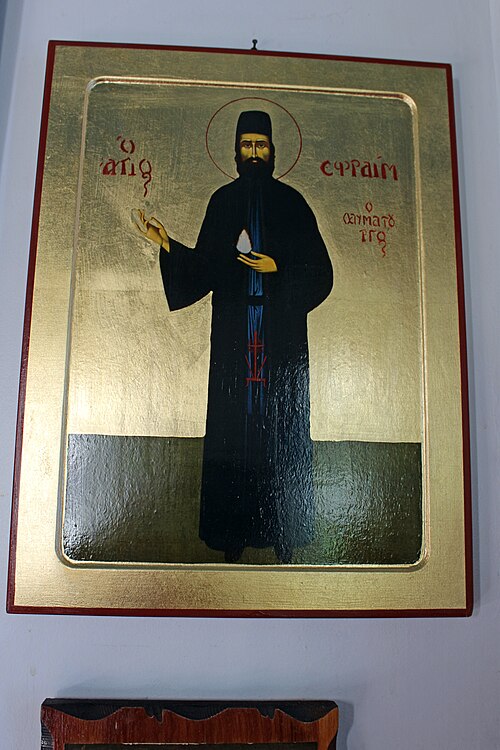
Venerable Martyr
Ephraim of Nea Makri
Monk martyr of Attica
Monk martyr of Mount Amomon in Attica, believed to have lived from 1384 to 1426.
Life
Saint Ephraim the New, also called Ephraim of Nea Makri or Ephraim of Mount Amomon, is a monk-martyr of Attica, commemorated on 5 May. According to the tradition that made his name known, he was born in 1384 at Trikala in Thessaly, lived in the Monastery of the Annunciation on Mount Amomon, and died in 1426 after eight months of torment at the hands of the Ottoman conquerors, because he would not renounce Christ. His life rests not on historical documents but on the discovery of his relics in 1950 and the visions that accompanied it. The Church honours him as a "newly revealed" saint.
The discovery of the relics
In 1945 the nun Makaria Desipri came to the ruins of an old monastery on Mount Amomon near Athens and decided to stay there in solitude, hoping to rebuild it. She prayed that God would reveal to her at least one of the monks who had struggled in that place. After about five years she heard a voice telling her to dig, and that she would find what she desired.
On 3 January 1950, helped by a workman, she uncovered the remains of a monk, from which a sweet fragrance rose. During Vespers the same monk appeared to her and asked that his relics be kept in the church. On the next day they were placed in the sanctuary of the monastery of the Annunciation. In the following years the saint appeared in dreams to several nuns, women and laypeople and told them of his life and martyrdom. What is known of him comes from these accounts.
Life
Born Konstantinos Morphes on 14 September 1384 at Trikala in Thessaly, he lost his father early and was brought up by his devout mother together with his six brothers and sisters. Thessaly had fallen to the Ottomans in 1393, and Byzantium had tried in vain to win it back. In those times, feeling the call to the monastic life and not wishing to be drafted into the Ottoman army, Konstantinos entered the monastery of the Annunciation on Mount Amomon in Attica in 1398, at the age of fourteen, and received the monastic name Ephraim. He was later ordained priest and lived a monastic life of struggle for many years, 27 or 32 according to different reckonings.
Martyrdom
The Ottomans took control of Attica in 1416 and began to plunder and oppress the local communities. In 1424 they attacked the monastery of the Annunciation and killed the monks in it. Ephraim, who was not in the monastery at the time but in a nearby cave, escaped and lived on for another year as a hermit among the ruins.
On 14 September 1425 he was seized in a new raid and taken captive. His captors tried to force him to deny his faith, imprisoned him, starved him and beat him for eight months. Because he would not yield, on 5 May 1426 he was brought out of prison and tied head down to a mulberry tree. They tore out his beard, struck him with pieces of iron and thrust a burning stick into his body, and on the same day the saint gave up his soul. Local peasants later buried his body. The tree believed to be the one he was bound to is preserved to this day in a chapel built around it.
Veneration
Healings are said to flow from the saint's relics, and the monastery archive held 124 letters of thanks for help received by 1999. The faithful pray to him above all for the healing of grave illnesses, depression and addictions, and women unable to bear children call on him. The Church of Greece canonized him in 1998, the Ecumenical Patriarchate entered him among the saints in 2011, and in December of the same year the Russian Orthodox Church added him to its calendar. The Synod of the Romanian Orthodox Church decided to include him in its calendar at its session of 22 May 2014.
His status has also been debated, since no sources attest to his historical existence, and the Church receives him on the strength of the miracles and the testimony of the faithful. The reliquary lies in the church of the monastery at Nea Makri in Attica, which bears his name and is one of the most visited pilgrimage sites in Greece, with many Romanian pilgrims. Believers donated the epitrachelion and slippers in which the relics are vested, worked in gold thread. Portions of the relics are kept in Thessalonica, on Santorini and at Goumenissa, and at Trikala, his city of origin, a feast is held at the church of Saint Stephen, which by tradition stood opposite his family home. He is commemorated on 5 May, the day of his martyrdom, and on 3 January, the day his relics were found.
Commemorated the same day May 5
 Hilary of ArlesSaint · Bishop of ArlesMay 5
 Irene of MacedoniaGreat Martyr · Great Martyr of MacedoniaMay 5
 Irene of ThessalonicaMartyr · Martyr of ThessalonicaMay 5
- Maximus III of JerusalemSaint · Bishop of JerusalemMay 5
 Adrian of MonzaVenerable · Founder of the Monza River monasteryMay 5
- LannoMartyrMay 5
- Matrona of HureziVenerable · Abbess of Hurezi MonasteryMay 5
- Gideon of SerpukhovVenerable · MonkMay 5
- Euthymius of MadytosSaint · Bishop of MadytosMay 5
- Amador, Pedro and Luis of MartosHoly MartyrsMay 5
- Amator of CórdobaHieromartyrMay 5
- Barlaam of SerpukhovVenerableMay 5