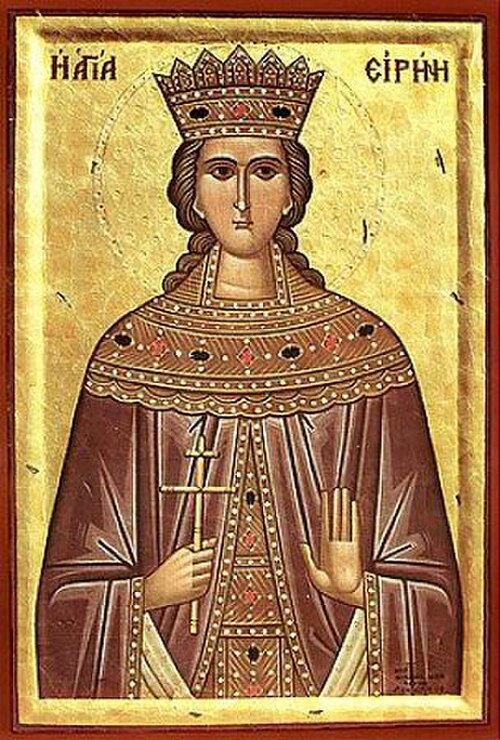
Great Martyr
Irene of Macedonia
Great Martyr of Macedonia
Great martyr said to have lived in the first or second century, honored as Irene of Macedonia.
- Feast
- May 5old style May 18
- Reposed
- 1001st century
- Place
- Lecce
- Order
- Great Martyrs
Life
Saint Irene of Macedonia, the Great Martyr, called in the Catholic Church Irene of Lecce, is regarded as the first woman honoured in this rank of holiness, that of great martyr. Tradition places her in the first or second century, while some Greek writers place her in the fourth. Her life is mixed with legend, and the Church remembers her on 5 May.
According to her life she was born in Macedonia, into the family of Licinius, the pagan ruler of the region of Mygdonia, and was named Penelope. Her father built her a palace of her own, where she lived with her governess Caria. She was taught by Apelianus, a tutor who was secretly a Christian. The account says that one day a dove flew through the open east window with an olive branch in its beak and laid it on the table. An eagle followed with a wreath of flowers, and then a raven with a small snake. Apelianus interpreted: the dove means the maiden's virtues, the olive branch the grace of Baptism, the eagle the height of her spirit, the wreath victory over the passions, and the raven with the snake the devil. He added that the heavenly King wished to betroth her to himself and that she would suffer much for his name.
Penelope was baptized by the Apostle Timothy and took the name Irene. She refused her father's wish that she marry. At first her parents quietly accepted their daughter's choice, then Licinius grew angry and ordered her thrown under the hooves of wild horses. The horses did not touch her, but one struck Licinius down and trampled him. Irene prayed, and her father was raised and received the faith, together with some three thousand people. Licinius gave up his office, and his successor, Sedekias, began a persecution of the Christians.
Irene was tortured: thrown into a pit of snakes, her body was cut with an iron saw, but she was unharmed. Her steadfastness brought ten thousand pagans to the faith, baptized by Saint Timothy. Preaching in Mygdonia, she healed the sick and raised a dead youth. From there she went to Callipolis, then to Constantina and Mesembria, where, according to tradition, she was put to death and God sent an angel and raised her alive from the tomb. In one version the emperor was baptized then with many of his people. The Greek sources also say that she preached in Persia in the time of Shapur I and suffered great persecution there. At Ephesus, told of her coming death, she went with the aged Apelianus and other Christians to a cave, entered it and ordered the entrance closed with a great stone. On the fourth day, when the entrance was opened, the cave was found empty.
The saint's head is kept in the church of Saint Irene at Riganokampos near Patras. It had once been carried to Patras, and on 5 March 1231 the Latin archbishop Anthelm took it to the West and gave it to the abbey of Hautecombe in Savoy. It was returned on 5 October 2002. In the fifth century two churches bore her name in Constantinople. Irene was patron of the city of Lecce until 1656, when she was replaced by Saint Orontius, and of the Hellenic Gendarmerie, and today she is patron of the Cyprus Police.
Commemorated the same day May 5
 Hilary of ArlesSaint · Bishop of ArlesMay 5
 Ephraim of Nea MakriVenerable Martyr · Monk martyr of AtticaMay 5
 Irene of ThessalonicaMartyr · Martyr of ThessalonicaMay 5
- Maximus III of JerusalemSaint · Bishop of JerusalemMay 5
 Adrian of MonzaVenerable · Founder of the Monza River monasteryMay 5
- LannoMartyrMay 5
- Matrona of HureziVenerable · Abbess of Hurezi MonasteryMay 5
- Gideon of SerpukhovVenerable · MonkMay 5
- Euthymius of MadytosSaint · Bishop of MadytosMay 5
- Amador, Pedro and Luis of MartosHoly MartyrsMay 5
- Amator of CórdobaHieromartyrMay 5
- Barlaam of SerpukhovVenerableMay 5