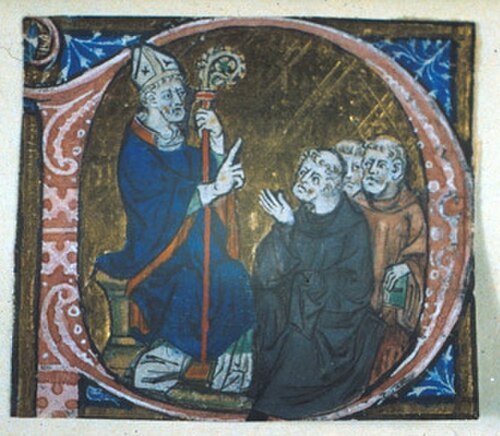
Saint
Erkenwald of London
Bishop of London
Anglo-Saxon prince and Bishop of London from 675 until his death in 693, who renewed the diocese.
Life
The Holy Hierarch Erconwald (Erkenwald, Earconwald) was an Anglo-Saxon prince and bishop of London from 675 until his repose, in 693, who renewed the diocese. He is regarded as the patron of London and was called "the most holy figure of London" and "the light of London." His feast is on 30 April, in the Orthodox Church as well.
Family
Erconwald is traditionally of royal ancestry, though there are competing theories about his pedigree, owing to limited records and the great antiquity of his period. He is often listed as a son of the house of King Offa of Essex (by William Dugdale) or King Offa of East Anglia (by John of Tynemouth), though the chronology makes these options unlikely. Another tradition identifies him as the son of King Anna, the "holy king of the East Angles." The Frankish element "eorcen-" in his name might indicate Kentish descent. He may have been born in the kingdom of Lindsey, in present-day Lincolnshire. As a young man he may have studied under Mellitus, archbishop of Canterbury. The name Erkenwald is a Germanic name composed of eorcen ("genuine," "pure," "precious") and weald ("rule" or "power"), that is, "genuine ruler."
The monasteries
Around 666 (in one source, 661) he established two Benedictine abbeys, with the wealth inherited from his family: Chertsey, in Surrey, for men, and Barking, for women. The abbey at Chertsey was destroyed and ninety monks were killed in the Danish wars; it was later refounded by King Edgar and Bishop Ethelwold. His sister Aethelburh was abbess of Barking; Erconwald is said to have engaged Hildelith to instruct Aethelburh in the role of abbess. Though sometimes mistaken for the first nunnery in England, it was not; the nunnery at Folkestone had been founded earlier, in 630, by King Eadbald, with his daughter Saint Eanswithe as first abbess. Erconwald himself served as abbot of Chertsey. A charter states that in the late seventh century he and Frithwald gave land in Streatham and Tooting Graveney to Chertsey Abbey; this grant was confirmed in the time of Athelstan, in 933. A legend says that he often preached to the woodmen in the wild forests that lay to the north of London.
Bishop of London
In 675 Erconwald became bishop of London, succeeding Wine; he was the choice of Archbishop Theodore of Canterbury, and according to another tradition his selection was at the insistence of King Sebbi. An ancient epitaph says he served as bishop of London for eleven years (by other dates, eighteen). About 691 he was granted the manor of Fulham, for himself and his successors in the see of London; the manor house was Fulham Palace, which, nine centuries later, was still the summer residence of the bishops of London. The early diocese of London was coterminous with the kingdom of Essex, so the bishop of London was the bishop of the East Saxons.
Erconwald was an important contributor to the reconversion of Essex and the fourth bishop of London since the restoration of the diocese; he was present at the reconciliation between Archbishop Theodore and Wilfrith. He was a peacemaker who reconciled competing traditions, Roman and Celtic, of Christianity. As bishop he contributed to the law code of King Ine of Wessex, and is mentioned in the code as one of its compilers; King Ine named him adviser in the composition of laws. In 677 he brought the king of Essex, Sebbi, to Christianity, according to some sources. Modern historians attribute to him a great role in the evolution of Anglo-Saxon charters; he may have drawn up the charter of Caedwalla for Farnham.
Repose and veneration
Erconwald fell asleep in 693 and was buried in Old Saint Paul's Cathedral. In the Middle Ages crowds came in pilgrimage to his tomb; like others, his shrine was destroyed at the Reformation. His cult survived for over eight hundred years. He is associated with a very early Anglo-Saxon phase of building at Saint Paul's Cathedral; William Dugdale says he began the building of the cathedral. A fourteenth-century English alliterative poem, Saint Erkenwald, often attributed to the Gawain poet, tells of a miraculous encounter with the preserved body of a pre-Christian judge and treats the salvation of virtuous pagans.
Commemorated the same day April 30
 James, son of ZebedeeApostle · Brother of John the TheologianApr 30
 Ignatius BrianchaninovSaint · Bishop and spiritual writerApr 30
 Quirinus of NeussMartyrApr 30
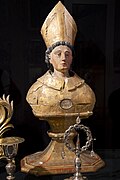 Eutropius of SaintesSaint · First Bishop of SaintesApr 30
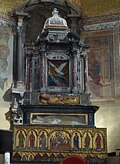 Donatus of EuroeaSaint · Bishop of Euroea in EpirusApr 30
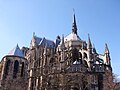 Maternianus of ReimsConfessor · Bishop of ReimsApr 30
- Pomponius of NaplesSaint · Bishop of NaplesApr 30
- Amator of Córdoba and CompanionsHoly MartyrsApr 30
- Anna JovanovichRighteousApr 30
- AphrodisiusHieromartyrApr 30
- ArgyraMartyrApr 30
- Augulus of ViviersSaintApr 30