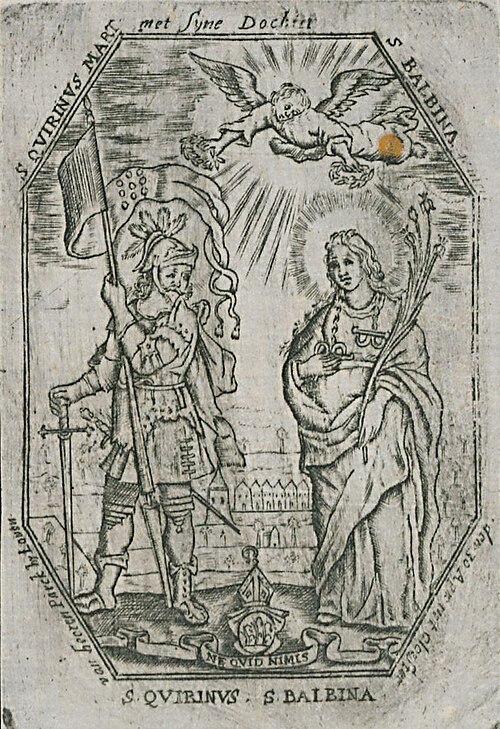
Martyr
Quirinus of Neuss
Martyr of Rome, venerated especially at Neuss in Germany, who died around 116.
Life
The Holy Martyr Quirinus of Neuss (Quirinus of Rome) was, according to tradition, a Roman tribune, killed for his faith in Christ around 116, in the time of the emperor Trajan. Although he suffered at Rome, his veneration spread mostly at Neuss, in Germany. His feast is on 30 April.
What is known and what tradition says
A Roman martyr named Quirinus was buried in the catacomb of Praetextatus on the Via Appia; his name and burial place are mentioned in the Martyrologium Hieronymianum, which places him on 30 April, a date that also appears in the catalogue of Roman martyrs of the fourth century, and in the itineraries to the graves of the Roman martyrs. Very little is known about him from historical sources, however. The story of his life comes from the legendary Acts of Pope Alexander I and Balbina.
According to these Acts, Quirinus was a tribune and head of the Roman guard set over Christians condemned to death. He was to carry out Trajan's order to put to death Alexander, Eventius and Theodulus, arrested by the emperor's command. Having witnessed a miracle, when Pope Alexander, bound in chains and praying, was found miraculously in the cell of his friend Hermes, to strengthen him before death, and then seeing other miracles of the three saints, Quirinus came to faith. He brought his daughter Balbina to Alexander, asking him to heal her of goitre; the pope granted the request after Balbina kissed the chains of the Holy Apostle Peter. Quirinus received Holy Baptism from Alexander, as did his daughter, and, according to the account, all his household.
When the emperor learned of it, Quirinus was condemned to have his tongue, hands and feet cut off. According to the popular legend, often shown in art, his tongue was offered to a falcon, but the bird would not eat it, and his hands and feet, thrown to dogs, were not touched either; but the Acts say nothing of this. Afterwards he was dragged by oxen to the place where his head was struck off. The year of his martyrdom is reckoned as 116 (by some, 116 or 117). He is believed to have been buried in the catacomb of Praetextatus on the Via Appia.
Relics and veneration
The historian Ado took the name from these Acts and put it in his Martyrology on 30 March, a date the Roman Martyrology also bore; the latest edition of the Roman Martyrology commemorates him on 30 April. According to a document from Cologne of 1485, his body was given in 1050 by Pope Leo IX to an abbess of Neuss named Gepa, said to have been the pope's sister. So the relics came to the Romanesque church of Saint Quirinus at Neuss, built especially for them; in 1900 a new sarcophagus was made. A statue of him stands atop the church. The people of Neuss called on his aid during the siege of the city by Charles the Bold, in 1474-1475. In the Middle Ages Neuss was a place of pilgrimage as well known as Cologne and Aachen.
His cult spread to Cologne, Alsace, Scandinavia, western Germany, the Netherlands and Italy, where he became the patron of Correggio. Many springs were dedicated to him, and pilgrims to Neuss sought the water of Saint Quirinus's spring. He was invoked against plague, smallpox, gout and other ills, and is considered a protector of horses and cattle, and in the Middle Ages of knights; in the Rhineland he was venerated, with Hubert, Cornelius and Anthony, as one of the Four Holy Marshals. Among farmers a saying is tied to his old day, 30 March: as Saint Quirinus's day goes, so will the summer.
Commemorated the same day April 30
 James, son of ZebedeeApostle · Brother of John the TheologianApr 30
 Ignatius BrianchaninovSaint · Bishop and spiritual writerApr 30
 Erkenwald of LondonSaint · Bishop of LondonApr 30
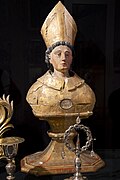 Eutropius of SaintesSaint · First Bishop of SaintesApr 30
 Donatus of EuroeaSaint · Bishop of Euroea in EpirusApr 30
 Maternianus of ReimsConfessor · Bishop of ReimsApr 30
- Pomponius of NaplesSaint · Bishop of NaplesApr 30
- Amator of Córdoba and CompanionsHoly MartyrsApr 30
- Anna JovanovichRighteousApr 30
- AphrodisiusHieromartyrApr 30
- ArgyraMartyrApr 30
- Augulus of ViviersSaintApr 30