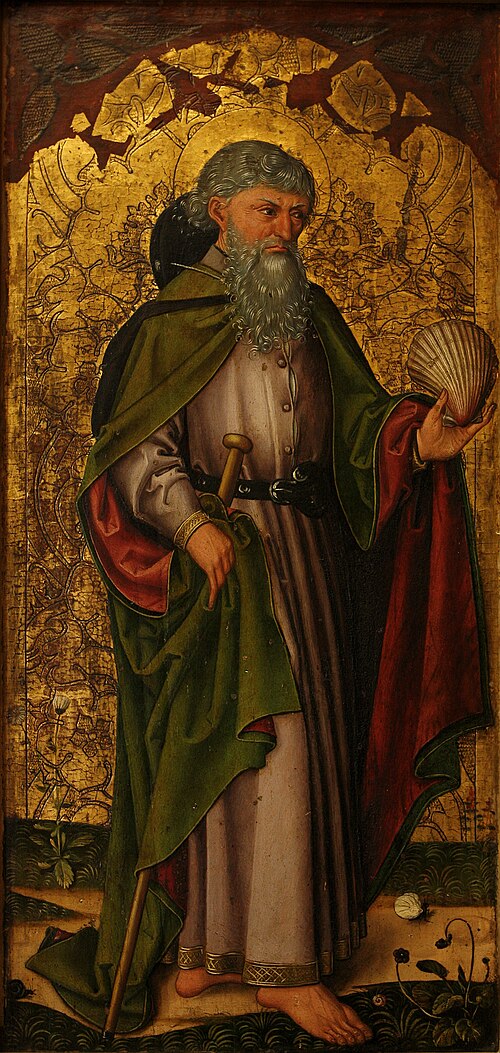
Apostle
James, son of Zebedee
Brother of John the Theologian
One of the Twelve, the first of them to die a martyr, beheaded in the year 44.
Life
The holy Apostle James, son of Zebedee and brother of Saint John the Evangelist, was one of the twelve apostles and the first of them to receive the crown of martyrdom. He was put to the sword at Jerusalem by order of King Herod Agrippa in the year 44. The Church commemorates him on 30 April, and on 30 June in the Synaxis of the twelve apostles.
The call
James was the son of Zebedee and Salome and came from Bethsaida in Galilee. He fished on the Sea of Galilee with his father and his brother John, in a boat they shared with Peter, with hired men to help. When they heard the call of the Saviour, the two brothers left the boat, their father and the hired men, and followed Him.
The Lord named them "sons of thunder" for their ardent zeal. Once, in a Samaritan village that had refused to receive Him, they wished to call down fire from heaven, and Christ rebuked them. Their mother asked that her sons might sit at His right and left hand in His Kingdom, and He asked whether they could drink the cup that He would drink. They said they could, and the Saviour showed them that true glory passes through suffering and the Cross.
Witness of the mysteries of the Lord
With Peter and John, James was chosen to be present at the raising of the daughter of Jairus, at the Transfiguration on Mount Tabor, and at the Lord's prayer in the garden of Gethsemane. These moments, from which the other apostles were absent, show how close he stood to Christ.
Preaching
After Pentecost James proclaimed the Gospel in Palestine. The Synaxarion, as given by the Orthodox Church in America, says that he preached also in Spain, and then returned to Jerusalem. There he spoke boldly of Christ as Saviour of the world and rebuked the scribes and Pharisees. According to the same tradition, the Jews hired the sorcerer Hermogenes to refute him, but Hermogenes' pupil Philip came to believe in Christ, and then Hermogenes himself burned his books of magic and received Baptism.
Martyrdom
The Acts of the Apostles say that King Herod Agrippa, wishing to please the Jews, killed James with the sword and then seized Peter as well. The historian Eusebius relates, following an older tradition, that one of the men who had denounced James, named Josiah, was struck by the apostle's calm. He fell at James's feet and begged forgiveness, and James embraced him and said, "Peace and forgiveness to you." Josiah confessed Christ before everyone and was beheaded together with the apostle in the year 44.
Relics and veneration
The Spanish tradition holds that his disciples carried his body by sea to Galicia, and that the tomb was discovered in the ninth century, in the time of Bishop Theodemir and King Alfonso II. Santiago de Compostela rose on that spot, and pilgrims from all over Europe walk to it along the "Way of Saint James". The tradition of Jerusalem speaks otherwise: in the Armenian cathedral of Saint James in the Armenian Quarter, the chapel beside the sanctuary is shown as the place of his martyrdom, and his head is said to lie beneath the altar.
The Romanian Orthodox Church celebrates the holy Apostle James on 30 April, and the Church of Rome on 25 July. In the troparion of the day the Church asks the merciful God, through him, to grant our souls forgiveness of their trespasses, and in the kontakion it names James, together with his brother, as one who was counted worthy to see the divine Transfiguration of the Lord.
Commemorated the same day April 30
 Ignatius BrianchaninovSaint · Bishop and spiritual writerApr 30
 Quirinus of NeussMartyrApr 30
 Erkenwald of LondonSaint · Bishop of LondonApr 30
 Eutropius of SaintesSaint · First Bishop of SaintesApr 30
 Donatus of EuroeaSaint · Bishop of Euroea in EpirusApr 30
 Maternianus of ReimsConfessor · Bishop of ReimsApr 30
- Pomponius of NaplesSaint · Bishop of NaplesApr 30
- Amator of Córdoba and CompanionsHoly MartyrsApr 30
- Anna JovanovichRighteousApr 30
- AphrodisiusHieromartyrApr 30
- ArgyraMartyrApr 30
- Augulus of ViviersSaintApr 30