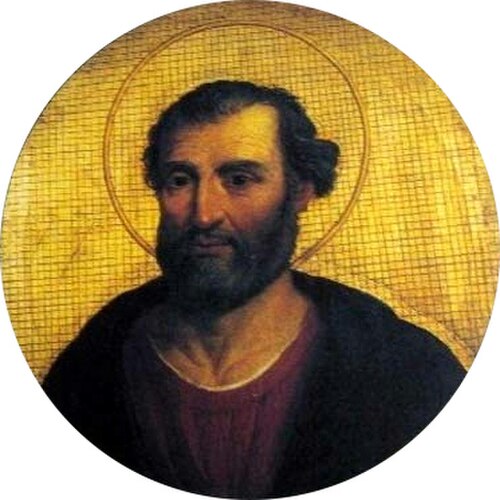
Saint
Eugene I of Rome
Bishop of Rome
Bishop of Rome from 654 to 657, chosen after Emperor Constans II banished Martin I.
Life
Saint Eugene I of Rome was bishop of Rome from 10 August 654 to 2 June 657. He was elected after Emperor Constans II had deposed and exiled Pope Martin I in the dispute over Monothelitism. He is commemorated on 2 June, both in the Synaxarion of the Orthodox Church and in the Roman Catholic Church.
His election
Eugene was a Roman, born on the Aventine, the son of Rufinianus. He had been brought up in the service of the Church, known for gentleness and love of people, and was already an elderly priest when the see of Rome, which rejected the Monothelite teaching, broke with the court in Constantinople, which supported it. Pope Martin was taken from Rome on 18 June 653 and carried off into exile at Cherson. While Martin was alive the see of Rome was governed by the archpriest and the archdeacon, and the court pressed, through the exarch of Ravenna, for the election of a successor. On 10 August 654 Eugene was appointed, and Martin agreed to it. The imperial authorities thought he would be more compliant and confirmed his election. Some Orthodox sources say he was chosen by the clergy and the people.
Ministry
Eugene ordained twenty-one bishops for various parts of the world and received the young Wilfrid at Rome around 654. He showed more deference to the emperor than his predecessor and took no public stand against the Monothelitism of the patriarchs of Constantinople. Among his first acts was to send envoys to Constantinople with letters to Constans, informing him of his election and professing his faith.
The envoys were deceived or bribed and brought back a synodal letter from Patriarch Peter, written in an obscure style and with no clear confession about the number of wills or operations in Christ. When the letter was read in 656 in the church of Santa Maria Maggiore, the clergy and people rejected it with indignation and would not let the pope leave the church until he promised that he would on no account accept it. The Greek synaxarion says that Eugene was ready to accept it, but the people and clergy of Rome resisted and forbade him to celebrate the Liturgy, and that afterward he stood firm against the Monothelite heresy, in the faith of the Fourth Ecumenical Council. The imperial officials were angry, and Constans threatened to depose Eugene as he had Martin, but was busy defending the empire against the Arab conquests.
Repose
Eugene fell asleep in peace on 2 June 657 (according to some Latin sources, on 4 June), before Constans could act against him. He was buried in Old Saint Peter's Basilica. The Greek synaxarion praises him for the holiness of his life, his gentleness and his love of people; a list of the Latin saints of the Patriarchate of Rome adds that he was kind to the poor. The same list says that after Martin's martyrdom in 655 Eugene was chosen to succeed him, but the other sources show that the election took place in 654, while Martin was still alive.
Commemorated the same day June 2
 Nikephoros the ConfessorSaint · Patriarch of ConstantinopleJun 2
 BlandinaMartyrJun 2
 Pothinus of LyonHieromartyr · Bishop of LyonJun 2
 Nectarius of ConstantinopleSaint · Archbishop of ConstantinopleJun 2
 Nicholas the PilgrimVenerable · Greek pilgrim in southern ItalyJun 2
 John the New of SuceavaGreat Martyr · Martyr of Cetatea AlbăJun 2
- Plato of ElisavetgradHieromartyrJun 2
- 38 MartyrsHoly MartyrsJun 2
- AdalgisVenerableJun 2
- Aedhan of Cluain DomhuilSaintJun 2
- Aemilia of LyonMartyrJun 2
- AlbinaMartyr · Martyr of LyonJun 2