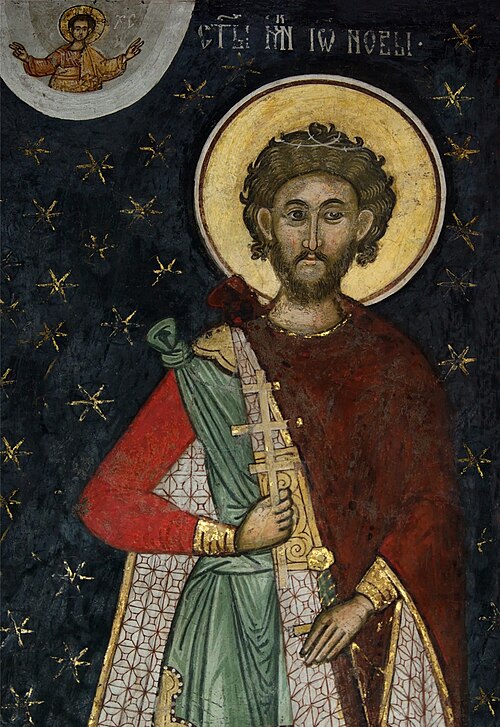
Great Martyr
John the New of Suceava
Martyr of Cetatea Albă
Martyr of the 14th century from Cetatea Albă, whose relics were brought to Suceava; commemorated June 2.
- Feast
- June 2old style June 15
- Reposed
- 134014th century
- Place
- Bilhorod-Dnistrovskyi
- Order
- Great Martyrs
Life
Saint John the New of Suceava, Great Martyr, was a Christian merchant from Trebizond who received the crown of martyrdom at Cetatea Alba, on the north-western shore of the Black Sea, in the early decades of the fourteenth century. His relics, brought to Suceava in 1402, made him the protector of Moldavia, and the Romanian Orthodox Church honours him on 2 June and commemorates the translation of the relics on 24 June.
Life and martyrdom
Little is known of his life, and the news comes from his Slavonic life. He was born around 1300 to Greek Christian parents at Trebizond, a port on the Black Sea. He was a merchant who travelled mostly along the Black Sea coasts and behaved with decency and mercy toward those around him, known for his faith in Christ, which he confessed also to others. On his journeys he visited holy places and the relics of the saints.
On one of these journeys the owner of the ship he sailed on, a western merchant whom the Romanian sources call Reitz, turned against him out of envy for his faith. While John was at Cetatea Alba, then held by the Tatars, the merchant denounced him to the governor of the city, saying that he wished to abandon Christianity and join the old religion of the place, that of the pagans who worshipped the sun. Brought before the official, John understood what the man had plotted and refused to renounce Christ, saying that the words reported were lies. Angered, the governor ordered him beaten with rods almost to death and thrown into prison in chains.
Next day they urged him again, promising that skilled physicians would heal his wounds. John answered that he should not trouble about the wounds of the body, since through what passes away one gains what does not. After the second refusal the martyr was beaten even more cruelly, tied to a horse's tail and dragged through the streets of the city. People in the crowd, among them some Jews, abused him, and one of them drew a sword and cut off his head. According to some sources Saint John died on 15 June 1332; according to others between 1330 and 1340.
Miracles at his body
The martyr's body was left in the street unburied. That night many lit lamps were seen there, shining men who sang and censed the body, and a pillar of fire rising from it to heaven. A local man who lived nearby thought that Christian priests had come to bury him and took up his bow to shoot at them, but his hands stuck to the weapon and he was freed only in the morning, after telling what he had meant to do. Frightened, the ruler of the city ordered the Orthodox of the town to bury the body. It was laid in the cemetery of a church at Cetatea Alba.
After a few days the ship's owner dug up the grave, wishing to take the body to his own country. The martyr appeared in a dream to the priest of the church and warned him; the priest ran to the cemetery and, with the help of the faithful, drove the thieves away. The incorrupt and fragrant body was taken by the community and placed in the sanctuary of the city church, where it remained for nearly seventy years, with many gifts of healing for those who came to pray.
Translation of the relics to Suceava
News of the miracles spread through all Moldavia. Prince Alexander the Good, who had obtained from the Ecumenical Patriarchate the canonical recognition of Metropolitan Joseph Mușat, wished to crown this great achievement of the Church of Moldavia by moving the martyr's relics to Suceava, where the new hierarch had his seat. In 1402 the prince and the metropolitan brought the relics from Cetatea Alba to the capital of Moldavia and placed them in the metropolitan church. Saint John thus became the protector of Moldavia, and Gregory Tsamblak later composed a service and a eulogy in his honour. He is believed to protect those who engage in trade.
In 1685 the king of Poland, John Sobieski, took the relics to Stryi and then to a monastery at Zhovkva in Galicia. Emperor Joseph II returned them to Suceava in 1783, after ninety-seven years. In the autumn of 2009 the relics made a pilgrimage in Ukraine, among other places to Kyiv.
Veneration
The relics lie today at Suceava, in the church of Saint George of the monastery that bears his name. Saint John is one of the best loved saints of north-eastern Romania, Moldova and Bukovina, and the Bukovinian writer Olha Kobylianska made a pilgrimage to Suceava to venerate his relics. In Russia his veneration spread at the end of the fifteenth century. Tsarevich Ivan Mikhailovich, born in 1633, was named for him; a measure icon of the saint was painted for him, a chapel was dedicated to him in the Verkhospassky cathedral in the Kremlin and another in the church of the Hrebnevska icon of the Mother of God in Moscow. At Bilhorod-Dnistrovskyi in Ukraine a church built over a well, on the spot where he suffered, draws pilgrims; the water there is held to be healing. Parishes of Saint John the New also exist in North America, at Winnipeg and Lachine.
Commemorated the same day June 2
 Eugene I of RomeSaint · Bishop of RomeJun 2
 Nikephoros the ConfessorSaint · Patriarch of ConstantinopleJun 2
 BlandinaMartyrJun 2
 Pothinus of LyonHieromartyr · Bishop of LyonJun 2
 Nectarius of ConstantinopleSaint · Archbishop of ConstantinopleJun 2
 Nicholas the PilgrimVenerable · Greek pilgrim in southern ItalyJun 2
- Plato of ElisavetgradHieromartyrJun 2
- 38 MartyrsHoly MartyrsJun 2
- AdalgisVenerableJun 2
- Aedhan of Cluain DomhuilSaintJun 2
- Aemilia of LyonMartyrJun 2
- AlbinaMartyr · Martyr of LyonJun 2