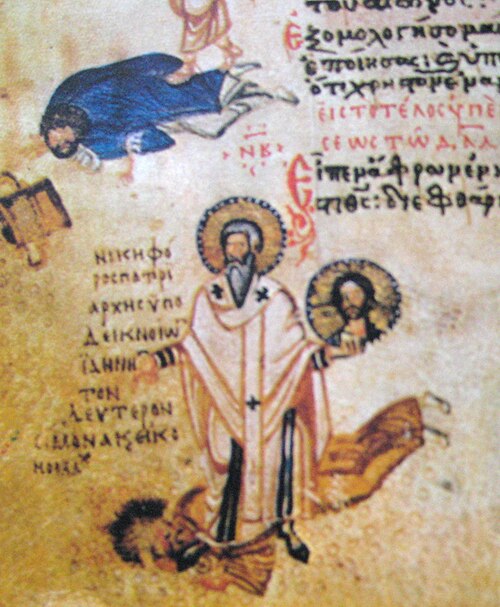
Saint
Nikephoros the Confessor
Patriarch of Constantinople
Patriarch of Constantinople from 806 to 815, writer and defender of the holy icons, exiled by the iconoclasts.
Life
Saint Nikephoros the Confessor was patriarch of Constantinople from 806 to 815, a writer and defender of the holy icons, driven from his throne by the iconoclasts. The Church commemorates him on 2 June, the day of his repose, and on 13 March, the day of the translation of his relics.
Early life
He was born at Constantinople, around 758, in the family of Theodore and Eudokia, a strictly Orthodox family, which had suffered under the first iconoclasm. His father, one of the secretaries of the emperor Constantine V, had been scourged and banished to Nicaea for his zeal for the icons, and died in exile. The son inherited his father's faith. While still young he was brought to court, where he became an imperial secretary. In the time of the empress Irene he took part, as the empress's commissioner, in the synod of Nicaea in 787, the Seventh Ecumenical Council. Then he withdrew to one of the monasteries he had built on the Bosporus. There he devoted himself to ascetic labours and study, of secular learning, such as grammar, mathematics and philosophy, and of the Scriptures. Around 802 he was called and placed at the head of the largest hospital for the destitute in Constantinople.
The patriarch
After the death of Patriarch Tarasios there was great division among the clergy and the court. At the wish of the emperor, Nikephoros, still a layman, was chosen patriarch and ordained on Easter day, 12 April 806. The choice was not according to custom and met with the opposition of the Stoudites. The opposition grew when, at the emperor's will, Nikephoros reinstated the priest Joseph, who had been excommunicated. As patriarch he was a very strict moralist in other respects, but mild in ecclesiastical and monastic rules.
Exile
After vain theological disputes, in December 814 personal insults followed. The emperor Leo V the Armenian, initiator of the second iconoclasm, removed him from the throne. Nikephoros first replied with excommunication, but in the end had to yield to force. He was taken to a monastery founded by him, that of Agathos, then to that of Saint Theodore. From there he carried on a literary struggle in defence of the icons, against the synod of 815. At the change of emperors, in 820, he was put forward again as patriarch, but obtained at most the promise of toleration.
Repose and relics
He died at the monastery of Saint Theodore, on 5 April 828, revered as a confessor. In 847 Patriarch Methodios brought his relics solemnly to Constantinople, on 13 March, and placed them in the Church of the Holy Apostles. According to tradition, the relics were incorrupt. The saint's hand is kept today at the Hilandar monastery on Mount Athos.
His writings
Unlike Theodore the Studite, Nikephoros was a friend of conciliation, learned in the Fathers and more inclined to defend than to attack. He wrote a Short History of the years 602 to 769 and a Chronography, a universal history from Adam to his own time, to which he added a list of the canonical books. His principal works concern iconoclasm: the Lesser Apology, the Greater Apology and the Refutations, as well as a rebuttal of the synod of 815.
Commemorated the same day June 2
 Eugene I of RomeSaint · Bishop of RomeJun 2
 BlandinaMartyrJun 2
 Pothinus of LyonHieromartyr · Bishop of LyonJun 2
 Nectarius of ConstantinopleSaint · Archbishop of ConstantinopleJun 2
 Nicholas the PilgrimVenerable · Greek pilgrim in southern ItalyJun 2
 John the New of SuceavaGreat Martyr · Martyr of Cetatea AlbăJun 2
- Plato of ElisavetgradHieromartyrJun 2
- 38 MartyrsHoly MartyrsJun 2
- AdalgisVenerableJun 2
- Aedhan of Cluain DomhuilSaintJun 2
- Aemilia of LyonMartyrJun 2
- AlbinaMartyr · Martyr of LyonJun 2