Saint
Nectarius of Constantinople
Archbishop of Constantinople
Archbishop of Constantinople from 381 to 397, successor of Gregory the Theologian and predecessor of John Chrysostom.
Life
The Holy Hierarch Nectarius of Constantinople was archbishop of Constantinople from 381 until his repose, in 397, successor of Saint Gregory of Nazianzus and predecessor of Saint John Chrysostom. He was, by the witness of the old historians, a man of fine family and fine character, chosen unexpectedly to head the Church of the Imperial City while still unbaptized. His feast is on 11 October.
Family and secular service
He was born at Tarsus, in Cilicia, in a noble family of senatorial rank; the year of his birth is not known. The historians Sozomen and Socrates Scholasticus say he was of senatorial family, and Theodoret of Cyrrhus says he was "a man of noble descent, adorned by the renown of his family and shining with his own virtues." His brother was Arsacius, who would become archbishop of Constantinople after Saint John Chrysostom. He was known for his admirable character, and at Constantinople he was praetor, that is, a high official of the imperial administration. Until 381, however, he remained unbaptized, and so did not belong to the clergy.
The unexpected election
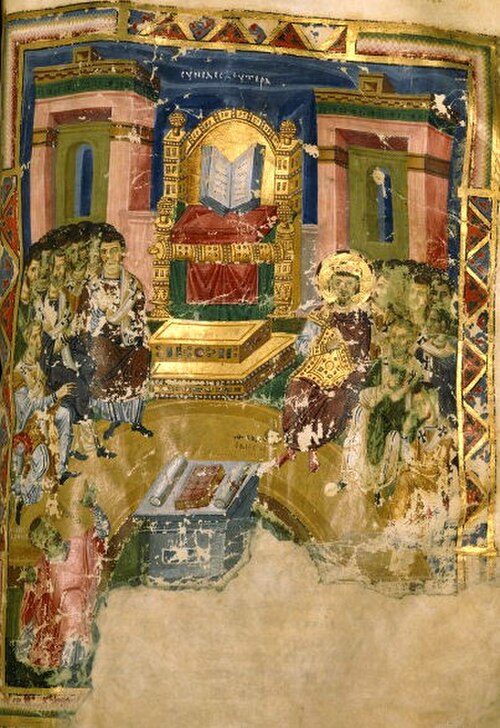
At the Council of Constantinople in 381, Saint Gregory the Theologian, seeing the disputes that had arisen, left the throne of Constantinople and withdrew to Nazianzus, and the question of choosing a new archbishop arose. Nectarius was preparing for a journey to Tarsus and went to see the bishop of Tarsus, Diodorus, who was attending the council, to ask if he had letters to send; his appearance and manners struck Diodorus so forcibly that he at once determined to propose him as bishop, and, on the excuse of other business, took him to Meletius of Antioch.
The emperor Theodosius the Great asked the bishops at the council to suggest candidates from whom he could choose. Meletius put Nectarius's name at the bottom of the list. The emperor read the lists, running his finger over them, and stopped at Nectarius. The Fathers were amazed and wanted to know who and what this Nectarius was; it was learned that he was still only a catechumen, and that though he was now grey-haired, gentle, kind and worthy, he had not received Baptism. The astonishment was great, but the people of Constantinople and the whole council were glad of the news. Nectarius was baptized, advanced through all the degrees of the priesthood, beginning with the lowest, and at last placed on the throne of Constantinople; in the robes of a bishop of the Imperial City he at once became president of the council. According to another account, the people took Nectarius and proposed him for this office. After the council ended, Nectarius learned the duties of the priesthood under the guidance of Cyriacus, bishop of Adana, whom he asked, through Diodorus, to stay with him for a time. He tried to persuade his friend and physician, Martyrius, to accept the priesthood, but he, because of the sins of his youth, drew back.
The council and the canons
The council confirmed the Creed and received the canons, and anathematized the Arians and the Pneumatomachians. Nectarius's name heads the 150 signatures to the canons of the council. The third canon decreed that the bishop of Constantinople should hold the first rank of honour after the bishop of Rome, because Constantinople is the New Rome; a more recent source notes that this is a place of honour, not jurisdiction over the whole East. He led the Church for upwards of sixteen years and is thought of as a good prelate. His work came after the change of imperial religious policy: the emperor Theodosius had driven out the Homoian bishop Demophilus in 380 and given the city's churches to the Nicenes. Nectarius lived to see the churches held by the Arians for over forty years restored to the Orthodox.
Disputes and synods
The bishops of the West opposed the election and asked for a common synod of East and West; so the emperor assembled, in the summer of 382, a new synod at Constantinople, with nearly the same bishops, for the healing of the Antiochene schism. The synod received a letter from the synod of Milan, inviting them to a great council at Rome, but the bishops answered that they could not go, having made no preparation for so long a journey; they sent, however, three envoys (Syriacus, Eusebius and Priscian of Lydia) with a synodal letter to Pope Damasus I, Saint Ambrose and the other bishops assembled at Rome. Theodosius also sent envoys to Rome, and in his fifteenth letter (to the bishops of Illyria) he indicated that the Church of Rome had finally agreed to recognize Nectarius and Flavian of Antioch. Six letters of Nectarius are preserved among the papers of his predecessor Gregory of Nazianzus; in one he expresses his good wishes for his episcopate, and the last, of great importance, urges him not to be too lenient with the Apollinarians.
In 383 a third synod was held at Constantinople; in spite of the decrees of bishops and emperor, the Arians and Pneumatomachians continued to spread their doctrines. Theodosius summoned all parties to the Imperial City, in June, for a great discussion. Nectarius consulted the Novatianist bishop Agelius, who did not feel able to judge, but had a reader, Sisinnius, a philosopher and theologian, who suggested that the testimonies of the old Fathers of the Church on the doctrine concerning the Son be produced, and that the heads of the several parties be first asked whether they accepted these authorities or wished to anathematize them. The archbishop and the emperor accepted the proposal, and at the meeting the emperor asked whether they respected "the teachers who lived before the Arian division" and whether they held them sound witnesses of true Christian doctrine; the question produced divisions, so the emperor ordered each party to draw up a written confession. The Arians hated Nectarius: in 388, when the rumour spread that the army of Theodosius, who was in Italy, had been defeated and that the emperor was a prisoner, the Arians, vexed that he held the churches, set fire to his house.
His work
Nectarius was the first to abolish the office of the priest set over penitents, then all the bishops followed his example. During his time the head of Saint John the Baptist was brought to Constantinople and the relics of the prophets Habakkuk and Micah were found. In 394 he took part in the synod of Constantinople, with the patriarchs of Alexandria and Antioch, where a rule was accepted that entered the canons of the Orthodox Church. He left a work, the Discourse on the Day of Saint Theodore the General. He fell asleep on 27 September 397 (in another source, 17 September). Saint John Chrysostom succeeded him on the throne.
Commemorated the same day June 2
 Eugene I of RomeSaint · Bishop of RomeJun 2
 Nikephoros the ConfessorSaint · Patriarch of ConstantinopleJun 2
 BlandinaMartyrJun 2
 Pothinus of LyonHieromartyr · Bishop of LyonJun 2
 Nicholas the PilgrimVenerable · Greek pilgrim in southern ItalyJun 2
 John the New of SuceavaGreat Martyr · Martyr of Cetatea AlbăJun 2
- Plato of ElisavetgradHieromartyrJun 2
- 38 MartyrsHoly MartyrsJun 2
- AdalgisVenerableJun 2
- Aedhan of Cluain DomhuilSaintJun 2
- Aemilia of LyonMartyrJun 2
- AlbinaMartyr · Martyr of LyonJun 2