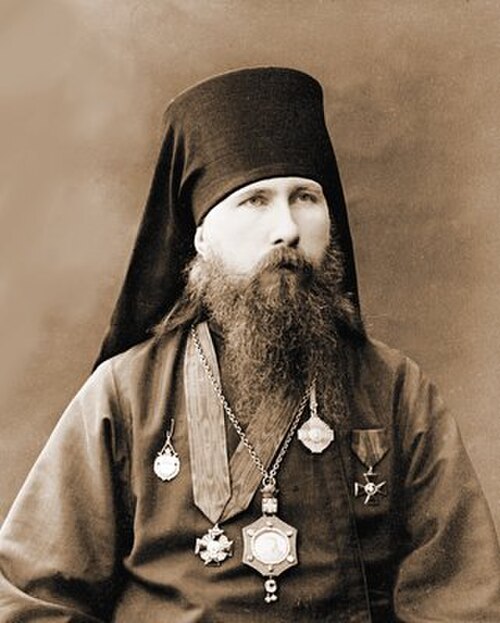
Hieromartyr
Eugene Zernov
Metropolitan of Gorky
Metropolitan of Gorky and Arzamas, who died a martyr in 1937 in a camp in the Karaganda region.
- Feast
- February 13old style February 26
- Reposed
- 193720th century
- Place
- Karlag
- Order
- Martyrs
Life
Saint Eugene Zernov, Hieromartyr, was Metropolitan of Gorky and Arzamas, a hierarch who served in Siberia, the Far East and at Vyatka, passed through Solovki and exile and was shot in the Karlag camp in the Karaganda region on 20 September 1937. Born on 18 January 1877 at Moscow into a deacon's family, he was numbered among the saints of the Russian Church at the Council of Bishops in August 2000. He is commemorated on 26 January (8 February) and on 7 (20) September.
Youth and learning
Born Semyon Alexeyevich Zernov, he graduated from the Zaikonospassky ecclesiastical school and in 1898 from the Moscow seminary. On 8 March 1900 he was tonsured a monk with the name Eugene, on 5 April ordained hierodeacon and on 25 March 1902 hieromonk. In 1902 he graduated from the Moscow Theological Academy as candidate of theology. From August 1902 he was teacher of polemical theology, history and refutation of the Russian schism and local sects at the Chernigov seminary, member of the council of the Brotherhood of Saint Prince Michael of Chernigov, head of the library-reading room and organizer of religious readings for the people. From 4 August 1904 he was inspector of the seminary. On 15 March 1906 he was named rector of the Irkutsk seminary and on 25 March raised to archimandrite. In the turmoil of the revolution of 1905 to 1907 he managed to calm the seminary without repressive measures. From 1907 he was also chairman of the diocesan school council, member of the Irkutsk missionary committee, of the Russian Geographical Society, of the Brotherhood of Saint Innocent and of the Blagoveshchensk section of the Imperial Orthodox Palestine Society, and editor of the diocesan journal. In 1910 he was main speaker at the Irkutsk missionary congress.
Bishop
From 20 January 1913 he was Bishop of Kirensk, vicar of Irkutsk, and from 11 June 1914 Bishop of Priamursk and Blagoveshchensk. He received the belt (1904), the Order of Saint Anna (1908) and the Order of Saint Vladimir (1911, 1914). He took part in the first session of the Local Council of 1917 to 1918, as member of the second, third, fifth, ninth, tenth and eleventh sections. In February 1918 he returned to the diocese, in 1919 submitted to the provisional church administration of Siberia and, as archbishop temporarily governing the Vladivostok diocese, opposed the spread of Renovationism. In a letter of 9 July 1923, from Blagoveshchensk, to Patriarch Tikhon, he wrote that in the Far East only he remained on his see, but that he too was threatened with forcible removal, since the Renovationist administration was sending in his place a false archbishop, Daniel; that he did not recognize it and so a struggle must begin which would probably end in his defeat, since among the clergy there are traitors; that he had fought long but alone, since the neighbouring sees were empty, without an Orthodox bishop at Vladivostok, Chita, Irkutsk, Yakutsk and Kamchatka. He wrote that in their cellar three priests had long been held, because they would not join the "Living Church", and that at Khabarovsk many clergy had also been imprisoned, while the envoy of that Church had as yet no success.
In the night of the Dormition in 1923, after the vigil, he was arrested "for taking part in strengthening the power of Kolchak's government" during the civil war, which caused a mass protest of believers, dispersed by the authorities. He was taken to Chita, then to Moscow, where he was provisionally released, forbidden to leave the city. On 21 May 1924 he was included in the permanent membership of the Synod beside Patriarch Tikhon, but was already sentenced to three years and from 22 February was in the Solovki camp, where he was chosen senior bishop among the bishops of Solovki; he took an active part in composing the "Memorandum of the Solovki Bishops", with the call that state and Church normalize their relations on the basis of non-interference in each other's affairs. In 1927 he was sent to forced settlement in the Ust-Kulom district, in Komi. He supported Metropolitan Sergius's Declaration of 1927. After release, on 13 August 1930, he was named Archbishop of Belgorod, but the decision was cancelled because of the authorities' refusal to register it. In 1931 he became Archbishop of Kotelnich, temporary administrator of Vyatka; in 1932 he received the cross on the klobuk and took part in the winter session of the Synod. From 8 September 1933 he was Archbishop of Vyatka and Sloboda; from 3 May 1934, Metropolitan of Gorky and Arzamas. He enjoyed great authority among the faithful, was always tactful and calm and preached much; his services were marked by grandeur, peace and reverence.
Last arrest and martyrdom
In May 1935 he was arrested and accused that, "being Metropolitan of the Gorky region, in 1934 and 1935 he used the pulpit for counter-revolutionary purposes, delivering in several churches sermons of anti-Soviet content". He did not admit guilt and said that all his sermons had exclusively religious and moral content. The immediate cause of the arrest was the events of 1 May 1935, when Pascha coincided with the proletarian holiday: hundreds of Orthodox, coming out of the church in which the metropolitan served, unwittingly "distracted citizens from taking part in the May Day demonstration". Moreover, after the service the metropolitan did not wait for the demonstrators to disperse but drove through the streets home in his white klobuk; advised by well-wishers to wait so as not to draw attention, he said: "Why should we be afraid... We must fear God." The authorities took this as a challenge. On 4 November 1935 he was sentenced by the Special Council of the NKVD to three years of camp, which he served in the Bidaik branch of the Karlag camp.
On 7 September 1937 he was arrested in the camp and accused, with other prisoners, that "being in Karlag, they systematically carried on counter-revolutionary agitation among prisoners (illegal prayers, distribution of counter-revolutionary akathists and prayers, serving memorial services) and weakened labour discipline". He did not admit guilt. He was sentenced to death by the NKVD troika of the Karaganda region on 20 September 1937 and shot the same day.
Canonization
In preparing the canonization of the new martyrs by the Russian Church Outside Russia, in 1981, his name was entered in the provisional list, but in the list of names, published only in the 1990s, it was not included, like those of other supporters of Metropolitan Sergius. At the Council of Bishops of the Russian Church in August 2000 he was numbered among the saints as a new martyr. On 9 February 2017 in the settlement of Lebedinyi in the Aldan district the founding meeting of a future parish in honour of Hieromartyr Eugene Zernov took place.
Commemorated the same day February 13
 Symeon the Myrrh-streamerVenerable · Grand Prince of SerbiaFeb 13
 Aquila and PriscillaHoly Apostles · Missionary CoupleFeb 13
 Eulogius of AlexandriaSaint · Patriarch of AlexandriaFeb 13
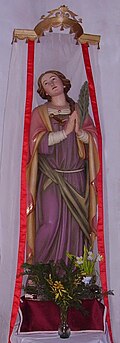 Fusca of RavennaMartyr · Child martyr of RavennaFeb 13
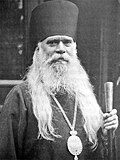 Seraphim SobolevSaint · Russian archbishop in BulgariaFeb 13
 Martinian of CaesareaVenerableFeb 13
 Zoe and PhotinaHoly Venerables · Venerables of PalestineFeb 13
 Seraphima of SezenovoVenerable · Abbess of Sezenovo ConventFeb 13
 Zosima TrubachevHieromartyr · ArchpriestFeb 13
 Basil GorbachevMartyr · Priest and iconographerFeb 13
- AimoVenerableFeb 13
- Anna KorneevaVenerable MartyrFeb 13