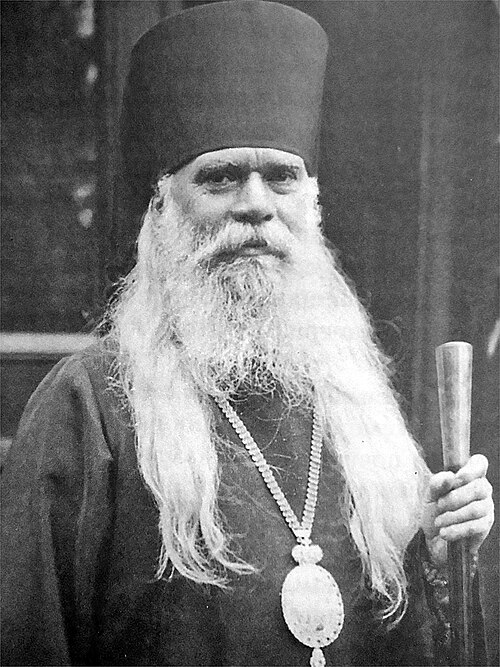
Saint
Seraphim Sobolev
Russian archbishop in Bulgaria
Russian émigré archbishop, author of Russian Ideology, a champion of Orthodox monarchism; died at Sofia in 1950.
- Feast
- February 13old style February 26
- Reposed
- 195020th century
- Place
- Sofia
- Order
- Hierarchs
Life
Saint Seraphim Sobolev, Archbishop of Boguchar, also called the Wonderworker of Sofia, was a Russian hierarch who spent nearly three decades of episcopal ministry in Bulgaria. Born in Ryazan in 1881 and driven into emigration after the Civil War, he shepherded the Russian communities of Bulgaria from 1921 to 1950 and was loved by Russians and Bulgarians alike. The Church honours him for his zeal in defending the purity of the Orthodox faith, for his theological writings, and for the help the faithful receive at his tomb in Sofia.
Childhood and studies
Nicholas Borisovich Sobolev was born on 1 December 1881, Old Style, in the city of Ryazan, to the townsman Boris Matveyevich Sobolev and his wife Maria Nikolaevna. In 1894 he entered the second class of the Ryazan theological school, then completed the Ryazan seminary, and in 1904 entered the Saint Petersburg Theological Academy. There he became a friend of the rector, Bishop Theophan (Bystrov).
On 26 January 1908, in his final year, Bishop Sergius (Tikhomirov) tonsured him a monk with the name Seraphim, in honour of Saint Seraphim of Sarov. In February 1908 he was ordained hierodeacon, and in March hieromonk.
In September 1908 he received the degree of candidate of theology for his thesis "The Teaching on Humility according to the Philokalia", with the right to a master's degree without further examination. Professor Alexander Bronzov noted the depth of his study of the Fathers and judged that the work went beyond the usual level of such a thesis.
Teacher and rector
In 1908 Hieromonk Seraphim began teaching at the pastoral school in Zhitomir founded by Archbishop Anthony (Khrapovitsky), and then became superintendent of the theological school in Kaluga. In 1911 he was appointed inspector of the Kostroma seminary.
On 22 December 1912 he was named rector of the Voronezh seminary and raised to the rank of archimandrite. Seminaries were troubled places at the time, and in Voronezh the students had rebelled and even attempted the lives of the rector and inspector. Archbishop Anthony wrote to him that he had been sent to the most hopeless and rebellious seminary of all. In 1917 he gave up the editorship of the Voronezh diocesan journal.
Consecration and emigration
During the Civil War Archimandrite Seraphim was in southern Russia under the church administration there, and for a time he headed the Tauride seminary. On 1 October 1920, the feast of the Protection of the Mother of God, he was consecrated bishop in the cathedral of Simferopol by Metropolitan Anthony (Khrapovitsky), with the title Bishop of Lubny.
On 14 November 1920 he left Russia aboard the ship of the commandant of Sevastopol, General Nicholas Stogov, and reached Constantinople. According to Bulgarian tradition, he taught for a time at the Halki seminary. In April 1921 he was appointed Bishop of Boguchar, vicar of the diocese of Voronezh, but news of this appointment by Saint Patriarch Tikhon reached the Synod Abroad only in 1928, so for some years he continued to be styled Bishop of Lubny.
Shepherd of the Russians in Bulgaria
In May 1921 he arrived in Bulgaria. The Russian church administration abroad entrusted him with the Russian Orthodox communities in the country and made him rector of the Church of Saint Nicholas of the former Russian embassy in Sofia and head of the Russian monastery of Saint Alexander Nevsky at Yambol. For almost three decades he cared spiritually for the Russian émigrés and for many Bulgarians as well, clergy among them.
In 1934 Metropolitan Anthony, president of the Synod of Bishops, raised him to the rank of archbishop. His name was not among the eight hierarchs of the Church Abroad penalised by Metropolitan Sergius in 1934, and during the 1930s he kept up contacts with hierarchs of the Moscow Patriarchate, such as Metropolitan Eleutherius of Lithuania and Archbishop Benjamin (Fedchenkov).
Defender of the faith
A large part of his ministry was the struggle for the purity of the Orthodox faith. In his work "The New Teaching on Sophia, the Wisdom of God" (1935) he examined and refuted the sophiology of Vladimir Solovyov, Father Sergius Bulgakov, and Pavel Florensky, and also gave a theological assessment of the "name-glorifying" movement. He also opposed the theory of redemption of Metropolitan Anthony (Khrapovitsky), much as he respected him.
He stood against the sects spreading in Bulgaria at the time, such as Dunovism. In August 1938, at the Second All-Diaspora Council of the Russian Church Abroad in Sremski Karlovci, he presented a report arguing that the Orthodox Church should not take part in the ecumenical movement. In a study on the calendar he showed that the new style does not agree with the Typikon and the liturgical tradition of the Church.
He composed in Slavonic an akathist to Saint John of Rila, whom he called the glory and beauty of the Bulgarian Church.
"The Russian Ideology"
In his book "The Russian Ideology" (1939), Archbishop Seraphim defended an Orthodox monarchy founded on the symphony of imperial and church authority. He saw Russia before the reforms of Peter the Great as the model of this symphony, and its rupture by Peter, who followed Western absolutism, he held to be the cause of Russia's later downfall and of aggressive atheism. He rejected absolutism and maintained that the emperor must act in full accord with the teaching of the Church. The book also called for very harsh penalties for atheist propaganda and blasphemy.
The historian Andrei Kostryukov points out that although he upheld the old calendar and opposed ecumenism, excessive severity was ascribed to him later, in the 1990s, when certain groups tried to make him an ideologue of zealot movements in Bulgaria and Romania. In his view, anyone who reads his writings, letters, and the memoirs about him finds a great defender of Orthodoxy, but not a fanatic.
The war years and after
In 1943 he refused to take part in the conference of bishops of the Church Abroad held in Vienna under the protection of the German authorities. He helped to heal the schism of the Bulgarian Church, which was lifted in February 1945.
In March 1945 he congratulated Patriarch Alexy I of Moscow on his election, and in April he asked to be received into the Moscow Patriarchate. Archbishop Gregory (Chukov), who led the Patriarchate's delegation to Bulgaria, described him in a report as a man without political interests, truly spiritual, and greatly respected by his flock. On 30 October 1945 he was received, together with seven Russian parishes in Bulgaria, into the jurisdiction of the Moscow Patriarchate, and in June 1946, during Patriarch Alexy's visit to Bulgaria, full liturgical communion was restored.
In 1946 he accepted Soviet citizenship, and the Soviet government placed the Church of Saint Nicholas of the former embassy in Sofia in his care. In the summer of 1948 he took part in Moscow in the conference of heads and representatives of the autocephalous Orthodox Churches, where he again argued that the Orthodox Church should not join the ecumenical movement.
Repose
Even in his lifetime he was regarded as an elder and a clairvoyant. He departed to the Lord on 26 February 1950, the Sunday of Orthodoxy, in Sofia. All the bishops of the Synod of the Bulgarian Church, together with many bishops, archimandrites, and priests, came to his funeral. He was buried in the crypt beneath the altar of the Russian Church of Saint Nicholas in Sofia.
Glorification
Ever since, believers of every age and walk of life have come to his tomb, asked his help, and testified to the miracles they received. In 2002 he was proclaimed a saint by the Old Calendar Church of Bulgaria, which stands outside canonical communion. From 2011 Archimandrite Philip (Vasiltsev), rector of the Russian metochion in Sofia, worked hard to prepare his canonisation, and from 2013 testimonies of help received through his prayers were collected. Patriarch Neophyte of Bulgaria supported the work.
In December 2015 a joint commission of the Russian and Bulgarian Churches recommended his canonisation, the first in history prepared jointly by two local Churches. On 3 February 2016 the Council of Bishops of the Russian Orthodox Church, in the presence of a Bulgarian delegation, voted unanimously to number him among the holy hierarchs. His glorification was celebrated in Sofia, in the Cathedral of Saint Alexander Nevsky, on 26 February 2016, and on 8 March 2016 Patriarch Kirill of Moscow and Patriarch Neophyte of Bulgaria celebrated together the Liturgy of his glorification at the Protection Monastery in Moscow.
Veneration
Saint Seraphim, Archbishop of Boguchar, Wonderworker of Sofia, is commemorated on 13 February (26 February New Style). His tomb in the crypt of the Church of Saint Nicholas in Sofia is a place of pilgrimage, and in February 2020 the foundation stone of a church dedicated to him was laid in the Bulgarian capital.
Commemorated the same day February 13
 Symeon the Myrrh-streamerVenerable · Grand Prince of SerbiaFeb 13
 Aquila and PriscillaHoly Apostles · Missionary CoupleFeb 13
 Eulogius of AlexandriaSaint · Patriarch of AlexandriaFeb 13
 Fusca of RavennaMartyr · Child martyr of RavennaFeb 13
 Martinian of CaesareaVenerableFeb 13
 Zoe and PhotinaHoly Venerables · Venerables of PalestineFeb 13
 Seraphima of SezenovoVenerable · Abbess of Sezenovo ConventFeb 13
 Eugene ZernovHieromartyr · Metropolitan of GorkyFeb 13
 Zosima TrubachevHieromartyr · ArchpriestFeb 13
 Basil GorbachevMartyr · Priest and iconographerFeb 13
- AimoVenerableFeb 13
- Anna KorneevaVenerable MartyrFeb 13