
Hieromartyr
Zosima Trubachev
Archpriest
Archpriest born in the Vologda governorate, shot at the Butovo firing range on 26 February 1938.
- Feast
- February 13old style February 26
- Reposed
- 193820th century
- Place
- Butovo firing range
- Order
- Martyrs
Life
Saint Zosima Trubachev, Hieromartyr, was an archpriest, a candidate of theology of the Moscow Theological Academy, a gifted singer and a pastor beloved by the people, in northern Russia, at Ivanovo and at Maloyaroslavets, shot at the Butovo range near Moscow on 26 February 1938. Born on 24 December 1893 in the village of Puchuga in the Vologda governorate, he is commemorated on 26 February, in the Synaxis of the New Martyrs and Confessors of Russia, in the Synaxes of the Saints of Ivanovo and of Vologda and in the Synaxis of the New Martyrs of Butovo.
Family and studies
His parents were of the priestly class. His father, Deacon Vasily Petrovich Trubachev, served in several parishes on the Northern Dvina and died in 1917, aged forty-nine; his merits toward Church and fatherland were rewarded with medals and with a cross and medal for the three-hundredth anniversary of the House of Romanov. His mother, Vera Petrovna, née Popova, died in 1942 at Arkhangelsk, aged seventy-three. His mother's brothers, Nikolai, Vladimir and Simeon, were priests. The deacon's children, Nikolai, Zosima, Pyotr and Panteleimon, got elementary schooling at the ecclesiastical school at Nikolsk, but only Zosima went on to the Vologda seminary and in 1914 to the Moscow Theological Academy, graduated in 1918 as candidate of theology.
The liturgical life of the Trinity-Sergius Lavra and the influence of Archimandrite Hilarion Troitsky and Fr Pavel Florensky were decisive for his desire for the priesthood. He greatly honoured Saint John of Kronstadt and kept as a blessing an icon of Venerable John of Rila, received from Vera Verkhovtseva, spiritual daughter of Fr John. Gifted with perfect hearing, he learned singing already at the seminary and successfully substituted for the regent. In his student years he directed the second choir of the Academy and the choir at the church of Saint Mary Magdalene at the Red Cross sisters' home in Sergiev Posad, where Pavel Florensky served, under whose guidance he wrote his candidate's thesis, "The Cosmic Element in Worship According to the Liturgical Books". The years at the academy strengthened his fidelity to the Church. He often went to the elders of Zosimova Hermitage, receiving from them answers to questions of spiritual life. A year before graduating he married Claudia Sankova, whose father, Georgy Prokhorovich, a railway foreman, greatly honoured Venerable Barnabas of Gethsemane. The wedding was performed by Fr Pavel Florensky; his part in the fate of Fr Zosima had a sequel: Zosima's son Sergei Trubachev married in 1946 Olga, daughter of Florensky (1918 to 1998). From this marriage were born Maria (1951), an art historian, and Alexander (in monasticism Andronik, 1952), hegumen, resident of the Trinity-Sergius Lavra, associate professor at the Moscow Theological Academy.
Priest in Vologda and Ivanovo
In March 1918 he was ordained deacon, and on 25 April Patriarch Tikhon ordained him priest in the Trinity cathedral of the Lavra. His first place of service was the church of the Protection of the Mother of God at the Theological Academy. From the end of 1918 he served in the church of the Nativity of the Mother of God in the village of Podosinovets, in the Vologda diocese; a few months before his arrival, its rector, Archpriest Nikolai Podyakov, had met a martyr's end at the hands of atheists. Being native to Vologda, he knew the life of the peasants, who farmed the land and flax, from which they wove cloth. At Podosinovets he gave himself entirely to pastoral work: the services, preaching, fatherly care for the parishioners, the Christian education of children. He visited the sick in the remote villages of the parish, held Sunday talks, rebuked sectarians, explained simply the truths of the faith and helped all in need. He loved children greatly: at Christmas a tree was always set up in the priest's house for the parish children, carols and children's game songs were sung. He took in Natasha Gruzdeva, a thirteen-year-old orphan, daughter of a drowned fisherman, who became a member of the family. There three children were born to him: Sergei (1919), Anastasia (1922) and Alexei (1924). With the youngest son, when he was an infant, something happened that the whole family took for a miracle: on a feast day Fr Zosima put the child on the windowsill and hurried out; a few moments later the boy fell from the second floor into the street. When he was brought in, he fell into a stupor, as if asleep. Fr Zosima went to another room and prayed fervently, and the child woke perfectly well.
He served collected, devout, immersed in prayer; he pronounced the exclamations in a sung, resonant voice and read the prayers with warmth. At Theophany the blessing of water at Podosinovets took place on the river Yug, and in summer the water blessings were held before the church on a huge boulder. In 1922 he was arrested for the first time, in the campaign for confiscating church valuables, and imprisoned at Veliky Ustyug, but was soon released and returned to Podosinovets. In 1924 he moved to the Ivanovo-Voznesensk diocese, headed by Bishop Augustine Belyaev, and between September 1924 and September 1926 led the "Tikhonite" Exaltation of the Cross community at Kokhma. In the middle of the 1920s the Orthodox of Ivanovo-Voznesensk lived through one of the hardest periods of their history: the Renovationists, with the authorities' support, had taken almost all the churches, and Bishop Augustine was forbidden to live in the city. In Fr Zosima the bishop found a firm defender of Orthodoxy and on 17 September 1926 sent him to the Entrance of the Mother of God church at Ivanovo, whose rector had fallen into Renovationism, and made him archpriest. He built a bell tower, blessed the bells and ordered daily ringing; on Sundays after vespers he held religious talks, and on Tuesdays the akathist was read before the icon "Unexpected Joy". He worked hard to set the services by the typikon and to overcome the clergy's carelessness, especially at confession. The authorities allowed processions to the Renovationists, not to the Orthodox, but he would not agree to stop the processions; on the night of Pascha the workers of the parish, holding hands, ringed the procession and prevented the beating of the faithful. His sermons convinced by the power of faith; he urged confessing Christ steadfastly, giving examples from the lives of martyrs. Of the Russian ascetics he honoured above all Venerable Seraphim of Sarov, to whom he went on pilgrimage in July 1926 with parishioners from Kokhma, walking most of the way, and at Diveyevo he walked prayerfully along the Mother of God's Ditch and visited the blessed Maria Ivanovna, who received him gently, though she was accustomed to scold visitors.
Arrest and martyrdom
In 1926 the authorities arrested Bishop Augustine and sent him to Central Asia. In Ivanovo his daughters remained, motherless, and Archpriest Zosima asked the parishioners to help them. As soon as the authorities learned of it, they arrested him and, on 7 September 1928, sentenced him to three years of exile at Velsk, with a ban on serving. In 1929 the sentence was made harsher, he was put in a camp and sent to logging near Nyandoma station, where he met Pavel Golubtsov (later Archbishop Sergius). In 1932 he was allowed to move to Yuryev-Polsky, where he worked as an accountant, and on free days directed the choir of the church of the Nativity. In summer 1934, at the end of exile, he went to his mother at Arkhangelsk, then to Moscow, from where he was sent to serve in the village of Ramenye. Bishop Augustine, back in 1934, named him rector of the Kazan church at Maloyaroslavets and dean of the parishes of the district. He was the confessor of many exiled nuns and clergy, among them Roman Medved, whom, in his mortal illness, he visited every day to the end.
On 26 January 1938 he was arrested again and held at Taganka. On 29 January the investigator asked whether he admitted guilt of active counter-revolutionary work; Fr Zosima categorically refused. The NKVD troika sentenced him to death and he was shot on 26 February 1938 at Butovo and buried in an unknown common grave.
Commemorated the same day February 13
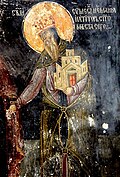 Symeon the Myrrh-streamerVenerable · Grand Prince of SerbiaFeb 13
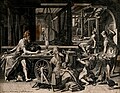 Aquila and PriscillaHoly Apostles · Missionary CoupleFeb 13
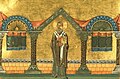 Eulogius of AlexandriaSaint · Patriarch of AlexandriaFeb 13
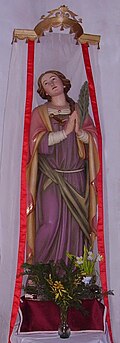 Fusca of RavennaMartyr · Child martyr of RavennaFeb 13
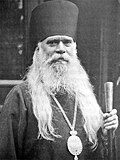 Seraphim SobolevSaint · Russian archbishop in BulgariaFeb 13
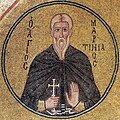 Martinian of CaesareaVenerableFeb 13
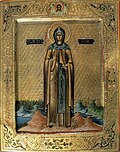 Zoe and PhotinaHoly Venerables · Venerables of PalestineFeb 13
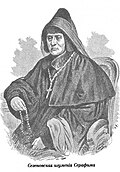 Seraphima of SezenovoVenerable · Abbess of Sezenovo ConventFeb 13
 Eugene ZernovHieromartyr · Metropolitan of GorkyFeb 13
 Basil GorbachevMartyr · Priest and iconographerFeb 13
- AimoVenerableFeb 13
- Anna KorneevaVenerable MartyrFeb 13