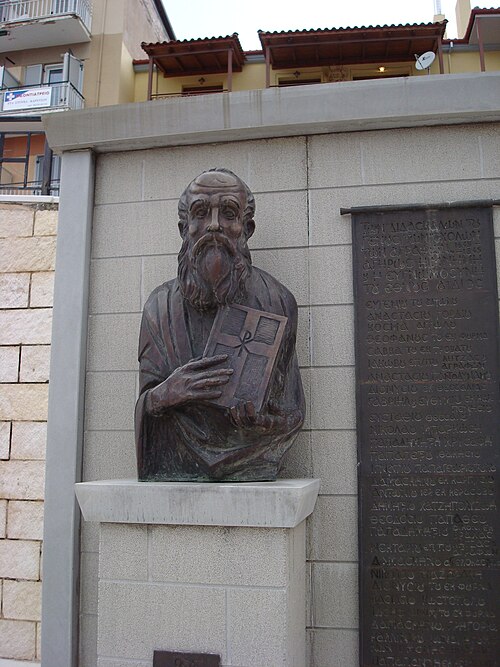
Saint
Eugenios the Aetolian
Greek cleric and teacher from Aetolia, born in 1597 and died in 1682.
- Feast
- August 5old style August 18
- Reposed
- 168217th century
Life
Venerable Eugenios the Aetolian (Eugenios Aitolos), in the world Ioannoulis or Giannoulis, was a distinguished teacher of the Greek nation and a steadfast fighter for Orthodoxy, born in 1595 (according to the Greek and Bulgarian sources; the record gives 1597) and died in 1682. He was numbered among the saints by the Holy and Sacred Synod of the Ecumenical Patriarchate on 1 July 1982. He is commemorated on 5 August.
Youth and studies
He was born at Mega Dendron of Apokouro, of poor parents. In 1616 he was ordained deacon at Tatarna monastery and stayed for a time at Xeropotamou monastery on the Holy Mountain. Visiting the monastery of Saint Catherine on Sinai, he was ordained priest in 1619 by the dynamic Patriarch of Alexandria, later Ecumenical Patriarch, Cyril Lucaris. After Sinai he made a pilgrimage to the Holy Places, where from 1619 to 1622 he served as priest of the patriarchal chapel of Saint Constantine. In 1626 he went to the monastery of Panagia Varnakova to study under the monk-teacher Kallinikos. He continued his studies at Trikala, on Cephalonia and on Zakynthos, where he was a disciple of Theophilos Korydaleus.
At Constantinople
When, in 1636, the Ecumenical Patriarch Cyril Lucaris summoned Korydaleus to the Great School of the Nation, he took the venerable one with him as well, and he was made priest at the church of Kontoskalion. Then he studied briefly with Meletios Syrigos, to return again to Korydaleus. He lived at close quarters the trials and adventures of Cyril Lucaris and suffered fierce persecution for his loyalty to Orthodoxy and his unyielding spirit. After the death of Cyril Lucaris he composed a service in his honour. He was deposed by Patriarch Cyril Kontaris, a friend of the Turks and Latin-minded persecutor of Cyril Lucaris. When ecclesiastical order was restored, the new Patriarch Parthenios I reinstated him with great honour in 1639.
Teacher in Aetolia and Evrytania
From 1639 to 1640 he directed the school of Arta. After hardship in 1641 at Aitoliko, where the Turks imprisoned him, he taught until 1645 at Mesolonghi and then went to Karpenisi, where he built a great church of the Holy Trinity and, in its precinct, a school of higher letters, which became for Evrytania a centre of spiritual renewal. He formed many important pupils, among them patriarchs, bishops and Anastasios Gordios. In 1661 he went to Vrangiana in Evrytania and founded a school at the monastery of Saint Paraskevi, later called the Hellenomouseion of Agrafa. He took care that a school be founded at Aitoliko as well. In 1674 he returned to Karpenisi, to his old school, where he remained until 1675. After some wanderings to Nafpaktos, Mesolonghi and Aitoliko and a stay at Tatarna monastery, he returned to Vrangiana and taught until 1680.
His end and veneration
In 1682 he departed to the Lord and was buried in the narthex of the church of Saint Paraskevi, where he had prepared his own tomb. He was believed to have the gift of prophecy. He was humble, merciful, philanthropic, an enlightened teacher, loved the liturgical life and lived a blameless life of privation. He taught his numerous pupils the genuine Orthodox faith and tradition. He left valuable writings and precious letters, distinguished by deep knowledge of Greek, genuine ecclesiastical mind and wisdom. He was numbered among the venerable saints in the Orthodox calendar by the Synod of the Ecumenical Patriarchate on 1 July 1982.
Commemorated the same day August 5
 FabianHieromartyr · Bishop of RomeAug 5
 AnterusSaint · Bishop of RomeAug 5
 Oswald of NorthumbriaRight-Believing · King of NorthumbriaAug 5
 Euthymius I of ConstantinopleSaint · Patriarch of ConstantinopleAug 5
 Abel of ReimsSaint · Bishop of ReimsAug 5
 Emygdius of Ascoli PicenoHieromartyr · Bishop of Ascoli PicenoAug 5
 Nonna of NazianzusRighteous · Mother of Gregory the TheologianAug 5
 EusigniusMartyr · Roman soldier of AntiochAug 5
 Memmius of ChâlonsSaint · First bishop of ChâlonsAug 5
 Venantius of ViviersSaint · Bishop of ViviersAug 5
 Job of UshchelyeVenerable Martyr · Founder of Job Monastery at UshchelyeAug 5
 Evdokia SheykovaNew Martyr · Blessed oneAug 5