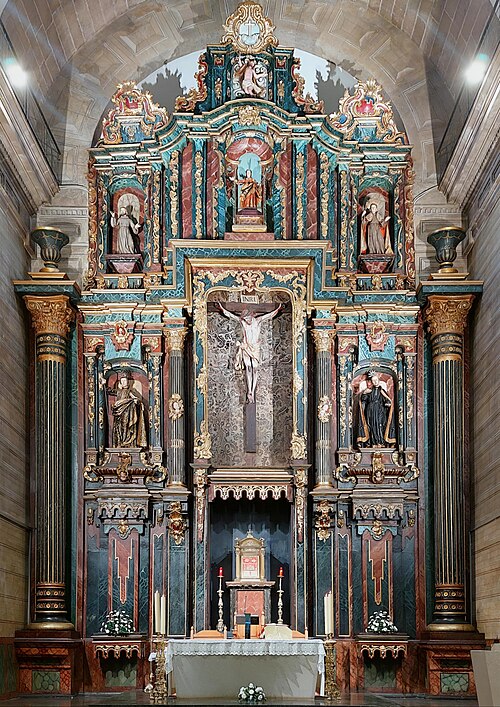
Martyr
Euphemia
A saint venerated at Lobios, remembered in the calendars of the Church.
Uncertain source. We are looking to verify this information as soon as we can.
- Feast
- September 16old style September 29
- Era
- 2nd century
- Place
- Lobios
- Order
- Martyrs
Life
Saint Euphemia of Ourense is venerated in Galicia in northwestern Spain as a martyr of the time of the emperor Hadrian. The sources say that nothing certain is known about her life; the many hagiographic accounts, written especially in the sixteenth century, are not trustworthy. She does not figure among the saints of the official martyrology and has often been confused with Saint Euphemia of Chalcedon; her feast, 16 September, falls on the same day.
The traditional story counts her among the nine daughters born at a single birth to Calsia, wife of the Roman governor of Gallaecia and Lusitania, Lucius Castelius Severus, and places her at Baiona or Braga, in the year 119 or 120. This cycle of stories is called the legend of the nine sisters. Her death is said to have taken place under Hadrian (10 July 138 or earlier).
About 1060 (by some sources 1090) a shepherdess at Campelo, in the district of Manín, discovered a tomb from which a hand protruded wearing a gold ring; when she took it, she lost her speech and regained it only after she put the ring back. A voice then said that there lay the tomb of Saint Euphemia. The relics were buried under the altar of the chapel of Santa Mariña, between the dioceses of Braga and Ourense. In 1159 the bishop of Ourense, Pedro Seguín, tried to move them to the cathedral of the city; the faithful of Braga opposed, and the dispute was settled by placing the reliquary on an ox cart, which went to Ourense. Her relics are venerated in the cathedral of Ourense; the linen cloth that had covered her body (twelfth century) was formerly used to wrap the sick. King Ferdinand II of León was healed in 1160, it is said, through her intercession. In 1720 the relics were solemnly placed beside those of Saints Facundus and Primitivus.
Commemorated the same day September 16
 Cornelius of RomeHieromartyr · Bishop of RomeSep 16
 Ludmila of BohemiaMartyr · Duchess of BohemiaSep 16
 MeletinaMartyr · of MarcianopolisSep 16
 Ninian of WhithornSaint · Apostle to the Southern PictsSep 16
 Edith of WiltonVenerable · Nun of Wilton AbbeySep 16
 Kuksha of OdessaVenerable · Priest and monk of OdessaSep 16
- Dorotheus the EgyptianVenerable · Hermit in EgyptSep 16
- AbundantiusMartyrSep 16
- Abundius and AbundantiusHoly MartyrsSep 16
- AnfadanSaintSep 16
- BasilSaint · Bishop of GortynaSep 16
- CaemhanSaintSep 16