Saint
Euphrasius of Clermont
Bishop of Clermont
Bishop of Clermont from 491 to 515, who held to the Orthodox faith defined at Nicaea.
Life
Saint Euphrasius of Clermont was bishop of Clermont from 491 to 515, holding to the Orthodox faith defined at Nicaea. The Russian source calls him a locally venerated saint of the archdiocese of Clermont of the Catholic Church, with commemoration on 15 May; our sources show no Orthodox glorification. He died in 515, in the twenty-fifth year of his episcopate.
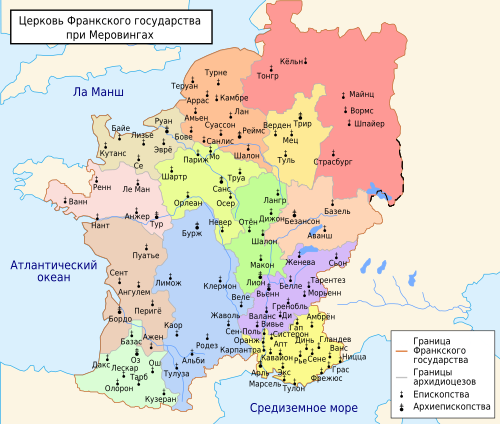
In 491 he was elected twelfth or thirteenth bishop of Clermont, succeeding a predecessor on the throne. The city of Clermont was then part of the Visigothic kingdom, whose state religion was Arianism. It is known that at the end of the fifth and the beginning of the sixth century a whole series of Orthodox bishops were persecuted by the Visigoths, but the sources preserve no information on Euphrasius' relations with the authorities of the kingdom in the first years of his episcopate.
On 11 September 506 a council of Orthodox bishops from the Gallic lands under the Visigoths took place at Agde, convened at the initiative of King Alaric II, who wished to secure the support of the Orthodox bishops on the eve of the conflict with Clovis I, the Frankish king. The Council of Agde was the first council in a barbarian kingdom convened with the support of royal power, and it was presided over by Saint Caesarius, archbishop of Arles. 24 bishops took part in it; another 10 hierarchs, among them Euphrasius of Clermont, represented by the deacon Paulinus, were represented by envoys. Euphrasius' absence from the council allowed him to avoid personally expressing loyalty to the Arian king, while the other bishops had to pray on their knees to God for the prolongation of Alaric's life and the good ordering of his government. The participants adopted 48 canons, chiefly aimed at strengthening church discipline.
In 507, after the defeat of the Visigoths by the Franks at Vouillé, Clermont was annexed to the Frankish state. The bishopric of Clermont was then one of the richest dioceses of the kingdom, whose monarch, Clovis I, professed the Orthodox faith. Gregory of Tours also writes of the wealth of the diocese: telling of the bishop of Rodez, Saint Quintianus, who fled between 508 and 511 to Clermont from the vengeance of the Visigoths because of his sympathy for the Franks, the historian shows that Euphrasius not only received the exile with honour but also gave him considerable property from the means of his bishopric.
On 10 July 511 Euphrasius took part in the Council of Orléans, convened by the bishop of Reims, Saint Remigius, with the support of King Clovis I, attended by 32 bishops from almost all the dioceses of the Frankish kingdom. In the acts of the council his name stands second in the list of bishops, which shows that he was second among all the hierarchs of the kingdom in length of tenure. The Council of Orléans adopted 30 canons, including some that confirmed the decisions of the Council of Agde of 506. An old martyrology of Clermont gives 14 January as the day of his death, but most historical sources give 15 May. His successor, who had bought the episcopate from the king of Austrasia, Theuderic I, died after three or four months, and the new bishop of Clermont elected was Saint Quintianus, former bishop of Rodez.
Commemorated the same day May 15
 Pachomius the GreatVenerable · Father of Cenobitic MonasticismMay 15
 DymphnaMartyrMay 15
 Achillius of LarissaSaint · Bishop of LarissaMay 15
 Euphrosynus of PskovVenerable · Founder of a monastery at PskovMay 15
 Severinus of SanseverinoSaint · Bishop of SeptempedaMay 15
 Adiutor of BeneventoSaint · Bishop of BeneventoMay 15
 Hilary of GaleataVenerableMay 15
 Arephas of VerkhoturyeVenerable · Archimandrite of Saint Nicholas MonasteryMay 15
 Isaiah of RostovSaint · Bishop of RostovMay 15
 Isaiah of the Kiev CavesVenerable · Monk of the Kiev Caves LavraMay 15
 Pachomius of NerekhtaVenerable · Abbot and founder at NerekhtaMay 15
 Serapion of PskovVenerable · Wonderworker of PskovMay 15