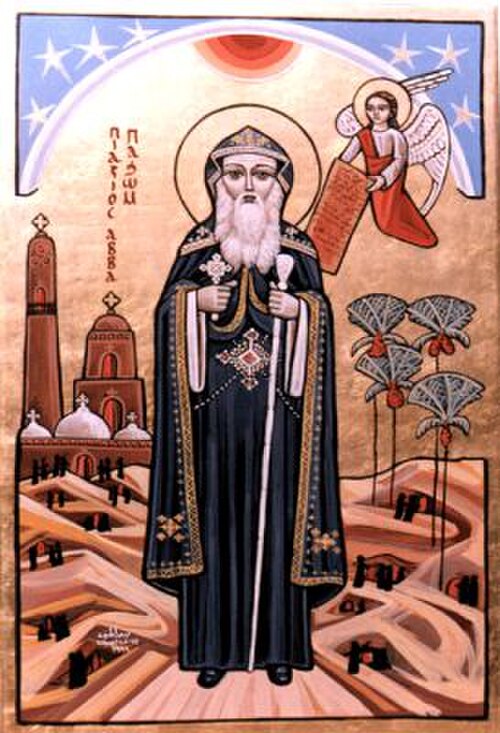
Venerable
Pachomius the Great
Father of Cenobitic Monasticism
Ascetic of Egypt, founder of communal monastic life, with monasteries in the Thebaid.
- Feast
- May 15old style May 28
- Reposed
- 3484th century
- Place
- Egypt
- Order
- Venerables
Life
Venerable Pachomius the Great was an ascetic of Upper Egypt and the founder of communal (cenobitic) monastic life, with monasteries on the banks of the Nile, in the Thebaid. Together with Saint Anthony the Great, he is counted among the fathers of monasticism. His rule was the first written monastic rule, and the Orthodox Church commemorates him on 15 May.
Youth and calling
He was born in the Thebaid, near present-day Luxor, around 292, to pagan parents. His name, Pachom, is Coptic and means "falcon." At about twenty he was swept into the Roman army during the civil wars between rivals for the throne. The young recruits were taken down the Nile, and at Thebes they were met by the local Christians, who brought them food and comfort every day. This moved him deeply. Learning that the people did this out of love for God and neighbour, Pachomius vowed that once free he would become a Christian.
He was released without having to fight. He settled at Shenesit in Upper Egypt and received holy Baptism, around 314. Then he went to the hermit Palamon, under whose guidance he spent nearly seven years in fasting, prayer with arms stretched out in the form of a cross, and labour.
Tabennisi
After close to ten years of struggle, Pachomius came in the desert to the ruins of the abandoned village of Tabennisi. There he heard a voice commanding him to stay and build a monastery, because many would come to be saved. The life tradition says that at night prayer an angel announced the will of the Lord to him: to serve the human race and unite it to God. Palamon blessed the place and foretold its future glory, but soon departed to the Lord. According to tradition, an angel gave Pachomius the rule of monastic life. His elder brother John came to struggle beside him.
The monastery was founded between 318 and 323. Until then Christian asceticism had been mostly the way of solitaries, who lived in huts or caves and met only for services. Pachomius set up life in common: the monks lived together, held everything in common and obeyed an abbot. The community grew quickly, and Tabennisi became too small. A second monastery followed at Pbow, which became the centre of the community, and after 336 Pachomius spent most of his time there.
The rule
His rule required that all receive the same food and clothing, own no private property and work for the good of the community. Mats and baskets were woven, gardens worked, books copied. The day was organised around the services, with time for work and for reading Scripture. Fasting and labour were measured by each person's strength. Pachomius demanded that the rule be kept strictly, but he valued obedience fulfilled with zeal above fasting. He himself looked after the business of the monastery, so that the others could give themselves to prayer.
For women he arranged a monastery on the other side of the Nile, whose first guide was his sister Maria. When she came to see him he did not receive her, but sent her, through the gatekeeper, a blessing to become a nun. According to tradition, neither he nor his monks accepted priesthood. Saint Athanasius the Great visited him in 333 and wished to ordain him, but he fled.
A father to his community
Pachomius was strict with himself and gentle with the weak. He visited the sick, eased their fast and urged them to give thanks to God. He taught his disciples not to judge anyone, even in thought. The synaxarion tells that when a monk longed for martyrdom, Pachomius guided him to fulfil his obedience and so humble his pride. When the monastery ran short of grain, he prayed all night, and in the morning bread arrived from the city, free of charge. Tradition also says that it was shown to him what the monks of later times would be like, and he wept for them, and a voice answered that they too would receive a reward, since they would bear a hard life.
His rule was translated into Latin by Saint Jerome. Saint Basil the Great came to know the community and adapted many of its customs at Caesarea, and Saint Benedict used part of them too. One tradition holds that Pachomius was the first Christian to use and recommend the prayer rope.
Repose
Near the end he was struck by an epidemic, probably plague, that was ravaging the region. His closest disciple, Saint Theodore, cared for him lovingly. Pachomius gathered the monks, strengthened them in faith and departed to the Lord in 348, on 9 May by the Coptic calendar, in his fifties. He was buried on a hill near the monastery. Historians say that by his death the community had eight monasteries and several hundred monks, while later tradition speaks of as many as seven thousand. Saint Theodore succeeded him as head of the community. He is honoured in all the Churches: the Coptic Church keeps his feast on 9 May, and the Orthodox Church on 15 May.
Commemorated the same day May 15
 DymphnaMartyrMay 15
 Achillius of LarissaSaint · Bishop of LarissaMay 15
 Euphrosynus of PskovVenerable · Founder of a monastery at PskovMay 15
 Severinus of SanseverinoSaint · Bishop of SeptempedaMay 15
 Adiutor of BeneventoSaint · Bishop of BeneventoMay 15
 Euphrasius of ClermontSaint · Bishop of ClermontMay 15
 Hilary of GaleataVenerableMay 15
 Arephas of VerkhoturyeVenerable · Archimandrite of Saint Nicholas MonasteryMay 15
 Isaiah of RostovSaint · Bishop of RostovMay 15
 Isaiah of the Kiev CavesVenerable · Monk of the Kiev Caves LavraMay 15
 Pachomius of NerekhtaVenerable · Abbot and founder at NerekhtaMay 15
 Serapion of PskovVenerable · Wonderworker of PskovMay 15