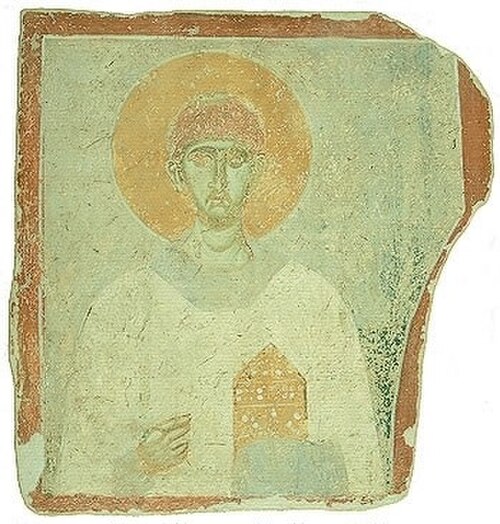
Martyr
Euplus of Catania
Deacon of Catania
Deacon of Catania put to death for his faith in the Diocletian persecution around 304.
Life
Saint Euplus, Hieromartyr, was a deacon (an archdeacon, according to the Russian sources) at Catania in Sicily, and received the crown of martyrdom by beheading in the year 304, in Diocletian's great persecution. The Orthodox Church remembers him on 11 August, and the Catholic Church on 12 August. His name in Greek means “good sailing,” on which the Vespers service in his honour plays.
His Passion says that he was arrested for owning and reading from a copy of the Holy Scriptures. When Diocletian sent an officer to Sicily to kill Christians, he found no one, for the few hid themselves. Someone then denounced Euplus, saying that he went with a book to hidden Christians and read it to them. Brought before the governor of the city, Calvisianus, he was asked to read from the book. The Holy Gospel was hung around his neck and he was thrown into prison, where he remained seven days without food. Then he was given over to torture and beaten with iron rods, but he mocked them, saying: “These tortures are for me like cobwebs, find some harsher ones.” Then he opened the Gospel and read from it to the people, and many turned to faith in Christ. He was beheaded in the year 304.
His relics lie in the cathedral of the Assumption at Trevico; it is plausible that they were brought there before the Arab invasion of Sicily in the tenth century. On 5 February 1654 the bishop of Trevico, Donato Pascasio, authorized the translation of a bone of the saint to the diocese of Catania. With Saint Agatha he is co-patron of Catania, and patron of Trevico and of Francavilla di Sicilia. An ancient church, of the fifth century, in Catania near Piazza Stesicoro, was dedicated to him; an American bombing in the Second World War reduced the eighteenth-century building to rubble and only the ancient crypt remains. The site coincides with the place of his martyrdom.
Saint Euplus was also much honoured in Russia. In 1471, in Moscow, on Myasnitskaya Street, a wooden church was built in his honour, to celebrate the peace between Grand Prince Ivan III and the Novgorod Republic. In 1657 Tsar Alexei Mikhailovich had it rebuilt in stone, and in the eighteenth century it was given a majestic facade. It was demolished in 1926, on Stalin's orders.
Commemorated the same day August 11
 Nephon II of ConstantinopleSaint · Patriarch of ConstantinopleAug 11
 Susanna of RomeVenerable MartyrAug 11
 Alexander the Charcoal-burnerHieromartyr · Bishop of Comana in PontusAug 11
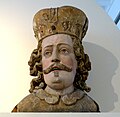 Tiburtius of RomeMartyr · Martyr of RomeAug 11
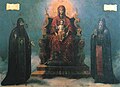 Basil and Theodore of the Kiev CavesHoly Venerable Martyrs · Monks of the Kiev CavesAug 11
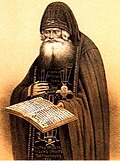 John of SviatohirskVenerable · Recluse of Sviatohirsk MonasteryAug 11
- Maximus of Asia MinorMartyrAug 11
- Alexander of RomeMartyrAug 11
- Anastasios PanerasNew MartyrAug 11
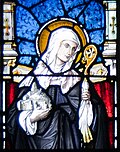 AttractaVenerableAug 11
- BanbhnatVenerableAug 11
- Basil of the CavesVenerable MartyrAug 11